Train for the life you want: A smarter approach to fitness for active adults
PARK CITY, Utah — For the recreational athletes who call this mountain town home, fitness has always been a means to an end. Ski longer. Play another round of golf. Keep up on the mountain bike trail. But what happens when the body starts to push back?
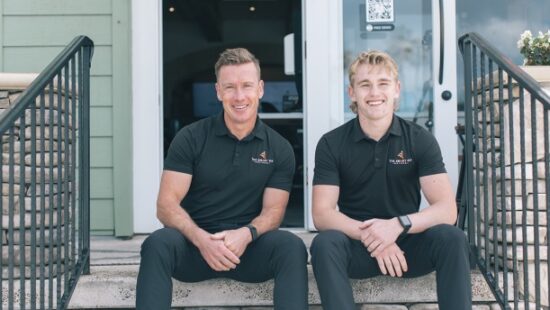
A growing number of active adults are discovering that the sports they love can’t carry the full weight of their fitness anymore, and that without the right foundation, injuries start to pile up. Connor Darnbrough, co-founder of The Smart Fit Method Park City, said that shift in thinking is exactly what his gym was built around.
“What Smart Fit really is trying to do for people is improve their lifespan quality,” Darnbrough said. “We’re not trying to make it about the gym. We really just want people to be able to do all the things they want to do.”
Smart Fit Method has expanded beyond its foundational programming to offer sports-specific performance tracks for skiers, golfers, cyclists, tennis players and pickleball players. The programs retain the core elements of the Smart Fit Method approach but add an emphasis tailored to the demands of a particular sport and the athlete’s experience level.
To kick off the launch, Smart Fit Method Park City is offering a $99 Sports Performance Assessment that evaluates muscle imbalances, glute activation, cardiovascular fitness and overall strength. The goal, Darnbrough said, is to identify what is driving pain or recurring injury, build a corrective plan for the first 90 days, and then continue building from there.
The problem with playing through it
Park City is a uniquely active community. Skiing, mountain biking, tennis, pickleball and golf are not just weekend hobbies for many residents. They are a core part of daily life. But Darnbrough said that relying on those sports alone for fitness becomes increasingly risky as people age.
“When you’re in your 20s and 30s, just mountain biking for exercise, or skiing for exercise, is usually fine,” he said. “The body is pretty pliable. You’re getting your heart rate up, you’re getting movement in. But as we get older, the body goes through what’s called sarcopenia, which is where we’re losing muscle as we age and putting fat on.”
That loss of muscle mass, he said, places more stress on the joints and makes recreational athletes far more susceptible to injury. The data backs it up. Pickleball, one of the fastest-growing sports in the country and a favorite among the 50-plus crowd, generated an estimated $400 million in medical claims in a recent year.
“I would guarantee that most of those injuries are between the ages of 50 to 70,” Darnbrough said. “The reason is that loss of muscle mass, putting more pressure on the joints, or having previous injuries coming into it, and then just using that as their sole modality for exercise.”
He said the pattern he sees most often is a discouraging cycle: a golfer or pickleball player gets hurt, spends three months in physical therapy, returns to the sport, and is injured again within six months.
“What do you do after your PT program, or after an injury, to get yourself in a place where you’re not going to get injured again?” Darnbrough said. “That’s where training like this comes in.”
What changes as we age, and how to train for it
When a new client walks into Smart Fit Method with a love of golf and a nagging lower back, Darnbrough said the first thing he does is look for imbalances.
Rotational sports like golf, pickleball, and skiing require repeated movement in a single direction from one side of the body. Over time, that asymmetry accumulates.
“If I’m right-hand dominant and I’m swinging a golf club, how many times am I swinging it the other way?” he said. “That imbalance over time will lead to injury, usually lower back pain.”
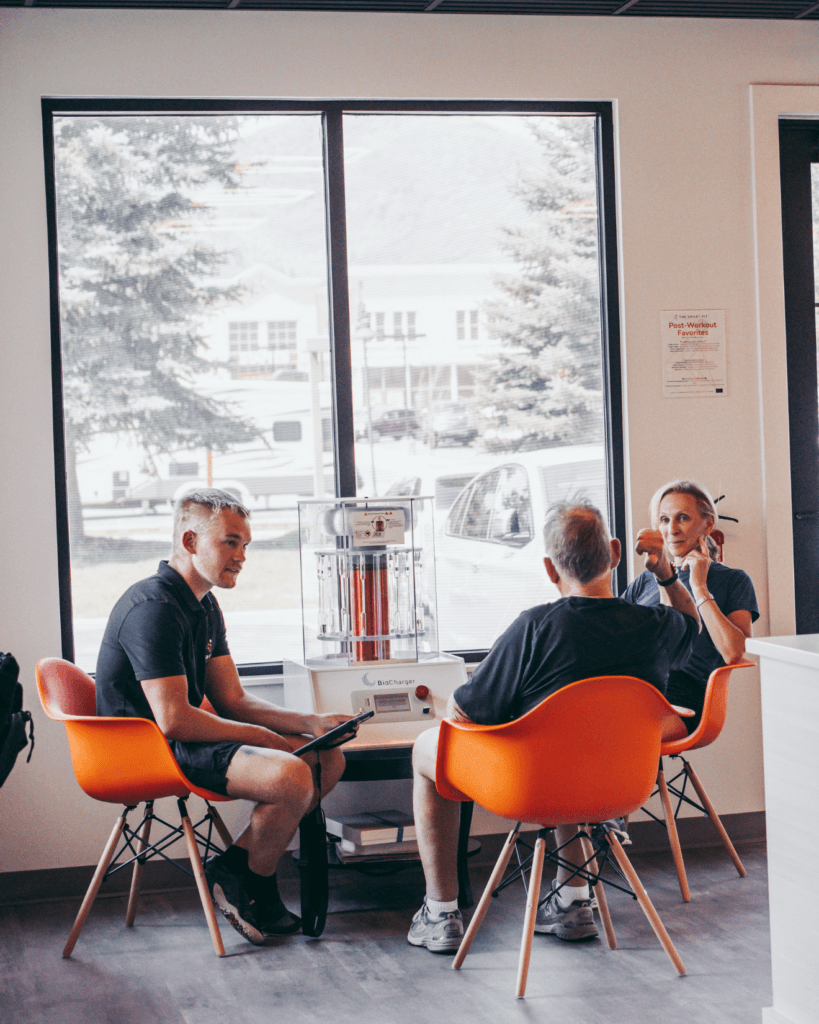
His assessment looks at shoulder and hip tilt, strength and balance between the left and right sides, and the ratio of upper- to lower-body power. From there, the program is built to correct what the sport has skewed, often through what he calls anti-rotational work, loading the body in opposition to its dominant movement pattern and giving extra attention to the non-dominant side.
But the approach to strength training itself also shifts as clients age. Darnbrough said the goal is to build maximum strength with minimal joint wear, something he described as high-intensity but low-impact.
“I’m not making a 55-year-old client who wants to keep playing golf do medicine ball throws or box jumps,” he said. “I’d start with the basics. Let’s build some strength, put very little wear and tear on the joint, and then as that strength accumulates, we can start looking at more explosive movements.”
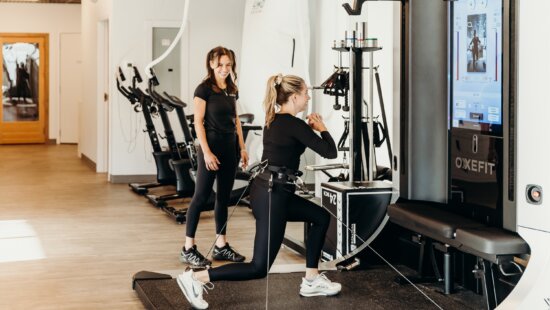
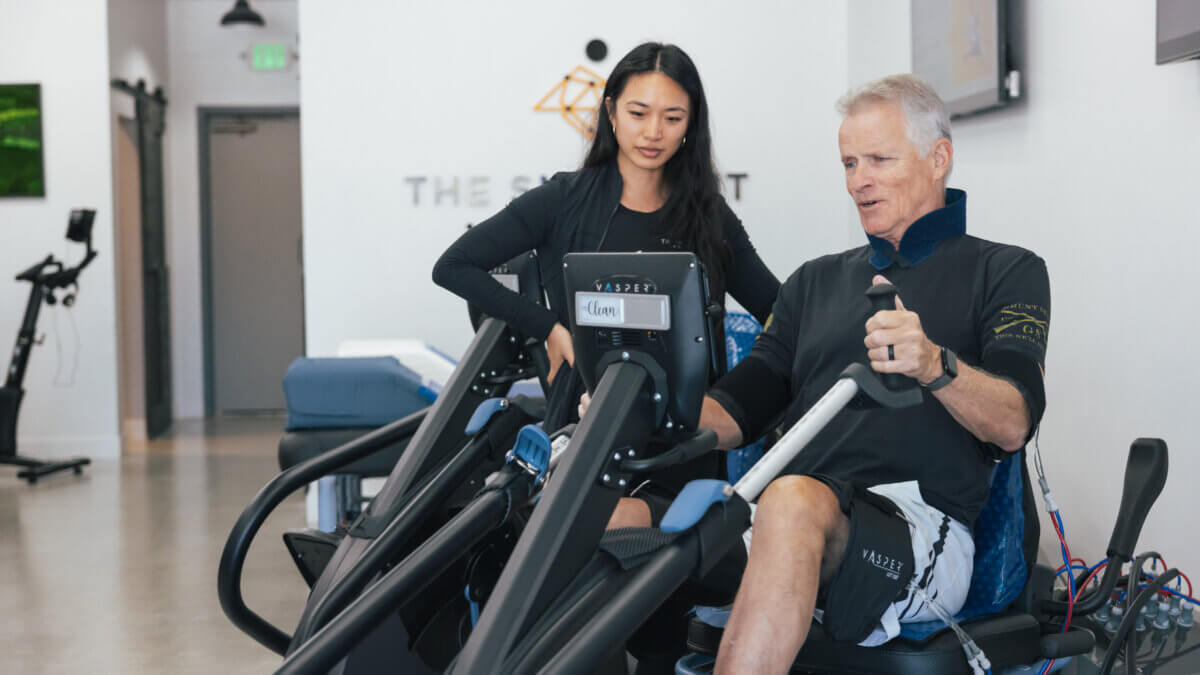
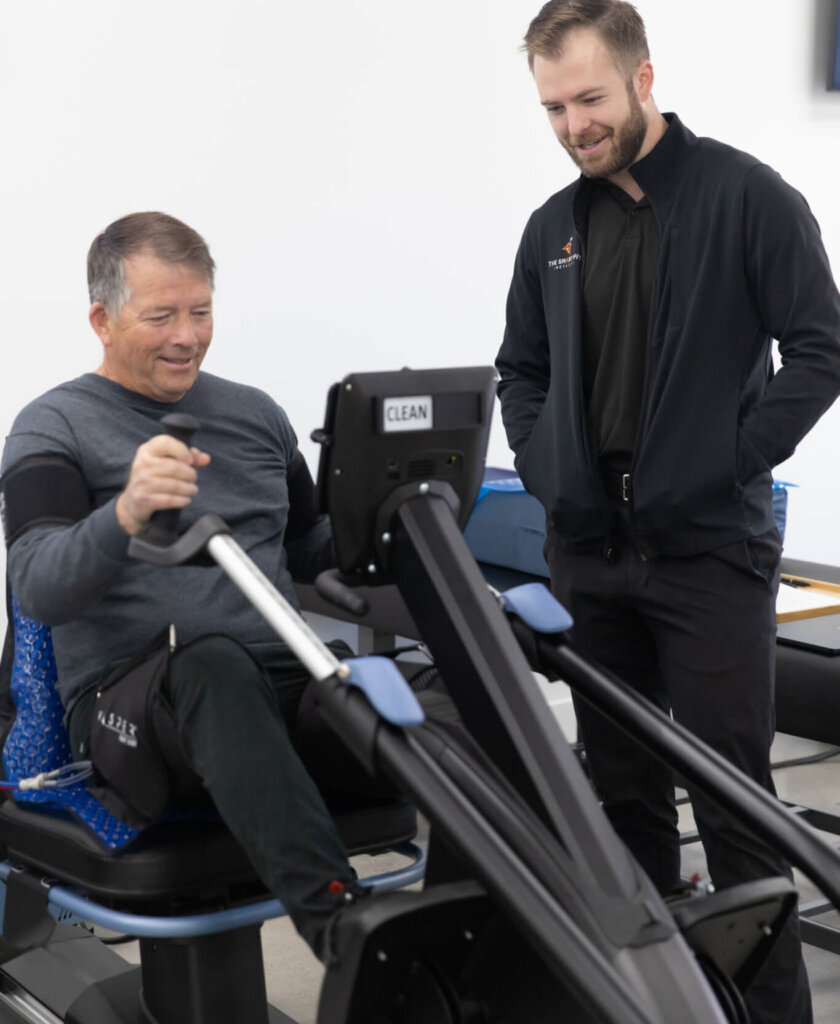
That means slower, more deliberate tempo training, fewer total sets and reps, and a focus on quality of movement over volume. The machines used at Smart Fit Method adapt resistance to the individual and allow coaches to program specific time under tension, which Darnbrough said is particularly valuable for older clients.
The overlooked muscle and the fatigue factor
Two themes recur when Darnbrough discusses injury prevention for recreational athletes: glute strength and cardiovascular conditioning.
The glutes, he said, are the foundation of rotational power in golf, pickleball, and skiing, and they are also the primary protector of the lower spine. When they weaken or fail to activate properly, the rest of the chain pays for it.
“Anything that is rotational puts a lot of torque on the spine,” he said. “The main thing that protects people’s spine is their glutes. If someone is starting to lose their glutes, we have got to do some focused work to get that back.”
He also trains clients in what is called eccentric strength, the ability to resist and control force rather than simply produce it. When a pickleball player sprints to the net and has to stop, or when a skier absorbs impact on a steep pitch, eccentric strength is what prevents the body from folding.
“The injuries occur on the impact of trying to slow your body down, typically,” Darnbrough said. “That’s something we actually train for at the studios.”
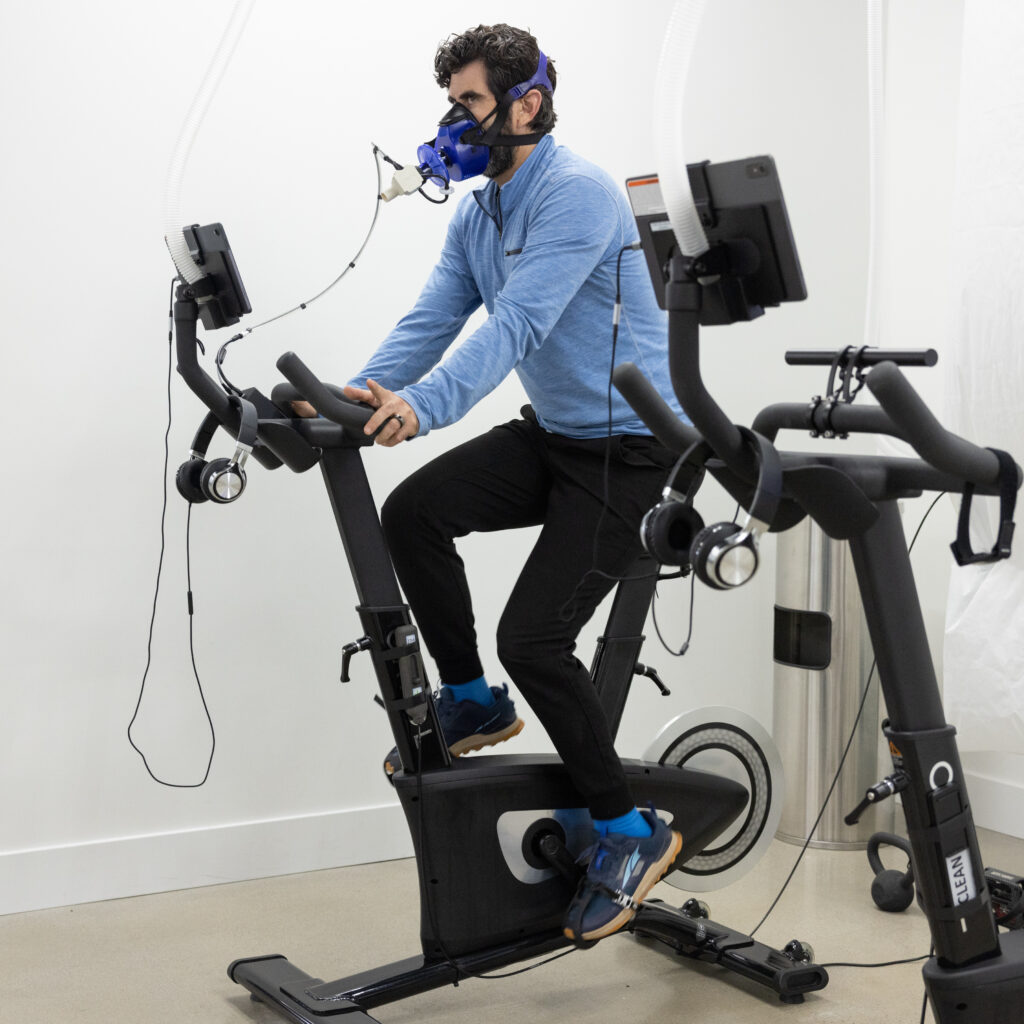
On the cardiovascular side, Darnbrough relies on VO2 max testing to establish a baseline and track progress. He said cardiovascular fitness matters not just for heart health and energy but also as a direct injury-prevention tool.
“Most people get injured when they hit fatigue,” he said. “Training your body to have more energy and training your body to protect your joints is really important for a lot of the age groups we work with. Think of that last run of the day skiing, that’s where injuries tend to happen.”
The signs worth paying attention to
Not everyone walks in knowing they need a different kind of training. Darnbrough said there are several warning signs that suggest recreational sports alone are no longer enough.
Persistent muscle stiffness is one. Recurring injuries that follow a pattern, even if they are not the same injury in the same place, are another. He described it as a “rhyme of injury,” where a client’s right shoulder bothers them one season, then the right elbow, then the right side of the neck.
“When we start seeing a kind of system, or a rhyme of injury, that’s when I’d start looking at whether the sport you’re doing is causing you to have some of these recurring issues,” he said.
He also said that too many active adults have simply accepted chronic pain and stiffness as the cost of aging.
“A lot of people just get accustomed to it,” he said. “I’m not saying someone who’s 60 is going to feel like they did at 20. But I can definitely make them feel better than they currently feel. A lot of people just accept the reality of, ‘My body hurts and it’s just the way it is.’ We can do a lot to make it better.”
The question he said he asks every new client: What would you be able to do if your body felt 10 years younger?
One week, three sessions, a complete picture of your health, all for $99


4251 E Lipizzan Jump
Moab, UT 84532