Vail CEO says crowding hasn’t worsened; skiers at Park City and beyond say otherwise

PARK CITY, Utah — Vail Resorts CEO Rob Katz is pushing back on a growing perception among skiers that lift lines and on-mountain congestion have worsened in the era of mega passes, telling The Wall Street Journal that crowding “has not gotten worse.”
“We actually are not seeing more people at our resorts on peak days, and we’ve actually seen the incidents of crowding go down,” Katz said in the interview. “The notion that it’s gotten worse … it has not gotten worse.”
Katz acknowledged that popularity has surged, driven in part by multi-resort passes like the Epic Pass, but said the company’s strategy has been to invest heavily in infrastructure to keep pace.

“The way you deal with crowding is … investing in the lifts, investing in infrastructure, investing in parking,” he said, adding that the company has spent hundreds of millions of dollars on larger, faster lifts and tools like real-time lift wait times.
But at Park City Mountain Resort — a flagship property in Vail’s portfolio — and at other Vail-owned resorts skiers and riders have for years reported a different on-the-ground experience.
Long lines, breakdowns and frustration
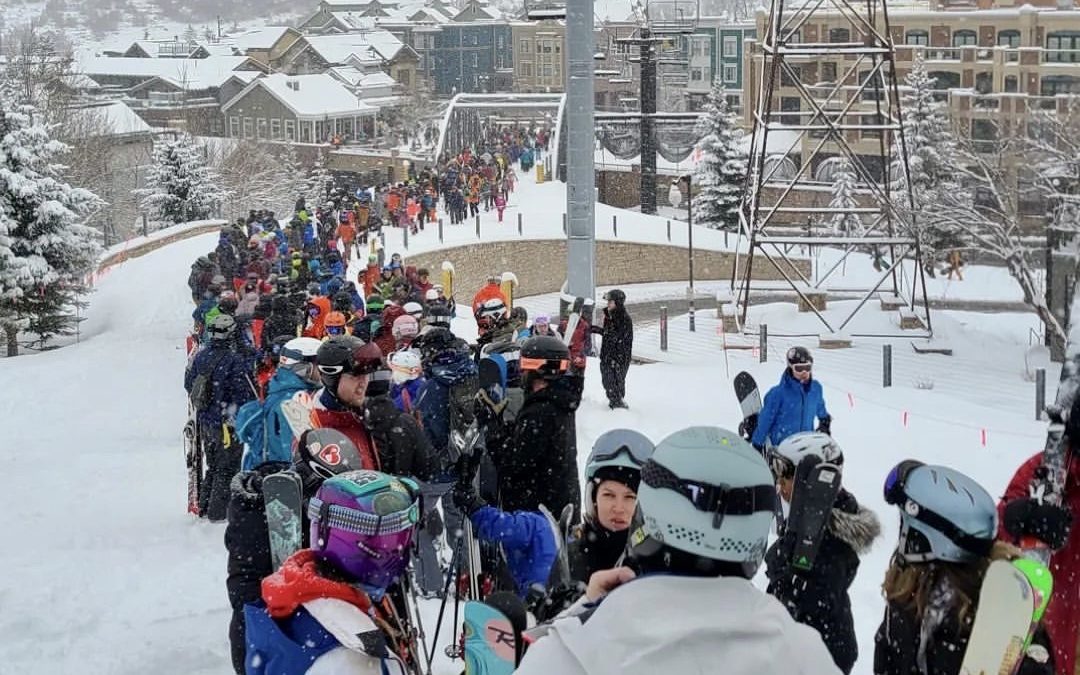
During peak periods and powder days, visitors to Park City Mountain have described long lift lines stretching well beyond maze boundaries, crowded trails and operational disruptions that compound wait times.
In recent seasons, mechanical issues have added to frustrations. During the 2025 holiday period multi-day closures of major lifts like Crescent at the Mountain Village base were reported and a high-profile incident on the resort’s Red Pine Gondola drew national attention after a skier was left hanging from a cabin, prompting a safety investigation by Utah regulators. While officials ultimately found no mechanical failure, the event highlighted broader concerns among guests about infrastructure reliability.
Skiers have also taken to social media and local forums to document lift stoppages, delayed openings and congestion at Park City Mountain, particularly during holidays and weekends when visitation spikes.
View this post on Instagram
Similar complaints have surfaced across Vail’s North American network, including resorts in Colorado and California, where guests have reported lift lines exceeding 30 to 60 minutes on busy days.
The “victim of its own success” effect
Industry analysts have long pointed to the rise of multi-resort passes as a key driver of increased visitation. Products like the Epic Pass and its competitor, the Ikon Pass, have lowered the marginal cost of skiing additional days, encouraging pass holders to ski more often — and to concentrate visits on high-quality snow days.
That dynamic can create what Katz himself acknowledged as a “victim of its own success” phenomenon, where strong demand converges on the same resorts at the same time.
Still, Katz maintains that crowding is not a new problem.
“At every single resort you will have a moment of crowding all the time. And it’s always been that way,” he said, noting that when he began skiing in the 1970s, lift waits were often longer due to slower technology.
Investment vs. perception
Vail Resorts has emphasized capital improvements as its primary solution, pointing to lift upgrades, terrain expansions and technology aimed at dispersing skiers across the mountain.
At Park City, that has included lift replacements and ongoing efforts to modernize infrastructure across both the Park City and Canyons sides of the resort.
Yet for many local skiers and destination visitors, the issue is less about lift speed and more about overall capacity — including parking, base area congestion and the sheer number of skiers on the mountain at once.
Tourism growth in Summit County has further compounded the challenge, as visitation to Park City continues to climb alongside Utah’s broader ski industry boom.
A widening perception gap
Katz’s comments highlight a widening gap between corporate metrics and customer perception.
While Vail Resorts says data shows crowding has not worsened on peak days, guest experiences — particularly at high-traffic resorts like Park City — continue to fuel debate over whether the company’s business model is pushing mountains beyond their comfortable capacity.
The rise of multi‑resort passes like the Epic Pass and Ikon Pass has fundamentally reshaped skiing economics, lowering the effective cost of access to dozens of major resorts and driving substantial increases in skier days — particularly on already‑popular peaks such as those in Utah and Colorado.
These “mega” passes guarantee season‑long, often unlimited access for a flat fee, transforming what was once a weather‑dependent, day‑ticket‑driven business into a subscription‑style model that locks in visitation months before snow flies and incentivizes holders to use their passes as often as possible.
Ski Utah reports that between the introduction of these products and recent seasons, skier participation has climbed dramatically, with multi‑resort passholders skiing more frequently than traditional one‑mountain season ticket holders — effectively increasing demand without corresponding growth in mountain capacity.
Nick Sargent, president of SnowSports Industries America, told Utah Business the increase in skier visits has been because multi-mountain passes made skiing more accessible.
“People who skied in their youth but stepped away because of cost are coming back and hitting the slopes more often,” he said.
On average, a skier used to ski about five times per season; passholders are now skiing eight to nine times, nearly doubling their participation.


4251 E Lipizzan Jump
Moab, UT 84532