Neighbors Magazines
The cost of silence and Katherine Wallisch’s fight to end it

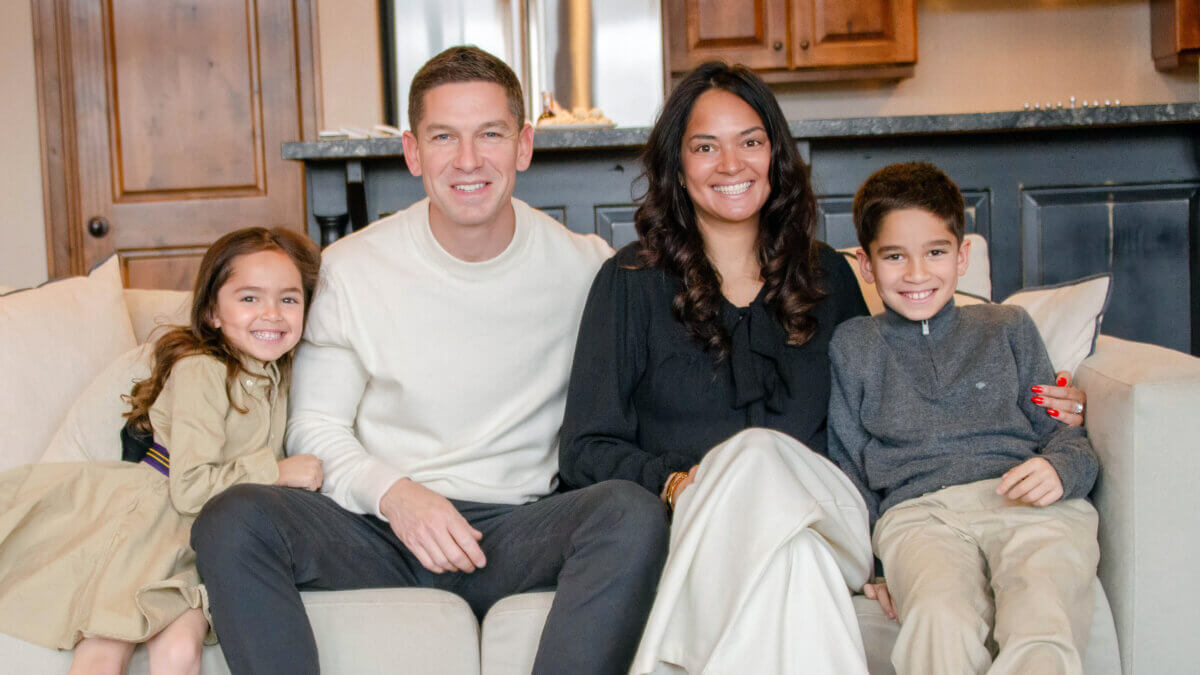
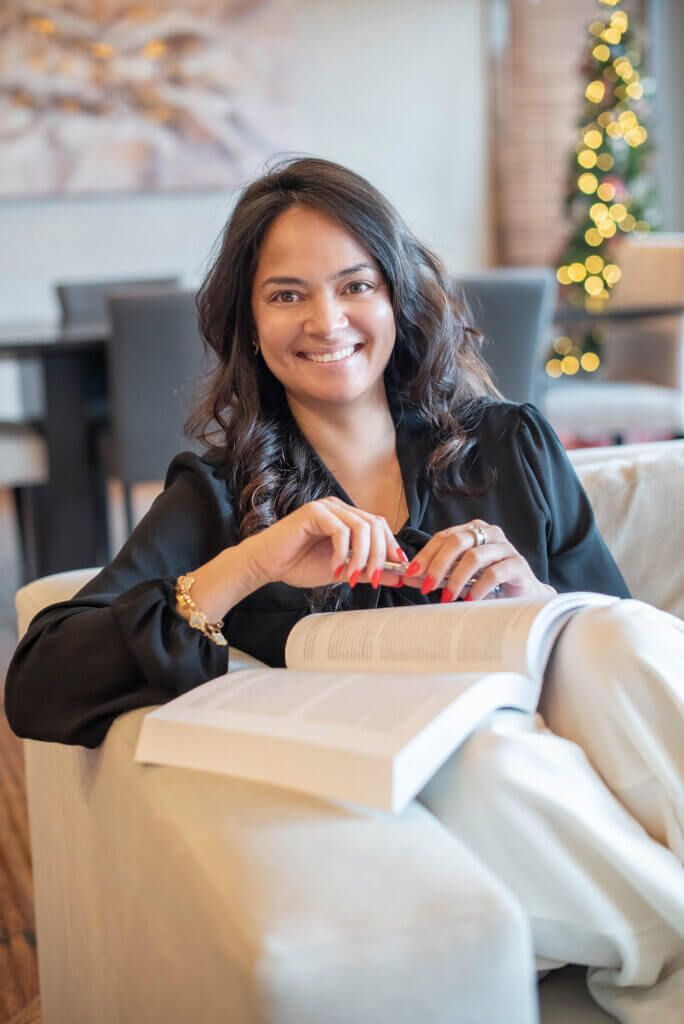
Photo: Neighbors of Park City // Dana Klein.
Katherine Wallisch speaks fiercely for those who cannot speak for themselves––yet. A speech pathologist and entrepreneur, she is nationally renowned for serving noncommunicative children with conditions like autism and cerebral palsy, and gives her professional perspectives forcefully. “Communication is a human right,” Wallisch says, on the foundation of her work. “It drives me nuts that I have to fight so hard to give my patients a voice.”
“The fight” is what brought Wallisch and her two children to Park City in September 2025. After building successful practices in Las Vegas and Reno, Wallisch wanted space to pursue her bigger vision: a mobile app that could teach clinicians anywhere in the world the skills to give children a voice.
Born in California, Wallisch’s mother served in Senegal with the Peace Corps, moving to Madagascar to work for Catholic Relief Services, and later, the U.S. Agency for International Development. There, she met Katherine’s father, a Malagasy Police Commissioner who would become a colonel, a general, and eventually a member of parliament.
The oldest of three daughters, Wallisch grew up in a setting she describes as “hard to explain.” Expat families like hers in Madagascar had drivers, maids, cooks, and house staff. And, because of her father’s political prominence, Wallisch also had security. “Even if we walked around the neighborhood, the guards would follow us,” she recalls. “[My dad] was always worried we’d end up kidnapped.”
Every summer, Wallisch traveled to the U.S. to visit her mother’s family, a trip that included a stop in Utah. Her grandparents, originally from upstate New York, were among the families that originally invested in Snowbird Ski Resort and built The Cliff Lodge. Five of her mother’s ten siblings followed them to the wild, and snowy, west.
In Madagascar, Wallisch grew up around government officials and diplomats, and by extension, their families. Her social life revolved around competitive horseback riding, Madagascar’s French school, and the American Embassy––until age 15, when she left for boarding school in Leysin, Switzerland, where she learned to snowboard, a sport she continues to this day. (Good thing her grandparents didn’t invest in Alta.)
As a teenager, Wallisch was eager to become a human rights lawyer, but when she graduated from Lewis & Clark College in 2009 with a degree in political science, the economy was still in fallout. Wallisch took the only job she could find, working at a French school in Portland, Oregon. While there, she dabbled in courses at Portland State University, including one on speech pathology. The subject was close to home, having witnessed her middle sister, Sarah, struggle with dyslexia and ADHD. At one point, a French speech pathologist lived with their family in Madagascar, helping Sarah learn to read and speak.
With her law career on hold, Wallisch pursued her second bachelor’s degree, this time in Speech Pathology. One afternoon, a professor covered Augmentative and Alternative Communication, or AAC. It’s a specialty that helps kids with severe speech challenges find ways to communicate, either through low-tech means, like drawing, or with sophisticated speech-generating devices, such as those used by the late Stephen Hawking. “By the end of that class, I was hooked,” says Wallisch. “I want to give children a voice through any means necessary.”

In 2011, Wallisch found herself back in Madagascar, staying at an ilmenite mine owned by Rio Tinto, her mother’s employer at the time. Bored, she offered to volunteer in the mine’s occupational health clinic, administering auditory tests for workers. Eventually, Rio Tinto hired her to build out their hearing program for occupational health. “They had nothing in place to protect the minors from hearing loss,” she remembers.
Soon, Wallisch was running the hearing department at a multimillion-dollar mine where she eventually trained a local team to execute her work while she relocated to the University of Cape Town in South Africa to run a student-led health clinic that provided free medical care, including speech pathology services, to people in South Africa’s historically segregated townships.
While the University of Cape Town would have taken Wallisch as a master’s student, the U.S. wouldn’t have recognized a South African speech pathology license. After two years in Cape Town, she moved to London to complete her master’s degree at the University of Essex.
Following her degree, Wallisch volunteered at a school for students with cerebral palsy, but struggled to find AAC work in the UK. In 2016 her son, Kai, was born, and Wallisch felt pressure to get on with her career. She relocated the family to Baltimore and then Las Vegas, where she practiced AAC through a home health agency. Soon, parents began to ask Wallisch if they could work with her directly. After running healthcare clinics in a Madagascan mine and South African townships, launching a business in Las Vegas appeared far less intimidating.

Her new clinic, the Autism & Brain Institute, thrived because Wallisch trained everyone herself, a role that proved difficult to balance while treating patients, managing the business, and raising both Kai and her second child, Leah, born in 2020. But one thought persisted. What if she could teach thousands of speech pathologists, clinicians, and parents all at once? The seed for a mobile app, The AAC School, was sewn.
Today, many of Wallisch’s students have an autism diagnosis alongside complex health complications. That puts her front and center in debates about what neurodiversity is, what causes it, and how families can best manage through it. “An autism diagnosis is among the toughest moments in a parent’s life,” Wallisch reflects. “Have I cried with parents? Yes, because I feel their pain. Their whole world shatters. It’s something I think most people don’t understand. Every missed milestone reminds you that your child is not neurotypical, and that your child will not have a neurotypical life.”
Parents have to stay informed, educated, and involved in their child’s care, or so Wallish hopes. “You cannot come to my office and just say, ‘fix it.’ It doesn’t work that way, and that can be hard for parents to hear. It’s never easy to be a special needs parent.”
While Wallisch is focused on The AAC School mobile app, she continues to treat children locally at her new clinic, Summit Speech & Autism Center. Boldly, she has made it a cash-only operation.
In Las Vegas and Reno, Wallisch found insurance companies impossible to work with. Few would consent to cover AAC treatments and devices for her patients, at least not without extensive reports and signoffs from the child’s medical doctors, most of whom had no experience with AAC. “It’s a completely backward system,” laments Wallisch. “We would love to give our clients all the services, but insurance blocks us.”

Wallisch shares the example of a patient with spinal muscular atrophy type one. Without injections to replace a protein they couldn’t produce naturally, this child had only a three-year life expectancy. “It took two years to get Medicaid to approve injections,” remembers Wallish, “let alone AAC treatment.” In Park City, Wallisch refuses to let insurance bureaucracies decide whether her patients have the right to speech.
For most of Wallisch’s career, neurodiversity was a professional matter, but in 2017, at just 17 months old, her son Kai fell and fractured his skull, resulting in two brain bleeds. Wallisch rushed Kai to Johns Hopkins where one of the world’s best neurosurgeons happened to be on call, saving his life. Like many parents of neurodiverse children, Wallisch had to work through intense feelings of guilt and take ownership over her son’s rehabilitation.
Wallisch also became more sensitive to neurodiversity after being diagnosed with ADHD in 2021. “I think being a mom helps me understand what other parents go through with their children,” she says. “I also think I’m a better therapist because I’m neurodiverse myself.”
These experiences, though difficult, give Wallisch standing to be candid with parents. “I don’t take excuses well. I won’t sugarcoat things for people,” she says. “Unless I’m honest with you about the realities of what your child can and cannot do, you cannot help your kid. So, I will tell you straight if I think there is something you need to be doing as a parent. Because the longer you sit in denial, the harder it is for me to help your child.”
In 2026, Wallisch plans to launch The AAC School app in the U.S., in English, and simultaneously launch an Arabic version in the Middle East. AAC needs are particularly high in that region for genetic reasons, and there is a lack of resources for clinicians.
Throughout 2026, Wallisch also plans to host Q&A nights where Summit and Wasatch locals can ask questions pertaining to communication, speech pathology, and neurodiversity.
Utah was always Wallisch’s home base in the U.S., and to be here again—with uncles, aunts, and cousins surrounding Kai and Leah—is a treat. Professionally, it has also been a refreshing change. “To make my job successful, collaboration is key,” she says. “I have to have access to the pediatricians, to their specialists. I have to have a direct line of communication with them. Here, they’re so much more open to that kind of collaboration, and they value me as a professional. That’s what I’m most excited about.”
By: Neighbors of Park City // Rich Ellis


733 Summit Way
Alpine, UT 84004
4251 E Lipizzan Jump
Moab, UT 84532
5758 Cobalt Circle
Park City, UT 84098
2266 E Garfield Avenue
Salt Lake City, UT 84108Talk of the Town


Park City Jobs

Line Servers, Aubergine Kitchen
1 day ago Full time $16.00 hourly

Hiring Barista Assistants and Baristas, Silver King Coffee
6 days ago Part time $17.00 - $30.00 hourly

HOA On-Site Supervisor, All Seasons HOA Management
8 days ago Full time $65,000 - $70,000 yearly

Buildings and Grounds Maintenance Technician, National Ability Center
8 days ago Full time $23.00 - $27.00 hourly
Lodge and Hospitality Coordinator, National Ability Center
8 days ago Full time $22.00 hourly