From surgery to the slopes: A Park City trainer’s approach to injury recovery

PARK CITY, Utah — As the summer heat begins to fade, the community starts anticipating that first snowfall. And to some, ski season prep means something specific: recovering from a surgery, injury, or protecting against a new one.
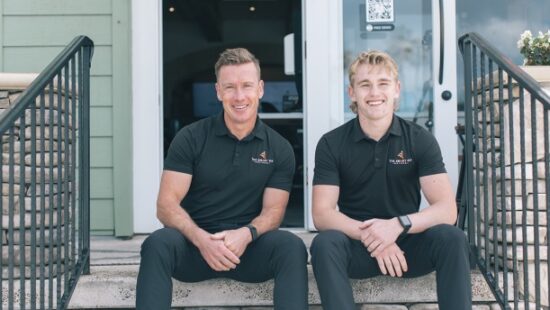
Connor Darnbrough, co-founder of Smart Fit Method Park City, said the studio is there to help prevent injuries and go beyond surgery and physical therapy.
According to Darnbrough, three body parts show up again and again in the studio: the low back, the knee, and the shoulders. Heading into ski season, the knee tends to take center stage.
Building the body back up for impact
For clients coming off surgery or a nagging injury, Darnbrough said the approach starts with restraint, not intensity.
“You need to build the body back up for impact,” he said. “If I’m coming off a knee surgery, I’m not going to start running right away.”
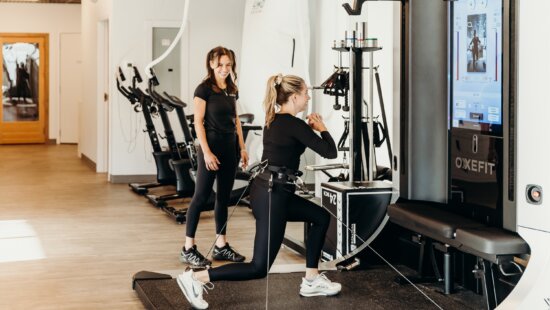
The process begins with strength training around the injured joint. Smart Fit’s adaptive equipment plays a key role here, adjusting resistance to match a client’s ability on any given day, whether that’s 2 pounds or 30.
“We’re going to adapt to where you’re at on that day, which is super helpful for injury rehabilitation,” Darnbrough said.
Among many tools and equipment, the studio uses the Vasper machine, a cooling and compression device, to perform blood flow restriction training. The method restricts blood flow to a targeted muscle group, causing it to fatigue faster without requiring heavy loads on the joint. The increased circulation to the area also promotes healing.
“It restricts a bit of blood flow, which causes a lot more fatigue in the muscle, and basically tells your body that muscle group is working a lot harder than it technically is,” Darnbrough said.
Addressing the whole body, not just the injury
Darnbrough said an injury rarely stays contained to one part of the body. As clients compensate for pain or weakness, other joints and muscles start to pick up the slack, often leading to new imbalances.
“Your body’s always going to be imbalanced when you account for an injury, because you compensate with your movement patterns,” Darnbrough said.
To identify those imbalances, Smart Fit trainers perform a range-of-motion assessment and a posture analysis before building a client’s exercise program.
“The body’s like a chain,” Darnbrough said. “If I hurt my right knee, maybe my left knee is the thing I have to worry about immediately, but then I could transfer up to my left hip, and so on.”
Why physical therapy isn’t always the final step
Darnbrough was careful to note that Smart Fit isn’t a substitute for physical therapy or medical care. But he said many clients reach a point where their prescribed PT sessions run out, often due to insurance limits, before they’ve addressed performance or long-term prevention.
“PT will bring you back up to where you need to be to function, but they’re not necessarily always looking at performance,” Darnbrough said.
That gap, he said, is where Smart Fit fits in, using its understanding of injury-adjacent training and its adaptive tools to help clients move from basic function back to full performance.
A personal mission
Smart Fit Method’s origins are personal for Darnbrough. His father developed a heart condition tied to an overuse injury from overtraining, prompting the two of them to look for a smarter path back to health and performance.
Darnbrough has faced his own long recovery road. As a competitive skier, he broke his back at 16 after over-rotating a double backflip and landing on his upper back. Years later, while wrestling in college, he tore nerves and ligaments in his neck, herniated discs, and experienced partial paralysis in his right arm.
“Doctors said you’re never going to be able to do X, Y or Z,” Darnbrough said. “You’re not going to be able to wrestle. You’re not going to be able to ski.”
Rather than accept that outlook, Darnbrough said he focused on correcting the movement patterns that contributed to his injuries in the first place, a lesson he now applies to Smart Fit’s clients.
Correcting movement patterns for the long term
Even for clients without an acute injury, Darnbrough said nagging pain often results from repeated, incorrect movement patterns, such as a golfer whose swing consistently strains the lower back.
“Movement patterns, when you do them incorrectly over and over and over again, will lead to an injury that will just keep developing,” Darnbrough said.
The goal at Smart Fit, he said, is to avoid a “band-aid approach” and instead correct the root movement pattern behind an injury, reducing the odds it resurfaces, or that a new injury develops elsewhere to compensate.
Don’t accept less than a full recovery
Darnbrough said one of the most common mistakes he sees is clients accepting a diminished version of their old life after surgery, assuming permanent limitations simply because a doctor said so.
“A lot of people just accept it,” Darnbrough said. “Now that I’ve had surgery, I’ll never run again. Or, I love mountain biking, but my knees bother me too much, so now I’m just going to swim.”
He was clear that Smart Fit isn’t offering medical advice or discouraging clients from seeing a doctor when surgery is needed. But once the immediate medical need has been addressed, he said, there are often more options than people realize.
“There are places and people who specialize in bringing people back up to where they need to be,” Darnbrough said. “You don’t have to accept living less of the life that you want.”
For Park City residents gearing up for another season on the slopes, that message may be the most important prep tip of all: recovery doesn’t have to mean settling.


2266 E Garfield Avenue
Salt Lake City, UT 84108