Snow
Utah Avalanche Center releases detailed report on fatal Brighton-area avalanche

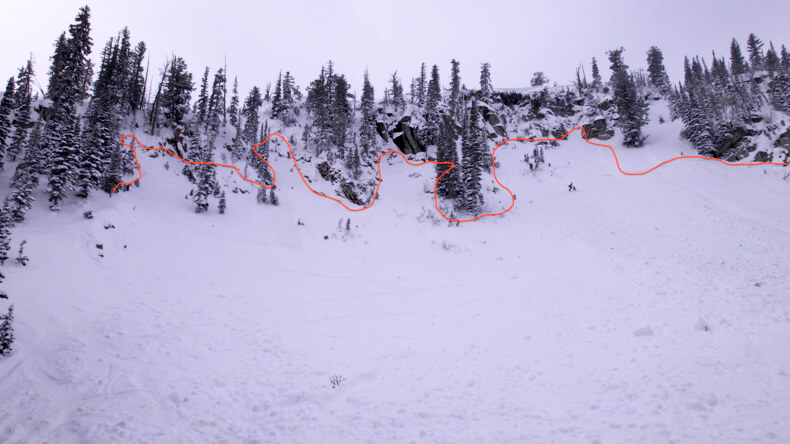
Photo of the terrain where the slide occurred. The victim entered from the left side of the photo, traversing into the bowl. he red line depicts the crown of the avalanche. Photo: UAC staff
PARK CITY, Utah – The Utah Avalanche Center has released a detailed accident report outlining the circumstances surrounding the Feb. 19 avalanche that claimed the life of an 11-year-old girl in backcountry terrain adjacent to Brighton Ski Resort.
According to the report, the girl was skiing inbounds at Brighton with her father and sibling shortly before noon when the family exited the ski area boundary west of the Crest Express lift. The victim was ahead of her family members as they entered the backcountry.
Witnesses reported she traversed north-northwest along the apron of Mary Main Bowl, near Rock Garden and the Mary Chutes, when an avalanche broke above her on a northeast-facing slope. She was caught and carried more than 200 vertical feet before being fully buried near the toe of the debris, just downhill of a tree.
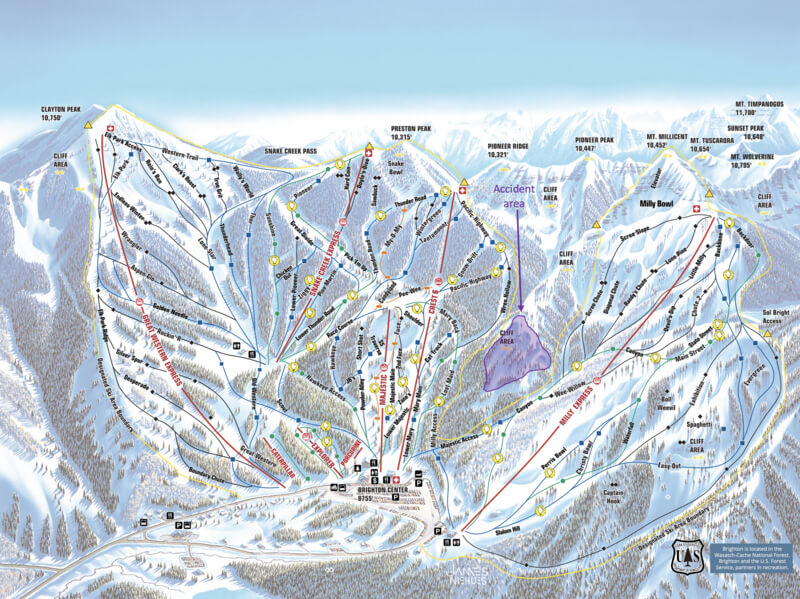
Bystanders on a ridge above called 911 and alerted ski patrol. The family did not have avalanche rescue equipment. A family member used a phone location service to help narrow the search area while bystanders began rescue efforts.
Brighton Ski Patrol located the girl approximately four feet below the snow surface after she had been buried for about 17 minutes, according to the report. Patrollers administered CPR for nearly 30 minutes. A rescue helicopter was dispatched but was unable to land due to poor weather. The girl was transported by ground ambulance to a higher level of care but did not survive the trauma.
Utah Avalanche Center staff visited the site with Brighton Ski Patrol the following day as part of the investigation detailed in the report.
Avalanche Conditions and Terrain
The report describes a large avalanche that began between roughly 9,200 and 9,380 feet in elevation and spanned approximately 550 feet wide. Slope angles ranged from 32 degrees to well over 40 degrees, which is considered steep avalanche terrain. The slide initiated in thinner, rocky terrain above the victim before propagating across the entire apron of Mary Main Bowl — an extent longtime members of Brighton Ski Patrol said they could not recall seeing in recent memory.
Forecasters wrote that the avalanche first broke on a mid-storm graupel layer about 53 centimeters below the surface before stepping down nearly a meter into a deeper persistent weak layer of faceted snow formed during January’s prolonged dry spell. That buried weak layer allowed the fracture to travel widely across the slope.
In the days leading up to the accident, the Central Wasatch had received nearly 50 inches of snow and 4.7 inches of snow water equivalent from a powerful storm cycle. The Avalanche Center had issued an Avalanche Watch on Feb. 16, escalating it to an Avalanche Warning on Feb. 18 as the danger rose to HIGH. The warning remained in effect Feb. 19, the day of the slide, with forecasters highlighting the buried persistent weak layer as the primary concern.
Boundary and Backcountry Risks
The area where the family exited the resort was marked by a rope line and signage stating: “Ski Area Boundary: No Ski Patrol or avalanche control beyond this point.”
In its report, the Avalanche Center stressed that terrain immediately outside ski area boundaries — often referred to as “sidecountry” — is uncontrolled backcountry and can harbor significantly different avalanche conditions just feet beyond the rope line.
Utah leads the nation in avalanche fatalities involving riders who leave ski area boundaries, the report notes.
It is unknown whether the family reviewed the avalanche forecast before exiting the boundary.
The Avalanche Center concluded the report with a reminder that anyone leaving a ski area boundary should treat the terrain as backcountry: check the daily avalanche forecast, carry a beacon, shovel and probe, know how to use them and travel with a partner.
The center and Brighton Ski Patrol extended condolences to the victim’s family, friends and the broader community, stating they share details from incidents like this to help others better understand avalanche hazards and prevent future tragedies.
By: Marina Knight


1548 W Woodsview Lane
St. George, UT 84770
1263 E Wild Maple Court
Draper, UT 84020
336 W Broadway Unit 201
Salt Lake City, UT 84101
29 Marilyn Court
Park City, UT 84060Talk of the Town


Park City Jobs

Live Like Sam: Marketing Manager, Live Like Sam
Today Full time $60,000 yearly

Construction Assistant, Jorgenson Builders
Today Full time $20.00 - $26.00 hourly

Business Development Specialist, Sky Digital Media
1 day ago Contractor $30,000 - $65,000 yearly

Barista, Baker, Salesperson, Kitchen Cleaner, Marvelli Artisan Breads
1 day ago Part time $18.00 - $25.00 hourly

Assistant Pit Master, Lush's BBQ
1 day ago Part time $20.00 - $25.00 hourly