Researchers find potential freshwater reservoir beneath Great Salt Lake as Utah faces record drought

A University of Utah pilot study detected freshwater-saturated sediments miles below the lake's hypersaline surface, raising questions about whether it could one day help suppress toxic dust on the exposed lakebed.
SALT LAKE CITY — At a moment when Utah’s water future looks bleaker than it has in decades, scientists at the University of Utah have uncovered something unexpected beneath the cracked, dusty bed of the Great Salt Lake: a potentially vast reservoir of freshwater, sitting just below the surface and stretching miles underground.
The discovery, published in February in the Nature-affiliated journal Scientific Reports, comes as the state grapples with its worst winter on record. Snowpack statewide peaked three weeks ahead of schedule at record-low levels, and experts have already warned that the dry, warm conditions could trigger an earlier and more intense wildfire season. For a region that depends on mountain snowmelt to replenish its lakes and reservoirs, the timing of the finding could not be more striking.
Unexpected Finding
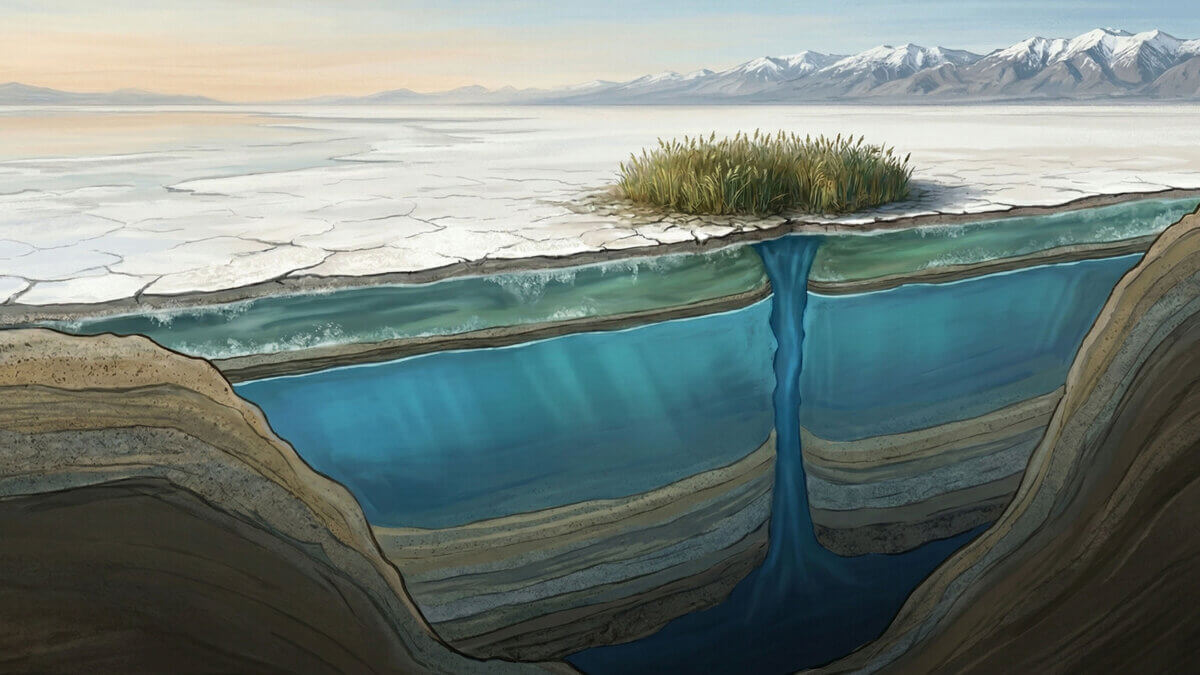
While the lake’s surface is hypersaline, among the saltiest water bodies in the Western Hemisphere, a thin brine layer averaging only about 10 to 15 meters deep is apparently all that separates that surface from a much larger body of freshwater below. Beneath that thin salty lid, researchers found freshwater-saturated sediments extending to depths of 3 to 4 kilometers, roughly 10,000 to 13,000 feet.
Some of that water may be ancient.
About 15,000 years ago, freshwater Lake Bonneville covered the entire region. As the climate shifted and the lake shrank and salinized into what is now the Great Salt Lake, freshwater became trapped beneath the lakebed. Researchers believe that ancient reservoir, fed over millennia by groundwater flowing westward from the Wasatch Mountains, may still be largely intact underground.
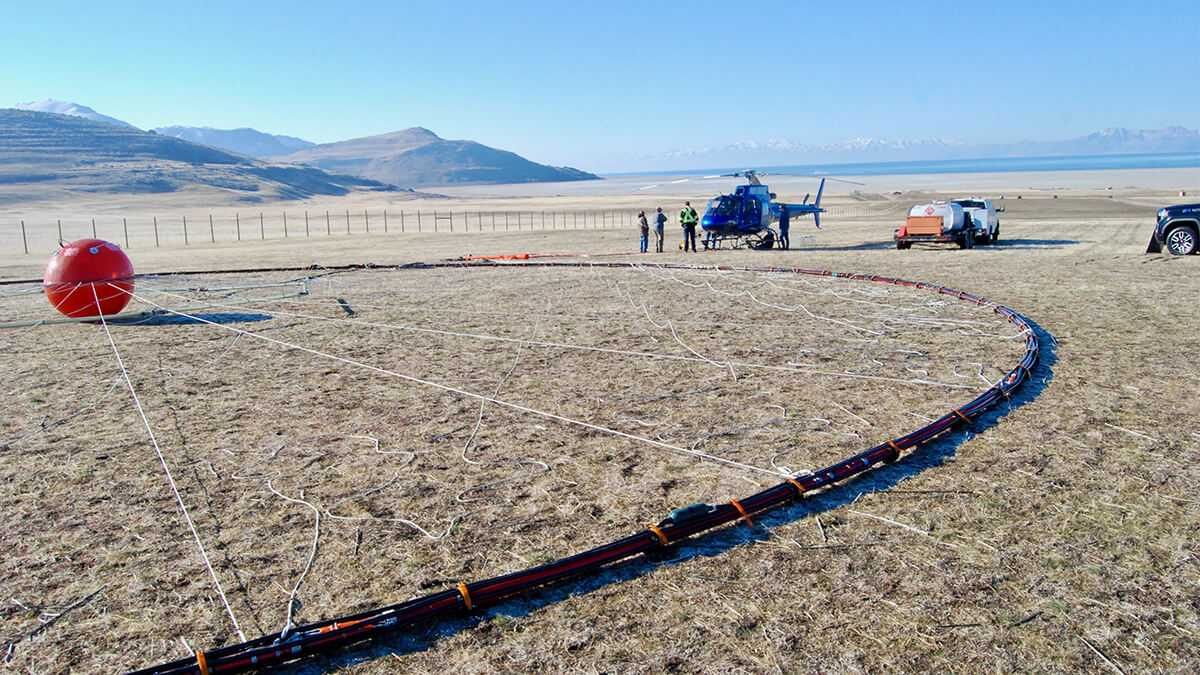
The U research team used a helicopter-borne electromagnetic survey system developed by a Canadian firm to essentially X-ray the geology beneath Farmington Bay and Antelope Island off the lake’s southeastern shore. Flying 248 line kilometers in a single day last February, the crew collected data that allowed scientists to map the boundary between salty and fresh water underground. Crucially, the geophysical findings were independently confirmed by direct measurements of water chemistry from cores drilled at the site, work published in a companion paper in the Journal of Hydrology this spring.
“The unexpected part of this wasn’t the salt lens that we see near the surface across the playa,” said Bill Johnson, a U geology and geophysics professor and co-author on both papers. “It’s that the freshwater underneath it extends so far in towards the interior of the lake and possibly under the entire lake. We don’t know.”
Johnson said conventional thinking held that brine, being denser than freshwater, would occupy the full volume beneath the lake, with mountain-fed freshwater entering only near the shoreline. The new data suggests something more complicated is happening underground, with freshwater pushing upward through gaps in the impervious layer in ways that defy the expected pattern.
Those pressure points gave the study its origin story. In recent years, strange circular mounds appeared on the dried-out bed of Farmington Bay, each 50 to 100 meters across and thick with 15-foot-tall stands of phragmites reeds. Scientists eventually traced the mounds to spots where pressurized freshwater was breaching the brine layer and reaching the surface, creating isolated pockets wet enough for the invasive reeds to take hold in what researchers call “phragmites oases.”
The Future of The Great Salt Lake
The practical question is what, if anything, this hidden water could do for a lake and a state in trouble. The Great Salt Lake has lost enormous surface area in recent years, exposing roughly 800 square miles of playa. That dried lakebed has become a significant source of toxic dust blowing into Utah’s Wasatch Front communities, a public health concern that has grown alongside the lake’s decline.
Johnson said one near-term goal is to determine whether the artesian groundwater could be carefully tapped to wet the most active dust hotspots, without disrupting the broader freshwater system.
“To me, that’s a primary objective because it’s very practical,” Johnson said. “It’s unlikely we’ll be able to fill Farmington Bay and other parts of the playa enough to avoid some dust spots appearing at the higher elevations. This would be a great way to get at that.”
But the researchers are careful about what the pilot study does and does not prove. It covered only a narrow slice of the lake’s roughly 1,500-square-mile footprint, providing what the paper describes as a localized view of subsurface conditions. The authors note that more hydrological study is needed before anyone can confidently characterize the scale or accessibility of the full reserve, and that extending the airborne survey across the entire lake is a necessary next step before any water resource planning could responsibly begin.
Still, the potential implications are significant. Zhdanov and his colleagues believe the same airborne survey technique could map the entire lake and possibly inform similar searches for hidden freshwater beneath terminal lakes around the world.
Johnson and his colleagues are seeking additional funding to expand the work. The study was funded by the Utah Department of Natural Resources and the Great Salt Lake Commissioners’ Office.
Whether the water locked beneath Utah’s most iconic struggling lake turns out to be a meaningful resource remains an open question.


2266 E Garfield Avenue
Salt Lake City, UT 84108