Community
As Utah courts massive data centers, Shoshone leader Darren Parry calls for responsibility to the land

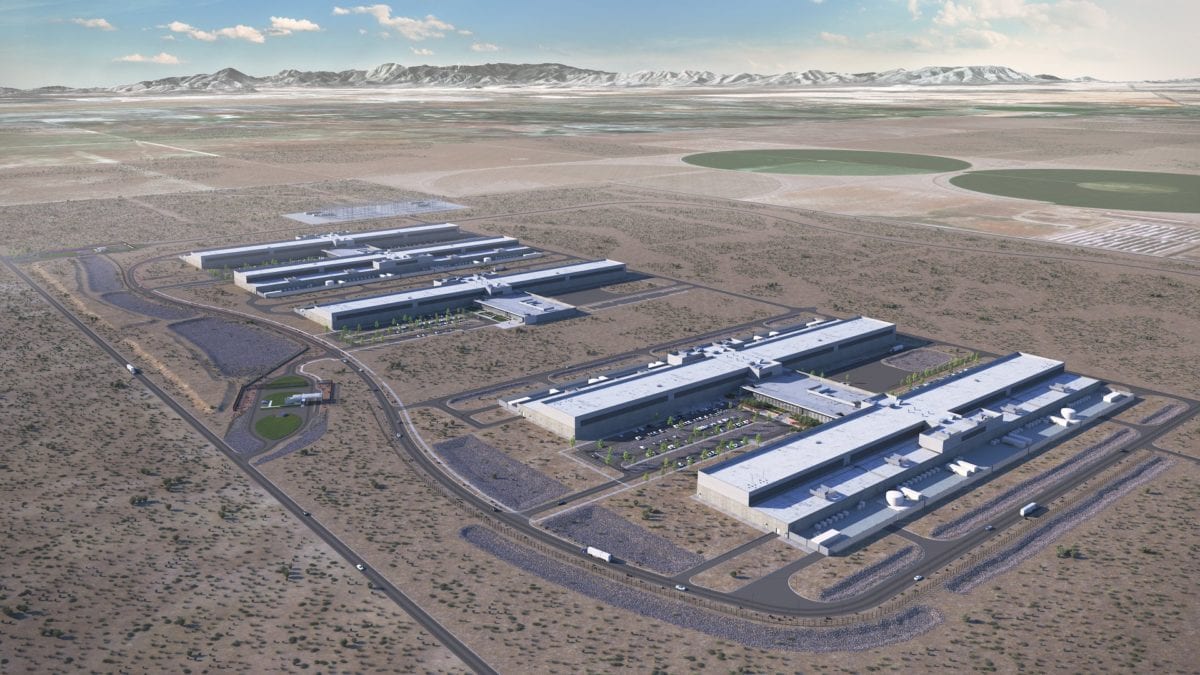
An Eagle Mountain data center in Utah. As debates intensify around proposed large-scale data center development near the Great Salt Lake, Indigenous leader Darren Perry says the conversation must move beyond technology and economics alone — and include responsibility, balance and humanity’s relationship to the land. Perry describes the approach as “Two-Eyed Seeing,” a framework that brings together Western science and Indigenous knowledge. Photo:
Parry says the future of the Great Salt Lake depends not only on technology and growth, but on restoring balance between knowledge systems.
PARK CITY, Utah — As Utah weighs the promise and cost of large-scale data center development, Shoshone leader Darren Parry says the question is not only about energy, water, or economic growth. It is also about how people decide on land.
The issue has become especially urgent after Box Elder County commissioners approved resolutions allowing the proposed Stratos data center project to move forward. The project has drawn public concern over water use and energy, and possible impacts on the Great Salt Lake, while supporters have framed it as an economic and national security opportunity.
TownLift asked Parry how Indigenous ecological knowledge might shape how Utah communities think about development, technology, and the future of the Great Salt Lake.

RB: As Utah debates a major data center near the Great Salt Lake, what do you think is missing from the conversation?
Darren Parry: I think what is missing is balance.
Long before there was a place called the United States, before borders, states, or the idea of owning land, many nations lived across this continent. Each had its own language, its own way of seeing, and its own responsibilities to the land.
The elders would say there was a time when a new people arrived from across the great waters. They came with different knowledge, different tools, and a different understanding of the world. The original people watched them carefully — not with fear at first, but with curiosity.
A decision had to be made.
Do we try to become like them? Do we ask them to become like us? Or do we find another way?
The elders chose a different path. They said, “We will build two fires.”
At one fire, the original people would sit. They would continue their ways — speaking their language, holding their ceremonies, caring for the land as they had always done.
At the other fire, the newcomers would sit. They would keep their ways, their knowledge, their beliefs.
And between those fires, there would be space. Not empty space, but relational space. A place where people could walk back and forth. A place where knowledge could be shared, but not forced. A place where respect, not dominance, guided the relationship.
The teaching was clear: We will not try to make you into us. And you must not try to make us into you. But we will learn how to live together.
But something happened. Over time, one fire grew larger. It began to take more wood, more land, more space. Instead of walking between the fires with respect, it began to pull the other fire toward it, trying to reshape it, rename it, and sometimes even extinguish it.
The space between the fires — the most important part — began to disappear. And when that space disappeared, so did balance.
Now here we are, 250 years into a country called America. The question is not only what happened, but what we do now.
The teaching of the two fires was never meant to be only a story of the past. It was a set of instructions for the future.
I want to ask a question before we move forward: Why is it that in Western society, knowledge that has lasted for thousands of years is so often dismissed?
Why do we hear words like “old,” “outdated,” or “primitive,” as if time itself makes something less valuable instead of proving its strength?
We live in a world that celebrates what is new, fast, and measurable. Because of that, we have been taught, sometimes without realizing it, to doubt knowledge that is not written in textbooks, tested in laboratories, or validated by institutions.
But if a way of knowing has guided people to live in balance with the land for generations — through droughts, change, and uncertainty — shouldn’t that be seen not as antiquated, but as enduring? As proven?
Traditional ecological knowledge is not something we wrote down in a lab notebook. It is something lived daily. It is knowledge shaped by observation, relationship, and responsibility over generations.
It is knowing when the snow will come by how the wind smells. It is knowing which plants will heal and which will harm, not because we tested them once, but because we listened to them over centuries.
This knowledge does not separate humans from the environment. It does not say, “Here is nature, and here are we.” It says, “We are part of this system, and if we forget that, things will fall apart.”
And that is exactly what we are seeing today. The systems are out of balance because we have been listening to only one fire.
So, if we are going to understand this knowledge — really understand it — we must go back to its source. We must go back to the first teacher we ever had: the land.
The land is not just where we live. The land is where we learn from. For Indigenous people, the land has always been the original classroom. Not four walls, not a screen, not a lecture hall. The land.
Every hill, every river, every animal carries instructions. If you slow down enough and pay attention, the land will teach you how to live.
But here is the catch: The land does not teach in a hurry. It does not give instant answers. You do not get a degree after four years and walk away. You build a relationship. You return again and again, through seasons, years, and generations. Slowly, the land reveals its patterns.
Those patterns become knowledge — but not the kind you can simply download. This is knowledge that must be earned.
Indigenous knowledge is not something you discover in a moment. It is something you inherit and then prove yourself worthy of carrying.
Our ancestors did not just observe the world once and draw a conclusion. They watched. They tested. They listened. Then they passed that understanding forward — not as a fixed truth, but as guidance. Each generation added to, refined, and adapted it. That is why we say this knowledge is alive.
Because it is earned, it comes with responsibility. You do not just take knowledge and use it however you want. You carry it carefully. You respect where it came from. You understand that it is tied to survival — not just yours, but everything around you.
That leads to a simple but powerful principle: Take only what you need.
I know that sounds almost too simple. But do not let that fool you. It is one of the hardest teachings to live by.
In a world that tells us to take more, buy more, and consume more, “take only what you need” sounds almost rebellious. But for Indigenous people, this was not a slogan. It was survival.
If you took too much, there would not be enough next season. If you were greedy, the system would correct you — and not gently.
This teaching creates balance. It keeps you aware that you are not the center of the world, but part of it.
When you live that way, you start to notice something important: everything around you has a role to play. Nothing is here by accident.
Every plant, every animal, every insect — everything has a purpose. Not just a use for us, but a role in the system.
The problem is that we have been taught to look at the world and ask, “What can this do for me?” rather than “What is its purpose?”
When you shift that perspective, everything changes. You stop seeing the world as a collection of resources and start seeing it as a network of relationships. You realize that removing one piece — whether it is a species, a forest, or a river — has consequences that ripple outward.
Once you see that, it becomes harder to treat the land as something separate from yourself. Because it is not separate. It is family. It is kin.
The land is our relative.
That is not poetry. That is not a metaphor. That is our worldview.
When we say the land is our relative, we mean it the same way you would talk about your grandmother or your brother. There is a connection. There is an obligation. There is care.
You do not exploit your relatives. You do not take from them without giving something back.
Imagine how differently we might treat the world if we actually believed that. If we saw rivers as relatives instead of resources. If we saw animals as nations instead of commodities.
This is where things get interesting, because this way of seeing the world does not always line up with Western ways of knowing. And that is OK.
There are different ways of knowing.
For a long time, one system of knowledge has tried to prove that it is the only valid one. If something cannot be measured, tested, and repeated, it is dismissed.
But Indigenous knowledge does not always fit into those boxes. It is experiential. It is relational. It is built on trust and continuity. That does not make it less valuable. It makes it different.
Here is the opportunity: not in choosing one over the other, but in learning to hold both. When you do that, something powerful happens. You start to see more.
That is what we call Two-Eyed Seeing.
Two-Eyed Seeing means you look at the world through one eye, drawing on the strengths of Western science — its ability to measure, analyze, and predict.
You look through the other eye with Indigenous knowledge — its ability to connect, relate, and understand place and responsibility.
When you use both eyes together, your vision gets sharper, wider, and more complete.
Because let’s be honest: One eye alone has not gotten us where we need to go. One fire alone has left us out of balance.
But when you bring both together, you do not lose anything. You gain depth.
Western science has given us incredible tools. It has helped us understand climate systems, map ecosystems, and predict outcomes. It has shown us clearly that the path we are on is not sustainable. That matters. That knowledge is critical.
But Indigenous knowledge asks a different question. Not just “What is happening?” but “What is our responsibility?”
It reminds us that data alone does not change behavior. Relationships do. You protect what you feel connected to.
One eye gives us information. The other gives us wisdom. One eye tells us how things work. The other reminds us why they matter.
If we are serious about the future — about life on this planet — we cannot afford to close either one. We need the clarity of science and the humility of Indigenous knowledge. We need the big fire and the small fire to sit side by side again.
Somewhere in the space between them, that is where balance lives. That is where solutions begin. And that is where, maybe, we remember how to be human again.
Let me leave you with a story from my own way of understanding the world.
There were once two hunters from the same community.
One was a careful observer. He trusted what he could measure. He read the tracks in the dirt, the bend of the grass, the direction of the wind. He believed the land left clues, if you knew how to read them correctly.
The other hunter moved differently. Before he went out, he would stop. He would listen — not just to the land, but to everything around it. The silence. His own sense of place. Even the dreams that stayed with him after he woke up.
Some people did not always understand him. They would say, “That is not how you find game. That is not reliable.”
Then came a hard winter. The animals shifted. Food became scarce. The usual ways of finding the herd stopped working.
The first hunter went out. He did everything right, everything he had always trusted. But the land was no longer speaking in the same way. He came back empty-handed.
The second hunter went out after him. He listened deeply, moved carefully, and trusted what he felt. But without the patterns, without the structure of the land’s changing signs, he also returned with nothing.
The people were worried. Both ways, on their own, had limits.
So the two hunters went together. They did not argue. They did not try to prove who was right.
One reads the land. The other listened to it.
One noticed the broken branches and old paths. The other noticed the feeling that something had shifted, something the usual explanations did not quite capture.
Walking together like that, they began to see something neither of them could see alone.
A new path. A changed pattern. A herd moving in a way that did not match the old rules, but made sense when both ways of knowing were present.
They found what they were looking for.
When they came back, the people asked what had changed.
The hunters said something simple: We stopped trying to see the world with only one eye.
That is what I mean when I talk about Two-Eyed Seeing.
One eye is grounded in the strength of what we can measure, test, and explain. The other eye is grounded in relationship, responsibility, intuition, and lived experience.
When you learn to use both, you do not get less truth. You get more of it.
If we are ever going to make it through what is coming, we have to stop arguing about which eye is right and start learning how to see.
Darren Parry is the former chairman of the Northwestern Band of the Shoshone Nation and a respected Native leader, historian, and educator. He serves on the board of directors for the American West Heritage Center, the Utah State Museum board, and the advisory board of the Huntsman Cancer Institute. Parry is the author of Tending the Sacred: How Indigenous Wisdom Will Save the World and The Bear River Massacre: A Shoshone History. He also teaches at the University of Utah and Utah State University.
Editor’s Note: This interview is part of an ongoing series exploring Indigenous history, culture, and perspectives in Summit County.
By: Rebecca Brenner


2400 E Walker Lane
Holladay, UT 84117
2475 W White Pine Lane
Park City, UT 84060
2154 S Rio Verde
Moab, UT 84532
137 W Bridlewood Lane
Midway, UT 84049Talk of the Town


Park City Jobs


Dog Walker, wagging tails on the trails
3 days ago Part time $20.00 - $25.00 hourly


Architect/Architectural Designer, Vera Iconica Architecture
4 days ago Full time $60,000 - $95,000 yearly
Assistant Pit Master, Lush's BBQ
4 days ago Part time $20.00 - $25.00 hourly