Neighbors Magazines
Grappling for Humanity

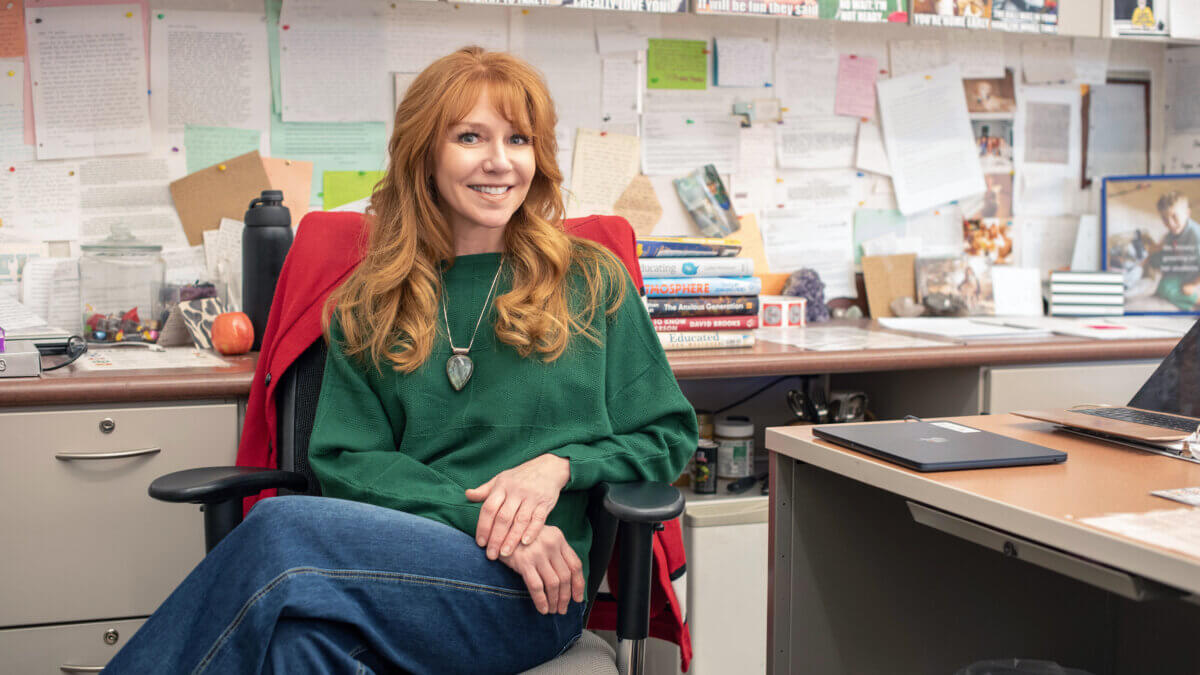
Photo: Neighbors of Park City // Dana Klein.
For nearly three decades, English teacher Melissa Nikolai believed that she could solve any challenge in her classroom. She had honed her teaching skills at a rural high school in Gardnerville, Nevada, for 14 years before taking a job at Park City High School (PCHS) in 2008. Melissa always found ways to engage students who never liked English or never thought they were “good” at it.
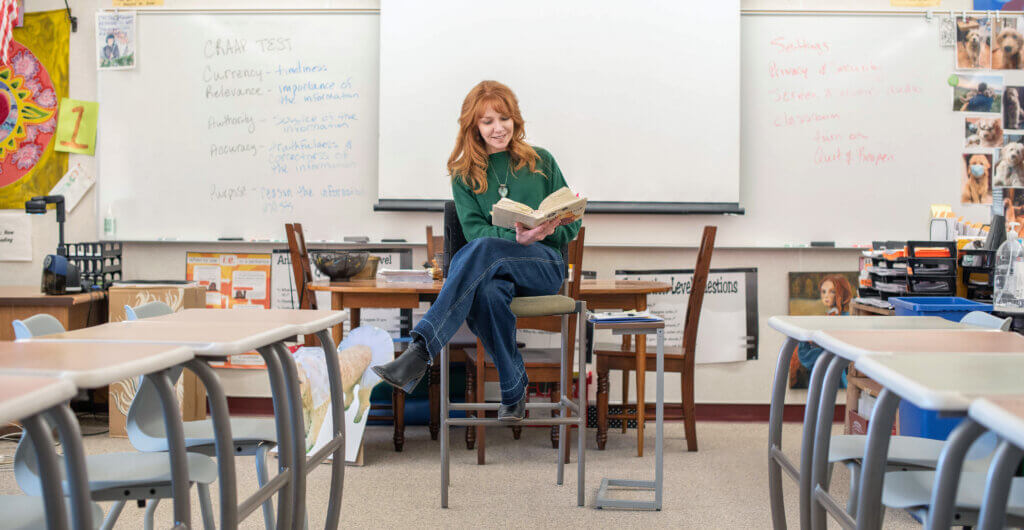
“My mantra has always been to awaken hearts and open minds. That’s why I teach,” she says, as we talk through her story at a high corner table in her PCHS classroom. Its walls are alive with landscapes, cute dog photos, juicy quotes, and letters from former students.
Then, in March 2023, a student who rarely completed his homework started submitting every assignment. At first, Melissa was thrilled. “Look what you can do when you try!” she told him. Soon, she realized that ChatGPT was writing his papers.
Melissa has had to adapt to artificial intelligence (AI). In some of her courses, students write essays in class rather than at home. It’s not ideal, but Melissa needed to try something. “I never thought I would be in a place as an educator where I don’t know what to do,” she shares. “My kids are amazing, full of possibilities that they haven’t even begun to recognize. My fear is that they will never realize their excellence and potential if they outsource their critical thinking to a robot.”
Developers of AI promise to spare us from hard work—the kind that forges our intellectual abilities. The point of reading and writing is to struggle, Melissa argues. “We want you to grapple. We want you to be changed after you have read this text. We want you to decide what you think about it, find ideas from the text to support what you think about it, tell us why you think about it that way, and then show how you’re grappling with opposing ideas.”
Melissa hopes that grappling will preserve the purpose of English class: to reveal and refine our own beliefs, values, and morality by empathizing with characters as they face the most difficult parts of being human. Although Melissa doesn’t have all the answers to teaching English in the AI era, her journey speaks to the power of books to unveil who we are and what we want from life.
Melissa fell in love with the “Little House on the Prairie” books by Laura Ingalls Wilder as an 8-year-old growing up in Manitowoc, Wisconsin, a small town on Lake Michigan. To this day, Melissa has been bothered by this scene: Pa tells young Laura not to wade too deep into the river because it’s springtime, and the water is running fast. Although Laura promises Pa that she won’t, she disobeys him and almost drowns. Her conscience won’t let her hide the truth. Laura confesses to Pa, and he punishes her.
“I remember being outraged!” says Melissa. “You can’t punish her. She told you the truth when she didn’t have to! And that was my first experience contrasting what I felt was right and true in the world, with what someone else thought was right and true. It sunk into me that reading is how you learn who you are.”
Reading helped Melissa create a life true to herself. She started college in Wisconsin, intending to become a fashion designer, but was “bored out of her mind” during classes. Meanwhile, she was reading “The Beauty Myth” by Naomi Wolf, who showed her “how the beauty industry preys on women’s insecurities.” Grappling with the moral nuances of fashion, through a book, reminded Melissa what really mattered to her.
“It was like, god, if I could teach kids to feel at ease, at peace, comfortable with themselves, to learn about who they are, to develop their confidence through books the way I did, that would be really something,” she recalls.
On a road trip to Missoula, Melissa toured the University of Montana. She was determined to become a teacher and to do so out west. Her parents tried to stop her, promising they’d pay for college if she remained in Wisconsin. But Melissa—like her first literary hero—decided to wade into the raging river.
Great teachers run classrooms with deceiving effortlesslessness, as if they were born with a natural talent. In truth, becoming a great teacher involves a lot of grappling, according to Melissa.
She graduated from the University of Montana in 1995 with degrees in English and education, paying her way by working in restaurants, in group homes, and as a nanny. When she arrived in Gardnerville to teach seventh through ninth grade, reality hit: “I soon realized, I have no idea what I’m doing. I feel like such an imposter.”
At back-to-school night, a parent raised her hand and asked Melissa, “How do you plan on teaching your kids writing?”
“Well…that’s still a work in progress,” Melissa claimed. There was no plan.
That parent turned out to be a teacher in the elementary school. She sent Melissa a book titled “The 6+1 Traits of Writing” by Ruth Culham. Melissa used Culham’s framework to teach writing successfully, and that motivated her to get much, much better at teaching.
“Those 14 years were all about developing myself as a professional educator,” Melissa says, summarizing her time in Gardnerville. “I wanted to know how to give my kids the best I can give them. And I got to apply it every day and practice it and try it and see what worked and what didn’t.”
Throughout those years of experimentation, Melissa regularly visited Park City with her then boyfriend, whose sister lived in town. To Melissa, Park City seemed like “the Land of Oz,” with hiking and mountain-biking trails right out the door. She was plotting her move to Park City when her boyfriend noticed that PCHS was hiring an English teacher.
She got the job. Although Melissa’s relationship didn’t survive the move, she met someone on the night of Savor the Summit 2013. “Ask me anything,” Jeff Batterson had said, after striking up a conversation with Melissa. So, she asked, “What is the last book you read?”
It was “Flow” by Mihaly Csikszentmihalyi. They exchanged numbers, and for three days, Melissa heard nothing. Then came Jeff’s text: “I believe I’ve waited the requisite three days before contacting you.” The two are now married.
For the next 18 years in Park City, Melissa taught college-level writing classes along with English 12, which seniors generally take if English “has never been their main thing,” she says. English 12 is Melissa’s last chance to teach seniors how to write before they leave for college or their career.

A few years ago, Melissa realized that her approach to English 12, born with “The 6+1 Traits of Writing” and refined over the decades, wasn’t working. The students were no longer interested in informational texts, like articles from “The Atlantic“ and “Vanity Fair.” She tried to make class more game-like with exercises that involved dicing up printed articles and arranging them into their conceptual parts. No one was excited to identify the thesis and topic sentences. They didn’t care. Eventually, Melissa recognized why: “What got me into teaching in the beginning was learning about who I am through great books. Why am I not teaching them that? Why am I not giving them great books?”
For the 2024–2025 school year, Melissa took a gamble. She selected two books she had never taught before—”Educated” by Tara Westover and “Born a Crime” by comedian Trevor Noah—and got them approved by the powers that be. For at least two quarters of the school year, every discussion, assignment, quiz, and activity would revolve around those two books. Initially, she planned to assign the reading as homework, but the students “flat-out told me they wouldn’t do it.” So, every student had to read in the classroom, quietly, with the audiobook playing along.
Students who seemed apathetic toward English began expressing opinions. Suddenly, class discussions became interesting, Melissa recalls. “We weren’t saying, ‘Show me your whiteboard. Who’s got the best claim for this article?’ It was more like, ‘What did you think about how Trevor handled that situation?’ Hearing their classmates all in disagreement about how he handled it was really interesting for them.” Melissa encouraged students to lean into their judgments. “Like I always said, you get to be as judgmental as you want when you’re reading a book, because that’s how you learn about what you believe.”
While describing this transformation, Melissa points to a poster at the front of her classroom. It reads, “The essential question: How are you different after reading this book?”
Her students were different. Finally, they had grappled with a text.
In English 12, Melissa continues to assign “Born a Crime” and “Educated.” And for now, her students continue to write essays during class on locked-down browsers that have no access to AI.
Compressing every essay into 85 minutes limits how much grappling can happen, but it’s better than the alternative. “Why do I want them to write?” Melissa poses. “Well, because writing is an expression of your thinking. I want to see their thinking. Their thinking is what matters. But they have to be able to develop an argument with a throughline of reasoning, and support it with proper evidence, and develop that evidence. All of that’s very hard.”
AI is marketed to do the hard things for us. Naturally, most students use AI to eliminate hard thinking. But Melissa’s students recognize that grappling matters. She has held many discussions with them about AI and how schools should address it. The students don’t know either, but they at least empathize with her position. “It sucks to be you, Ms. Nikolai,” as one memorably put it.
In 10 years, when every student may have access to superintelligent AI, what does English class become? “We read,” Melissa answers. “I find the most provocative and interesting things that matter to them. I teach them how to read.” For those 85 minutes, AI cannot relieve students from thinking.
Melissa doesn’t have all the solutions to education in the AI era, but, she says, “If I can give them in any book that sense of awareness of who they are and where they stand in the world and what they believe in, nothing could ever take that away from them.”
What we win through grappling is ours to keep forever. That grappling just might awaken the hearts and open the minds of Park City seniors before they enter a world with different priorities.
By: Neighbors of Park City // Rich Ellis


4251 E Lipizzan Jump
Moab, UT 84532
2266 E Garfield Avenue
Salt Lake City, UT 84108
5758 Cobalt Circle
Park City, UT 84098
733 Summit Way
Alpine, UT 84004Talk of the Town


Park City Jobs

Line Servers, Aubergine Kitchen
1 day ago Full time $16.00 hourly

Hiring Barista Assistants and Baristas, Silver King Coffee
6 days ago Part time $17.00 - $30.00 hourly

HOA On-Site Supervisor, All Seasons HOA Management
8 days ago Full time $65,000 - $70,000 yearly

Buildings and Grounds Maintenance Technician, National Ability Center
8 days ago Full time $23.00 - $27.00 hourly
Lodge and Hospitality Coordinator, National Ability Center
8 days ago Full time $22.00 hourly