In a time of distrust, how do we know Utah’s elections are secure? Clerks show us

Utah election officials frustrated by rhetoric casting doubt on voting by mail walk through what happens to your ballot and what measures are in place to guard against fraud
This article was written by Katie McKellar.
Editor’s note: This story is part of We Vote Utah, a partnership between KUER, PBS Utah and Utah News Dispatch to cover Utah’s 2026 elections.
Ballots will start hitting Utahns’ mailboxes this week ahead of the contentious midterm elections, marking another year when a national spotlight has been cast on voting by mail — largely due to President Donald Trump’s ongoing rhetoric of widespread fraud without evidence.
Utah clerks on both sides of the political aisle, frustrated by national discourse that’s not based in fact but has cast a shadow over voting by mail, are pushing back.
“The general rhetoric, I’m very tired of it because it continues,” Grand County Clerk/Auditor Gabe Woytek, who is unaffiliated, told KUER in an interview for the station’s State Street episode that aired Monday. “There continues to persist a rhetoric that threatens the idea that it’s safe and secure, when I know in practice that it is a very safe and secure system … and we continue to add in those safeguards. Yet the conspiracy and the discontent continues to persist.”
In Utah, voting by mail has a long history. Since 2018, when nearly all of Utah’s counties started running elections primarily by mail while also allowing in-person voting options, the system has been lauded by state leaders, Republicans and Democrats alike. But in recent years, as Trump has continued raising doubts about its security, Utah’s GOP-controlled Legislature has reacted.
Lawmakers have enacted more ID requirements and slowly pulled back on universal, automatic voting by mail by requiring voters to opt in to continue receiving their ballots in the mail by 2029.
Meanwhile, the federal debate rages on.
Although Utah’s own top election official, Republican Lt. Gov. Deidre Henderson, has been ardently opposed to it, the state’s senior GOP Sen. Mike Lee continues to push the SAVE Act that would demand voters prove their citizenship in order to cast a ballot. And Trump, through an executive order, has tried to change how the U.S. Postal Services processes by-mail ballots. That rule would require states to send voter information to the federal government while also banning the Postal Service from delivering or collecting mail-in ballots from people who haven’t been confirmed as eligible voters.
Had Trump’s Postal Service executive order not been blocked by the U.S. Supreme Court for this year’s election, Henderson, a Republican, has said it would have been an “unmitigated disaster,” since it would have been logistically impossible for clerks to adhere to it with such a short timeframe before the Nov. 3 election.
To highlight allegations of voter fraud and to make the case for Trump’s Postal Service rule, the Trump administration last month spotlighted federal charges against a former Utah letter carrier accused of throwing 300 primary ballots into a dumpster before they could be delivered to Eagle Mountain voters’ mailboxes.
In an interview with law enforcement, the ex-letter carrier indicated he did not have a political motive but said he threw away the mail, which also included advertisements, “because he wanted to ‘lighten his workload’ so he could presumably go home earlier,” prosecutors said in charging documents.
The tossed ballots are unusual. Even so, 300 ballots make up a fraction of Utah’s more than 2 million registered voters, and the charges don’t indicate a concerted fraud effort. And multiple recent state audits, while they’ve found some areas of improvement, have concluded that Utah’s election system contains “no significant fraud.”
All of this political debate over voting by mail has cast doubt and confusion over a longstanding voting system that Utah clerks of all political stripes — Republican, Democrat and unaffiliated — defend.
‘When people have doubt, they disengage’
Davis County Clerk Brian McKenzie, a Republican, said in an interview with KUER one of his “biggest concerns” is that the rhetoric doesn’t match reality.
“Even if our elections are run very well and are very efficient and are very accurate, we do have some criticism out there, recognizing that the system is not perfect; it never will be perfect,” he said. “But sometimes people take those small issues and amplify those and add to them when it’s not justified.”
McKenzie noted change is not a foreign concept to elections — in fact, in his more than two decades working in various election roles, he said the process has evolved “significantly.” But he gets concerned when big changes are proposed under a tight timeframe.
“That creates disruption, that creates question, and when you have questions like that, that creates doubt. When people have doubt, they disengage,” McKenzie said. “That is a concern for me as an administrator. It’s a concern for me as a fellow voter as well.”
From Wasatch County, Woytek shared a similar concern.
“Added rules, added regulations, more confusion for the voters, I can handle it,” he said. “You know, it’s my duty to follow the law, and I will do so, and I won’t complain about it. But what I will complain about is it causing discontent and confusion among voters, which either causes them to not participate at all, or develop their own uncertainty regarding the system that they wouldn’t have had otherwise.”
Henderson, another Republican and Utah’s top election official, has been a fierce defender of Utah’s vote-by-mail system, and she’s called out the Trump administration’s political “gamesmanship” with voting, which she said in a recent interview keeps her up at night.
“I learned a long time ago that (the Trump administration doesn’t) want to know that we’re doing things OK,” Henderson said. “They don’t want to know that things are going well, because it goes against a narrative that is being pounded relentlessly of mass fraud or ineligible people voting. And the facts just don’t support that narrative.”
Salt Lake County Clerk Lannie Chapman, a Democrat, said Henderson’s willingness to speak out is “reassuring” in an interview with States Newsrooms’ CEO Chris Fitzsimon for a “Stories from the States” podcast episode that aired Friday.
“It’s not just me. It’s not just me waking up in a panic at 3 a.m. The Republicans are too,” Chapman said. “This isn’t a partisan issue. This is (an) access issue. This is ensuring that voters who are eligible to participate in elections understand the methods that they can do so and make a plan ahead of time, as opposed to the chaos and confusion, frankly, that we’ve been inundated with over the last couple months.”
Chapman said since 2020, Utah lawmakers have passed more than 60 laws changing the state’s election administration — and clerks have been doing their best to keep up. She said for the most part, the changes have been good, increasing transparency and creating additional layers of security, but she’s critical of the shift away from automatic voting by mail.
“It’s going to make it a lot more difficult for people to have that easy access to a ballot earlier on,” she said. “We’re going to notice more people waiting until closer to Election Day to participate in elections, causing maybe a little bit more congestion on Election Day, and a little bit more panic. … That’s not the Utah way.”
What happens to your ballot and how do you know it’s safe?
In an effort to combat distrust, Utah clerks welcome Utahns to come to their offices and see for themselves how ballots are processed.
“I love to encourage people to come in and see how ballots are processed, and I’ve given hundreds of tours,” Chapman said.
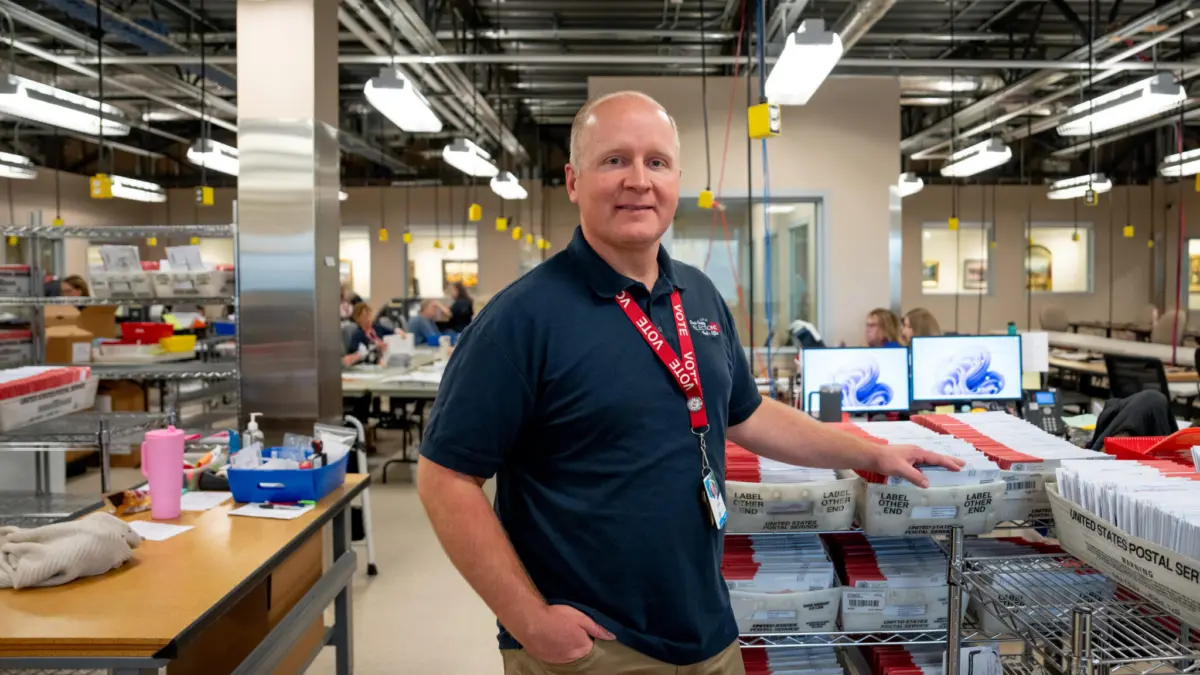
McKenzie did just that for KUER and PBS Utah last month. During a tour of the Davis County election center, he walked through how ballots are processed. As he did, he described layers of existing — and new — security measures.
“There’s always going to be a minimum of two election workers that go and pick up those ballots, they have to log the date, the time, the location, and who it was that retrieved those ballots,” McKenzie said. “They’ll bring those ballots directly here to our election facility. The moment that they come into our building, they’re under 24/7 video surveillance.”
The election center, where ballots are stored and processed, is also armed with an alarm system. Only certain staff have access to it. When ballots are being processed, it has three observation areas where election watchers can keep an eye on everything.
Each ballot envelope has a unique barcode that ensures no voter can vote twice, even if they request a second ballot, maybe because they lost it or if it was delivered to the wrong address.
“What’s important is any time that we issue a new ballot, the previous ballot has been canceled,” McKenzie said. “So that barcode has been canceled. It cannot be utilized again.”
When ballots are returned, election staff must follow chain of custody rules that ensure they’re always handled by two or more election workers. They log “where they came from, when they came in, and who received them,” McKenzie said.
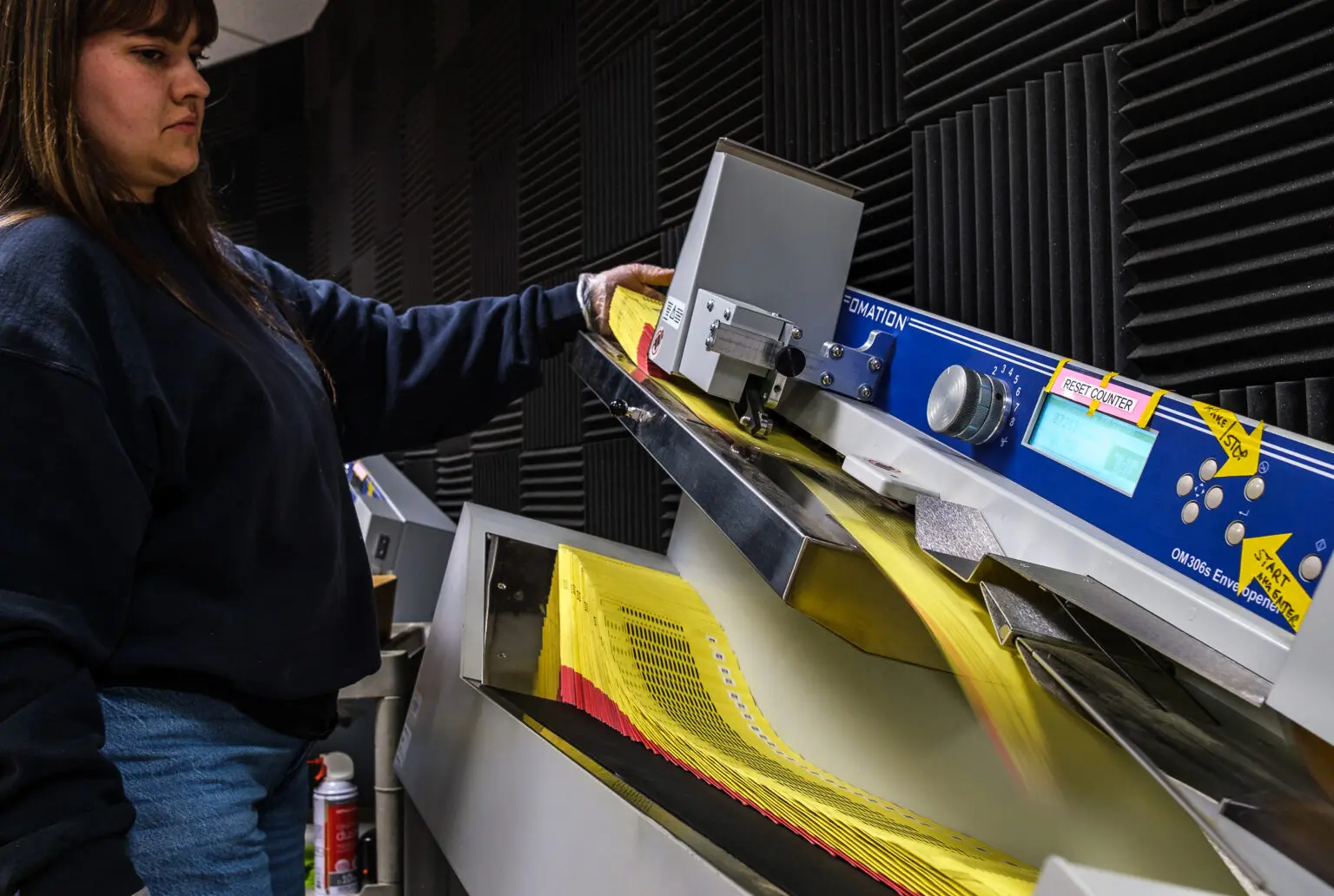
Ballots are then put through a machine to authenticate whether the envelope and the barcode are valid to ensure the voter hasn’t already voted, maybe through early voting or another method. It will also date stamp the ballot and take a picture that election workers can use to verify the signature.
Ballots are then organized and stored into batches, while election workers verify votes one by one by looking at the image of the signature on the envelope and comparing that to the signatures the clerk’s office has on file.
“We can have up to five different images of your signature,” McKenzie said, from voter registration records and driver’s license records.
Under new state law, voters have the option to put the last four digits of their state ID, driver’s license or Social Security number on their envelope. Starting in 2029, those last four digits will be required. But currently, if voters include those digits, election workers must verify those numbers match as well.
If signatures match and the ballot is validated, election workers then determine that it can be counted, and they’ll indicate that in the clerk’s system. If it can’t be validated and counted, they’ll indicate that and give a reason why, McKenzie said.
“Maybe the signature doesn’t match, maybe the last four don’t match, or maybe the signature is missing, or any number of reasons,” McKenzie said. “Then those envelopes are going to be run through this machine again. It’s going to sort out the valid ones from the invalid ones. All of the invalid ones, we have to notify the voter and let them know that there’s a problem with their ballot and how they can correct it.”
To count verified ballots, election workers then put them into machines that remove the ballots from their envelopes. An operator will watch to make sure the process goes smoothly, but the machines ensure votes are separated from their envelopes, “maintaining your constitutional right to a secret ballot,” McKenzie said.
Ballots are then put through a scanner to capture an image and count the votes on each one. After ballots are scanned, their data is stored on machines, and whenever the data is transferred to the clerk’s election management software, it’s through a special encrypted device.
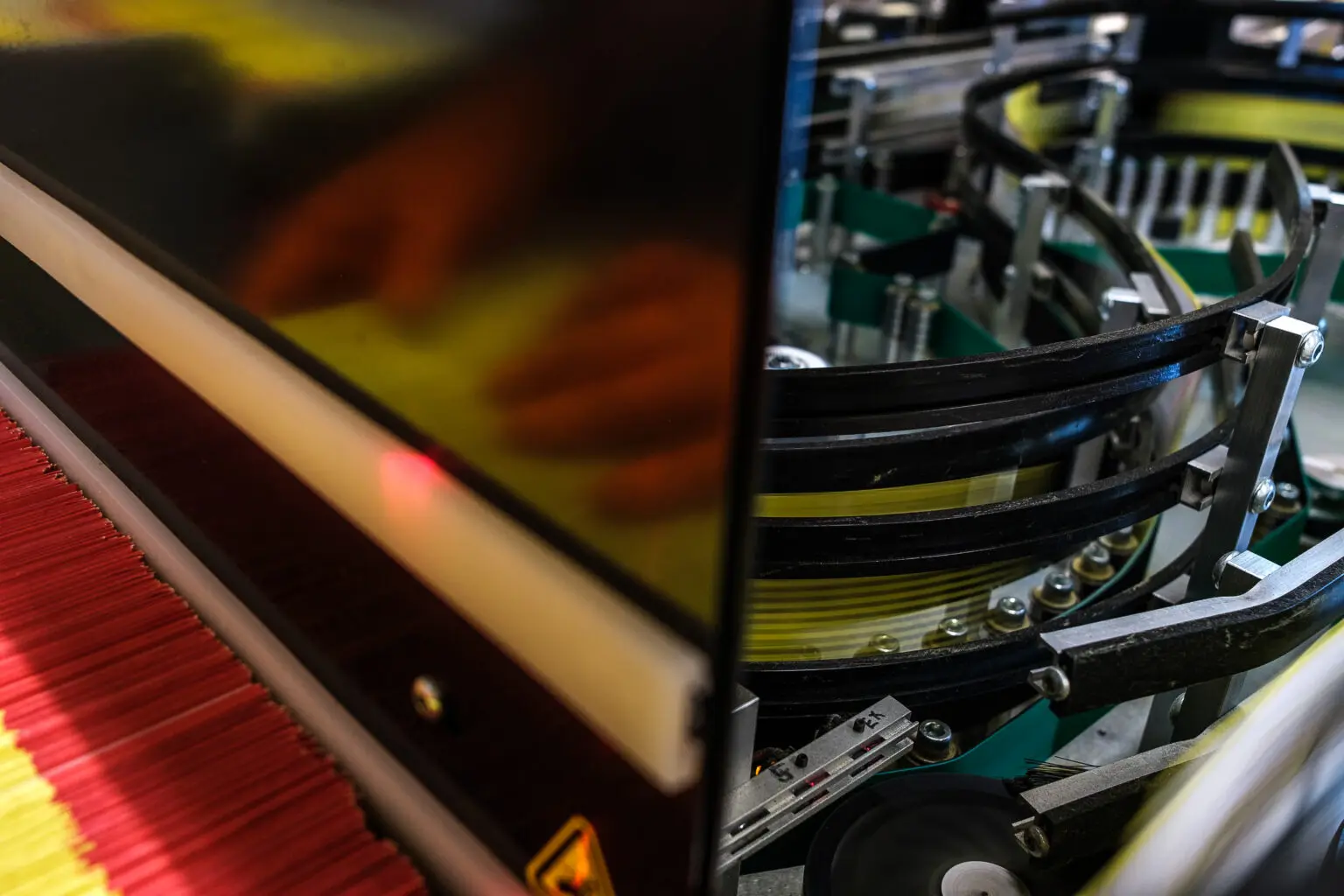
“These pieces of equipment really have multiple levels of encryption,” McKenzie said. “So you can’t just get a jump drive from Walmart, say, and plug it in here. … It has to be vendor specific. It has to be equipment specific. So that machine’s memory stick, I can’t take from there and plug it into this one. It won’t communicate.”
McKenzie said when it comes to data transfer, “nothing is wireless, nothing is web based. It’s all a physical manual process to transfer that data from one place to another.”
“A lot of people ask, ‘How could our election results be manipulated or changed?’ You have to have physical access,” he said. “So nothing remote can connect into our facility here on any of our tabulation equipment.”
The only time that data is shared with a web accessible computer is when it’s shared with the state, he said.
“Yes, we do transmit reports to the state, and sometimes people will say, ‘Well, that could be interrupted,’” McKenzie said. “In theory, yes, it could, but the official results will always be maintained here at the county. And so, if somebody was ever curious and (they) say, ‘Well, how do we know?’ Well, quite easy. You can look at the results that we’ve posted on our Davis County website and compare it to the results that are available on the state’s website.”
One of the best ways Utah voters can keep track of whether their ballot has made it safely back to the clerk’s office and been counted is by signing up for Track My Ballot notifications through the state’s website. If election workers run into a problem, they’ll automatically send a notification to voters urging them to contact the clerk’s office to resolve the issue.
Clerks encourage voters not to wait until too close to the election to mail their ballots back, especially if they’re sending it through the mail. Under a new Utah law, ballots must be in clerks’ possession no later than 8 p.m. on election night, regardless of their postmark.
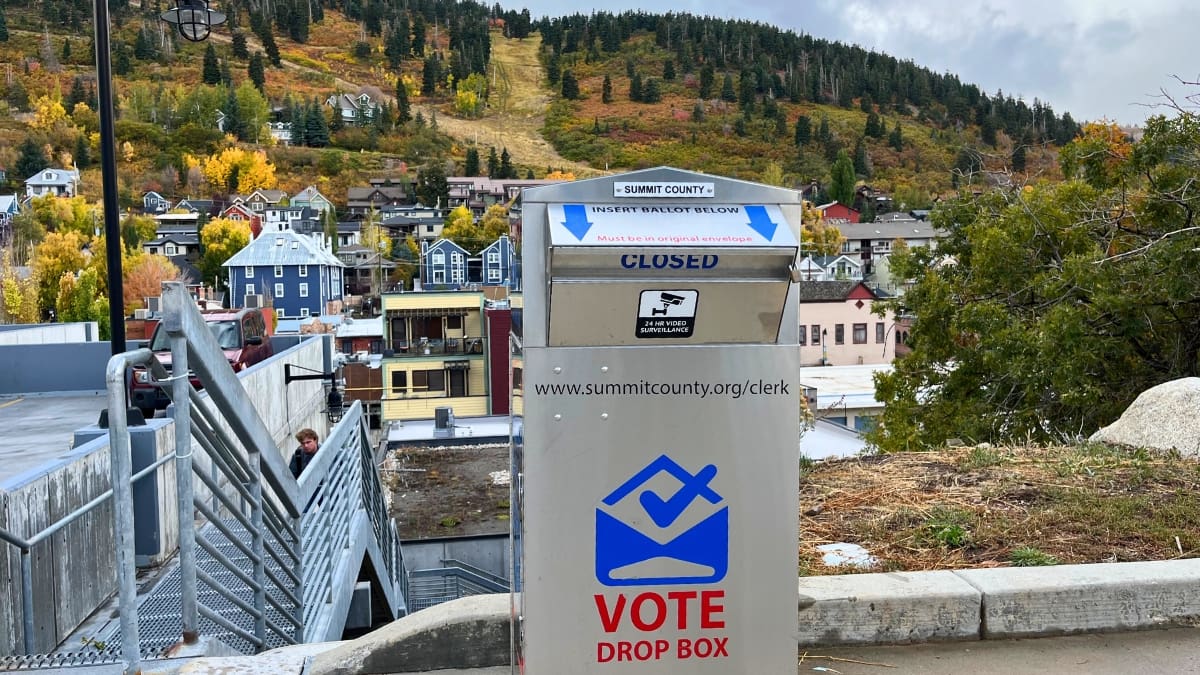
Voters can also drop their ballots off at secure drop boxes (they can find locations on the state’s website) up until voting closes on election night. But for those sending them back through the mail, McKenzie recommended signing up for the Postal Service’s Informed Delivery notifications, a free service to track mail.
“That empowers our citizens to be aware, to be to make sure that the process is transparent,” he said. “and that they can take responsibility on tracking and making sure that their ballots are being handled correctly.”


2266 E Garfield Avenue
Salt Lake City, UT 84108