Western governors announce regional grid initiative from Deer Valley

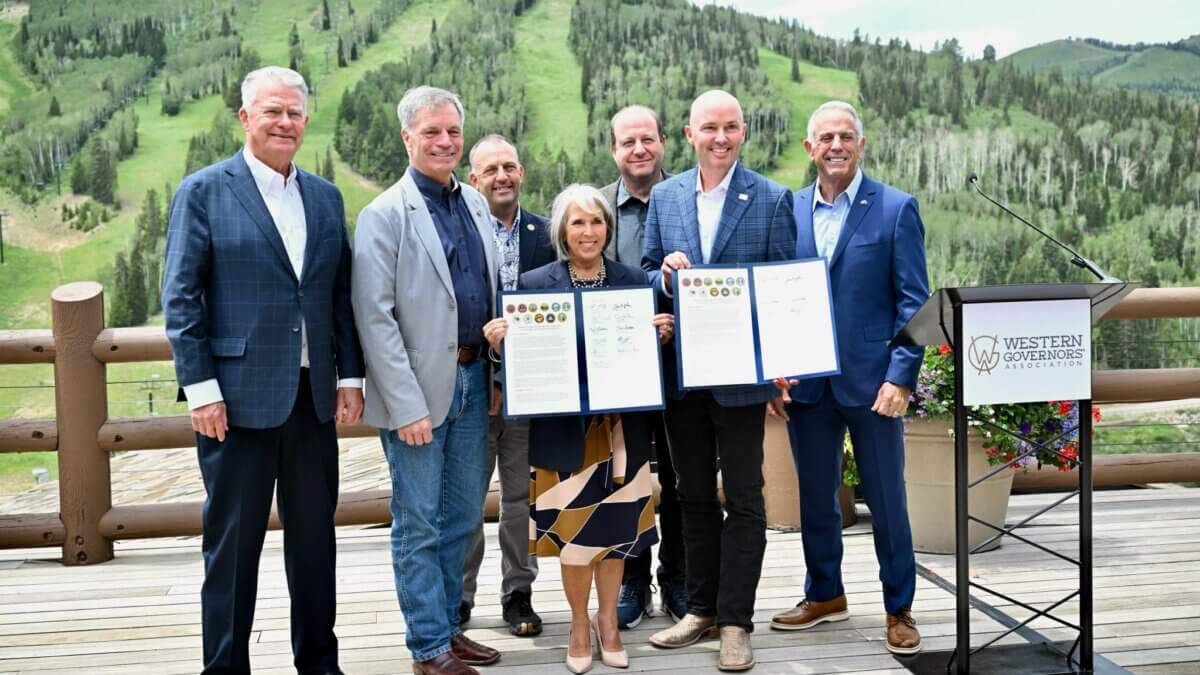
PARK CITY, Utah — Stein Eriksen Lodge played host to a major regional energy announcement Tuesday as 11 Western governors gathered in Deer Valley to endorse a new multi-state effort aimed at modernizing the West’s aging power grid.
The announcement came during the Western Governors Association’s 2026 Annual Meeting, held June 30 through July 2 at the Deer Valley resort. Utah Gov. Spencer Cox, who serves as chair of the association, used the occasion to unveil the Western Transmission Expansion Coalition, known as WestTEC, an initiative to study transmission needs across the region and develop a plan to expand infrastructure.
“WestTEC is an industry-led effort that takes a new collaborative approach to one of our region’s most pressing infrastructure challenges,” Cox said. “Recognizing that this grid system is a team sport, we can’t just fix the grid in Utah. It won’t help everywhere else. We have to do it everywhere.”
Cox was joined by the governors of Colorado, Wyoming, Nevada, Idaho, Oregon, Montana, North Dakota, Arizona, New Mexico and Washington, who all signed a letter endorsing the coalition. The bipartisan group committed to establishing a coordinating body to work with the federal government to accelerate the development of new transmission lines.
WestTEC brings together more than 70 parties, including utilities, planning bodies, state and tribal governments, public-interest organizations and other stakeholders in what organizers describe as a transparent and inclusive process.
Much of the West’s power infrastructure was built more than 60 years ago, Cox said, and transmission lines are aging or expanding too slowly to keep pace with growing energy demand, more extreme weather events and rapidly shifting energy mixes.
“We often talk about energy and energy production, it’s of course paramount to everything that we need to do as a country moving forward,” Cox said. “But that energy production and generation really doesn’t matter if we can’t move those electrons across the grid.”
For Utah, the effort aligns with Cox’s Operation Gigawatt and Energy Superabundance initiatives, which aim to aggressively expand energy production statewide. But state officials say generation alone is not enough.
“Getting energy to where it’s needed, when it’s needed, is just as important as generating it in the first place,” said Emy Lesofski, energy advisor to the governor and director of the Utah Office of Energy Development. “Think of the grid like the roads and highways connecting our communities. It doesn’t matter how much is produced if you can’t move it to where people actually live and work. Utah and other Western states are united on this because it’s just common sense: a stronger, more connected Western grid means lower costs, greater reliability, and more opportunity for every state in the region.”
New Mexico Gov. Michelle Lujan Grisham, a Democrat, echoed that urgency, saying the current national system is too constrained to meet the region’s needs.
“We cannot move enough electricity under the current national system,” Lujan Grisham said. “The West has already demonstrated that they can do transmission better and faster, and that demonstration means that we can alleviate some of the consternation about what is possible and what isn’t.”
According to the governors’ letter, the WestTEC study must promote competitive energy markets, assess transmission needs across the region and offer a roadmap for expanding infrastructure to improve reliability and reduce costs.
Cox said a unified, multistate voice is critical for pushing federal permitting reform forward. While permits are moving faster under the current Trump administration, he said states can still do more to coordinate and speed up timelines.
Jack Waldorf, executive director of the Western Governors Association, called the setting and timing fitting for the announcement.
“Through WestTEC, Western governors are working together to advance the energy transmission infrastructure we need to deliver reliable, affordable energy, which requires navigating a complex patchwork of jurisdictions, permitting processes, and siting decisions — challenges that demand strong interstate leadership and coordination,” Waldorf said. “With Western governors at the helm, I’m confident this agreement will produce tangible results for communities across the region by strengthening energy reliability and helping keep costs affordable for American families and businesses.”
“We’re going to cut through the red tape, we’re going to do this together, we’re going to get projects moving much more quickly, and we’re going to fix our grid,” Cox said.
More information on the grid challenges and proposed solutions is available in the Western Power Pool’s WestTEC 10-Year Horizon report, with a 20-Year Horizon report forthcoming.


4251 E Lipizzan Jump
Moab, UT 84532