The house that became a canvas: Family fights to preserve Casa Pilar


A fundraising campaign is nearing its first milestone as supporters work to save the Salt Lake City home and artistic legacy of Spanish-born painter Pilar Pobil.
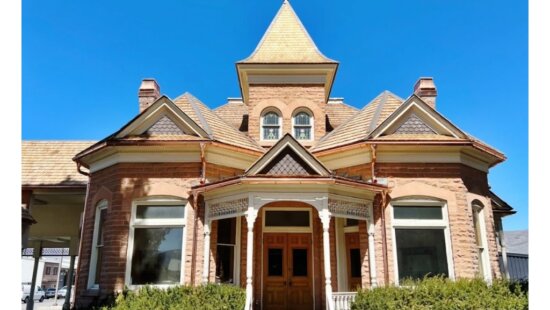
SALT LAKE CITY — From the outside, Casa Pilar is a late-19th-century house tucked into Salt Lake City’s Avenues neighborhood. Inside, nearly every surface carries the imprint of the artist who lived there for more than six decades.
Doors, furniture and staircases are painted in saturated colors. Pobil’s paintings and sculptures fill the rooms. Her gardens extend the artwork beyond the walls.
Now, the family of the late Utah artist Pilar Pobil is raising money to keep the home intact and eventually establish it as a permanent nonprofit arts and cultural center.
Pobil’s daughter, musician and writer Monica Pasqual, launched a GoFundMe campaign in June seeking an initial $50,000. As of Friday, the campaign had raised more than $43,000 from 136 donors. The first milestone is part of a broader $200,000 bridge-funding goal.
Pasqual said the funding would help cover property repairs, preservation of Pobil’s art and archives, staffing, public programming and the work required to establish a new nonprofit organization.
Without that support, Pasqual wrote, she and her sister may be forced to sell the house before a permanent preservation structure is in place.
“Casa Pilar doesn’t get a second chance,” Pasqual wrote in the campaign.
Pobil, who died in November 2024 at age 98, was a Spanish-born, self-taught painter, sculptor, writer and mentor whose work became part of Utah’s cultural landscape. She moved to Salt Lake City with her husband in 1956 and began pursuing art professionally in her 40s.
Over the following decades, she worked in oils, acrylics, watercolor and clay, creating expressive figures, landscapes and scenes shaped by her childhood in Spain and her life in the American West.
Her home became one of her largest and most personal works.
Built in the 1890s, the house is filled with hand-painted architectural details, sculptures, furniture and artwork. Casa Pilar describes the property as a “living museum” that has welcomed visitors for exhibitions, concerts, garden gatherings and other community events.
The Salt Lake Tribune recently reported that Pobil lived in the house for 64 years, gradually transforming it into the art-filled environment her daughters are now trying to protect.
Pobil also supported younger artists and students. Her connection to the University of Utah included permanent art installations and an endowed humanities scholarship supporting students with a commitment to human rights and social justice.
In 2016, King Felipe VI of Spain awarded her the Order of Isabella the Catholic in recognition of her contributions to Spanish and Mallorcan culture in the United States.
Efforts to preserve the property predate Pobil’s death. Artists of Utah reported that supporters formed the Pilar Pobil Legacy Foundation in 2013 with plans to eventually acquire the house and operate it as a community arts resource. The earlier foundation later directed much of its funding toward the University of Utah scholarship and dissolved in 2024.
Pasqual is now working to reestablish nonprofit status and create a structure that could eventually purchase the property from the family.
The larger $200,000 goal is intended to maintain the house and programming for roughly two years while organizers pursue grants, partnerships and long-term funding. Plans could include exhibitions, performances, artist residencies, educational programs and continued public access.
For Pasqual, the preservation effort is not simply about saving a building. It is about protecting an immersive work of art that cannot be separated easily into individual objects or moved to another gallery.
The paintings matter. So do the rooms where Pobil placed them, the furniture she decorated, and the garden she shaped over decades.
Together, they tell the story of an immigrant artist who created a world of her own and invited others inside.
More information about Casa Pilar, future events and the preservation campaign is available through the Casa Pilar website.


2266 E Garfield Avenue
Salt Lake City, UT 84108