Artist Chantry Brewer overcomes personal challenges to paint again

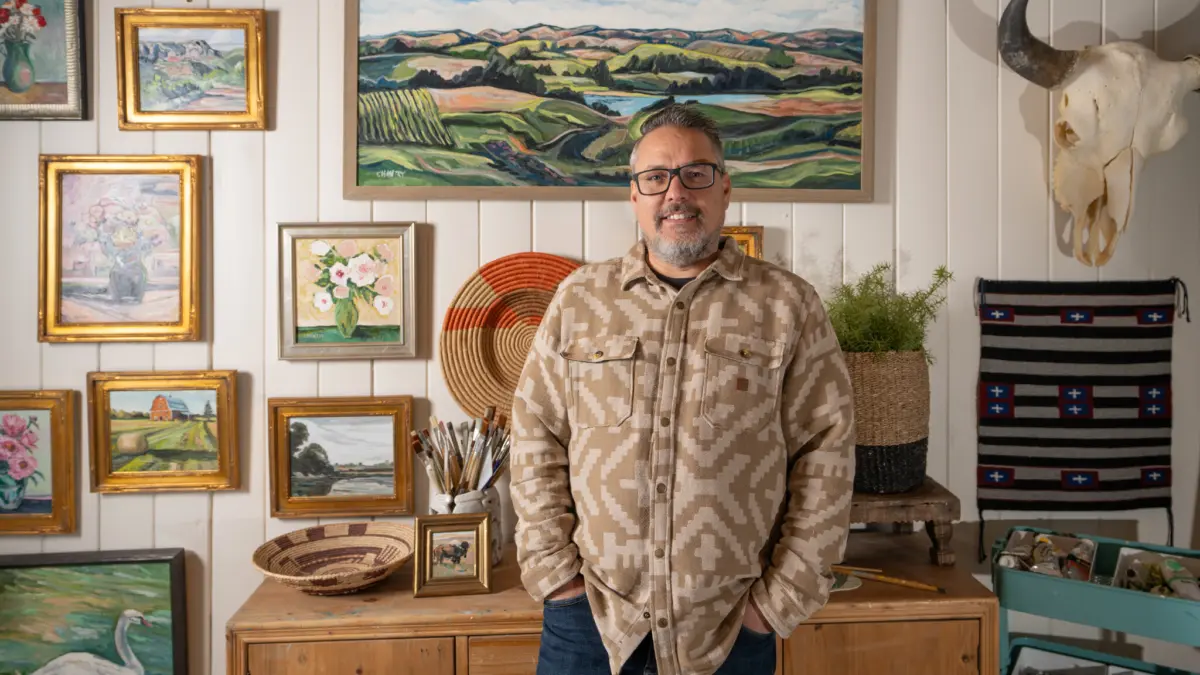
Buffalos gather together and charge headfirst into an approaching storm. This survival strategy minimizes their exposure to harsh weather. Since they travel in the same direction of the storm, they don’t waste time and precious energy outrunning it. Moving in unison, they push through rather than panic, conserving energy and facing the storm as a collective. This instinctive wisdom resonates with Chantry Brewer, local artist, who has faced his own storms with resilience.
Chantry was born in Claysprings, a small town in Arizona, and started painting when he was 12. “My first painting was a sunset landscape,” he says. “My mom painted a lot and introduced me to art. Growing up, I always saw myself as an artist. I explored the Native American artifacts all over my little town, and that had a profound effect on my aesthetics.”
After elementary school, his family moved from the white mountains of Claysprings to the lush forests of Oregon. There, he met Bonnie Hoerger, a phenomenal art teacher who nurtured his talent through junior high and high school. “Bonnie was a dedicated and selfless teacher,” he says. “She took me to art museums and galleries in Portland. Everyone thought I was going to be a famous artist.” Bonnie’s encouragement left a lasting mark on Chantry’s growth as an artist.
In 1995, he moved to Utah, where he’s been ever since. “I have lived in Utah longer than [in] any other state,” he says. “Utah and Heber Valley are home.” He studied design at Utah State University and earned a fine arts degree. After graduating, he put his creative talent to use as a web designer and a user experience (UX) designer. Early in his career, he worked as an art and creative director for several online dating websites, most recently for The Church of Jesus Christ of Latter-day Saints. He also worked for Zions Bancorporation as a user experience researcher and designer. While he built his 25-year career in UX design, he took a hiatus from painting. But, life has a way of throwing curveballs.
Chantry suddenly lost vision in his left eye. And that changed everything. “I developed keratoconus,” he explains. “I can still see color, but everything is blurry. Even with glasses, it’s hard to see clearly out of my bad eye.” He feels it was an uncanny mercy that he lost sight in only one eye, because often, the disease claims the eyesight from both eyes at once. When he lost the vision in his left eye, he felt an urgency to return to the canvas, while still having vision in his right eye.

“I owe remembering who I am as an artist to my mom, who strongly encouraged me to pick up a paintbrush and paint again while visiting her for Thanksgiving several years ago,” says Chantry. “Shortly after, I painted a Native American chief. Although my wife, Abby, and I had been married for three years at that time, she didn’t know I had it in me. Her jaw dropped to the floor. Abby bought me paints and brushes for Christmas, and I began to paint again.”
It wasn’t easy at first. “It was like relearning a language,” he says. “It was difficult to put on canvas what I saw in my mind, and it made me grumpy. But, the more I leaned into it, the more alive I felt. Now, painting is my voice, my vision, and the way I feel most myself.”
And the more he enjoyed it, the more he painted. His vision challenges created a subconscious exigency—to paint while he can, to fully use his sight and to share beauty while it is still available to him. “It can be frustrating not being able to see clearly,” he admits. “But I think it’s also shaped my style. I used to see perfectly straight. Now, some of my flowers lean. They reflect the way real life is lived, adapting as we’re weathered by time and experience. And that gives my work a handcrafted, imperfect, and deeply human feel.”
A few years ago, Chantry and Abby moved to Midway. Chantry has four stepchildren who call him “Dad,” along with three children from his first marriage, who all live in Washington. “Some of my kids are artistic too,” he says. “So that’s been fun to explore creative outlets with them. Abby has been my inspiration—she is endlessly supportive. Our relationship is incredibly close. We both share a creative spirit and artistic fluency.” For 20 years, Abby worked as an image consultant, a hair stylist, and a makeup artist. She also had her own in-home studio in Heber, where she sold Chantry’s paintings to clients.
Last summer, Abby hung up her shears, and around the same time, Chantry left his role as a UX designer at Zions Bank to pursue art full-time. Now, retired from their former careers, Chantry and Abby are pouring their creative energy into a shared dream: opening an art studio and gallery in the little cottage they are renovating on Midway’s Main Street.
Chantry works in oils and is known for his natural landscapes, native chiefs, florals, and buffalo. “I love the rich luminosity of oils,” he says. “I paint alla prima—wet on wet—embracing the way pigments blend, bleed, and interact directly on the canvas. Painting this way gives me the ability to work quickly, but also the freedom to rework if needed. This approach results in layers, textures, and depth. There’s a steadfastness to the color and a sense of permanence in oil paint that makes me feel connected to a long tradition of oil painters.”
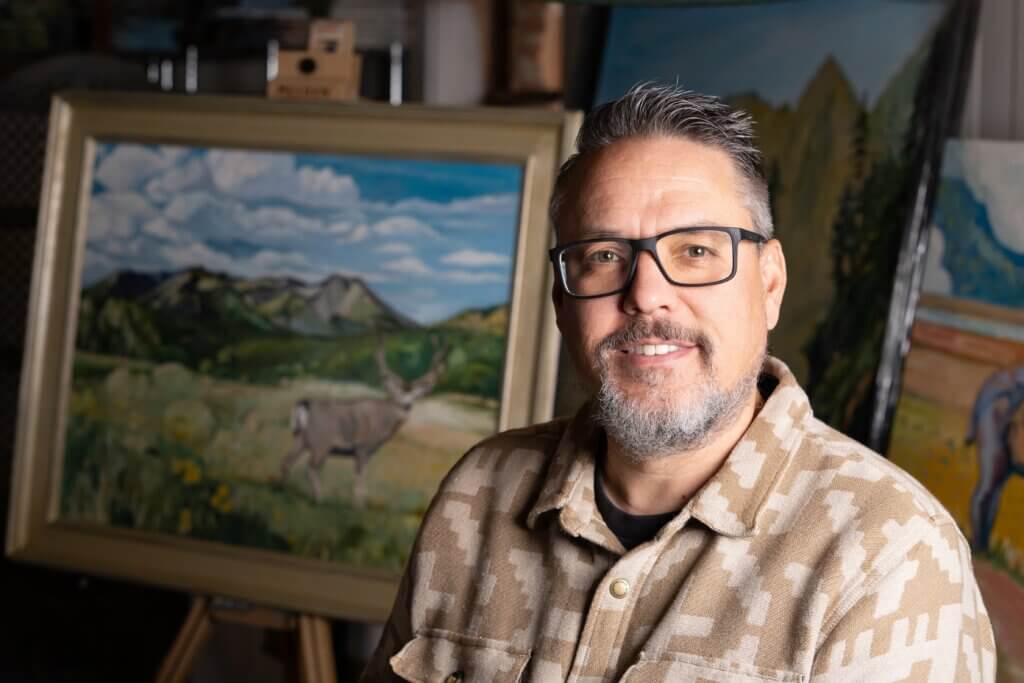
Chantry’s paintings are distinguished by bright, vibrant colors and lively brush strokes. “Color is life to me,” he says. “Color has an energy all of its own and is made up of a variety of elements from our natural world. Color also evokes emotion and reminds us of experiences and places. I use loose, energetic brushstrokes to capture that, so my paintings have motion and emotion.”
He loves painting the majesty of natural landscapes, such as Mount Timpanogos, the Provo River, or winter scenes with barns, as well as florals. “When I lived in Oregon, I developed a love of gardening and did the family garden in high school,” he says. “Two of my daughters are named after flowers. I love to play with abstract floral imagery. I’m inspired by 19th-century European floral painters, so I follow that style but with a modern take. I’m always learning and exploring.” He captures the bright essence of blossoming flora, from pink peonies to hydrangeas and hollyhocks.
If you are looking for something to revitalize a space in your house, Chantry’s paintings can be found in local home décor stores such as Bolt Ranch, Fernweh Lifestyle, The Dainty Pear Co., the European Food Market, and other vintage shops in Heber. Folklore Bookshop commissioned a piece that adorns its hearth; the shop also sells smaller works of his book-stack paintings. In addition, Chantry sells his art and commissioned pieces out of his Midway home and via social media, reaching both high-end clients and local collectors alike.
When he’s not painting, he’s traveling, hiking, and fishing at Strawberry Reservoir in Heber. “My wife and I love finding quaint places to explore eating local food, hiking, and doing puzzles together,” he says. “I handle the sorting, so Abby gets the satisfaction of fitting the pieces together.” He also enjoys reading Western novels. “My name, Chantry, came from the Louis L’Amour books,” he adds with pride.
Now that he’s a full-time artist, he takes his time connecting with people and listening to their stories. He’s found that everyone has overcome some kind of adversity or another, but that there is always a path forward. The buffalo, a recurring subject in his work, embodies this resilience. It endures, faces the storm, and keeps going. “I’ve had my share of heartbreak and health struggles, but everyone faces trials in life,” he says. “You push ahead with perseverance. When you live in harmony with the earth, it can be incredibly abundant.”
Ever curious, Chantry is on the road to see national parks. “I plan to visit the national parks in Utah and paint them on location,” he says. He has also begun entering the plein-air competition in Midway every year. “I always look forward to learning more about plein air painting and meeting the other artists.” And, he’s studying flowers, learning their names and painting them with different treatments to see how he can expand his talent.
Look for Chantry at his easel, in the shadow of a canyon, atop a mountain, or by a flowing river translating the world he loves onto canvas. He’ll be the artist seeing all the beauty of the world through one eye.


4251 E Lipizzan Jump
Moab, UT 84532