Environment
What’s in the dust? Great Salt Lake plume renews concern over toxic exposure risks

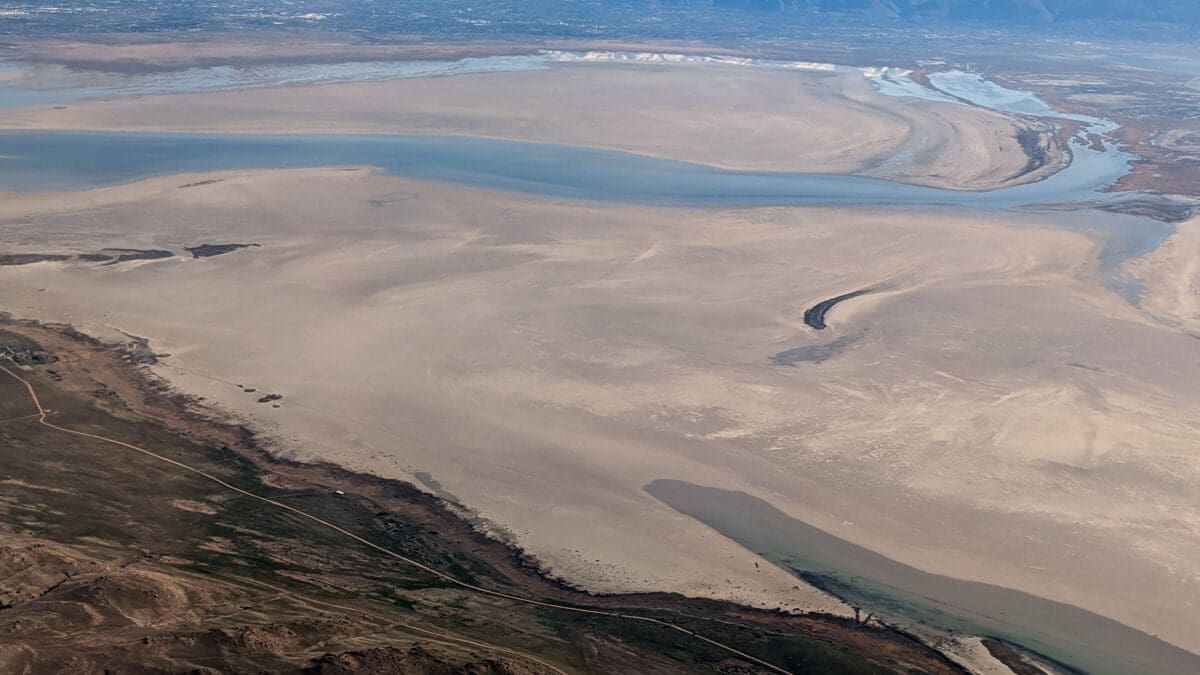
Dust from the exposed Great Salt Lake bed swept across the Salt Lake Valley on July 8, pushing particle pollution to about four times the healthy limit, according to The Salt Lake Tribune. Photo: TownLift // Kirsten Kohlwey
PARK CITY, Utah — A wall of dust pushed east and south off the Great Salt Lake on Wednesday as thunderstorm outflow winds moved across northern Utah, offering a visible reminder of a growing public health concern tied to the shrinking lake.
Meteorologist Chase Thomason posted video of the dust plume Wednesday, with footage credited to Travis Padilla. In the post, Thomason said some of the dust may contain particles from the exposed Great Salt Lake lakebed, though he noted it was impossible to know exactly what was in the plume without testing. He warned that visibility could drop quickly and air quality could temporarily worsen.
The dust event came as new research from Utah State University and the University of Utah is raising questions about how toxins from the exposed lakebed may move through air, soil, crops, and human bodies.
A Utah State University-led study published this spring found that metal-laden dust from the drying lakebed may enter human bodies directly through ingestion and indirectly through food systems. Researchers found leafy vegetables exposed to Great Salt Lake dust contained elevated levels of elements including arsenic and uranium, even after the plants were washed, according to USU.
The research was led by former USU graduate student Molly Blakowski and supervised by Janice Brahney, an associate professor of watershed sciences at USU. University of Utah geochemist Diego Fernandez supported the work through analysis at the U’s mass spectrometry facility, according to the University of Utah.
“Dust is an acute health hazard, but it is rarely measured for composition or bioavailability of potentially toxic components,” Brahney said, according to USU.
Researchers exposed cabbage plants to dust collected from Farmington Bay’s playa. Some dust was applied directly to leaves, some to soil, and some plants were left untreated as a control. The team found that dust applied directly to leaves resulted in elevated levels of uranium, lithium, beryllium, arsenic, and antimony, according to the University of Utah. Dust applied through soil did not show the same effect.
The findings do not mean all local produce is unsafe. Researchers said they point to the need for more monitoring and a clearer understanding of how Great Salt Lake dust moves through the environment and into people.
More than one-third of the modeled exposure scenarios in the USU-led research showed toxic metal exposure surpassing levels of concern for children, according to USU. Researchers said some metals dissolve more readily in the environment, making them easier for plants to take up, while others become more soluble in stomach acid, raising concerns about ingestion.
The study builds on earlier University of Utah research that examined how dangerous Great Salt Lake dust may be compared with other regional dust sources. That research found sediments from the exposed playa had higher reactivity and bioavailability than sediments from other major dust sources affecting Wasatch Front air quality. Researchers also found elevated levels of metals, including arsenic and lithium, that exceeded U.S. Environmental Protection Agency residential soil screening levels.
Scientists have cautioned that more monitoring is needed. While researchers can identify what is present in exposed lakebed sediments, determining how much of that dust reaches populated areas during specific wind events requires more on-the-ground sampling and air monitoring.
That distinction matters for events like the plume captured in Thomason’s post. The video shows dust moving off the Great Salt Lake area, but without testing, researchers and forecasters cannot say exactly what was in that specific cloud.
Still, scientists say the broader risk is real. As the lake shrinks, more lakebed is exposed to the wind. Those sediments have been shaped by natural processes as well as more than a century of mining, waste disposal, oil refining, and other industrial activity, Blakowski said, according to USU.
“The dropping levels of the lake have exacerbated the problem,” Blakowski said, according to USU.
Researchers said restoring lake levels, reducing industrial pollution and expanding dust monitoring would all help reduce risk.
For residents, the immediate guidance during a dust event remains practical: slow down if visibility drops, avoid unnecessary outdoor exertion when dust is blowing, and take extra precautions for children, older adults, and people with asthma, heart disease or other respiratory conditions.
The larger question is harder. As the Great Salt Lake continues to expose more dry lakebed, scientists say Utah needs better answers about what is in the dust, where it travels, and who is most at risk.
By: Rebecca Brenner


4539 S Willow Road
Holladay, UT 84117
965 Goshen Canyon Road
Mona, UT 84645
10584 Basin Canyon Road
Park City, UT 84098
19 East 100 North
Spring City, UT 84662
24 South 600 East
Salt Lake City, UT 84102Talk of the Town


Park City Jobs

Assistant Manager, LOMA
5 days ago Full time $35.00 hourly

Property Inspector, Park City Rental Properties
6 days ago Full time $23.00 - $25.00 hourly
Owner Relations Manager, Park City Rental Properties
6 days ago Full time
Operations Manager, Park City Rental Properties
6 days ago Full time

Hiring Barista Assistants and Baristas, Silver King Coffee
8 days ago Part time $17.00 - $30.00 hourly