A rezone first, details later? Summit County weighs new development rules

County officials say Ordinance 1016 would streamline costly rezone reviews, but critics say moving detailed project review to later stages could limit public scrutiny after elected officials have already approved a zoning change.
COALVILLE, Utah — Summit County officials will take another look Wednesday at a proposed overhaul of the Snyderville Basin Development Code that would change what developers must submit — and what the public and county officials must evaluate — before a property can be rezoned.
The Summit County Council is scheduled to hold a work session July 29 on Ordinance 1016, which would create a new “Concept Development Plan” process for rezonings tied to specific development proposals. The council is expected to use the work session to provide direction to county staff before the ordinance returns for a public hearing and potential vote in early August.
County staff say the proposal is intended to streamline the rezone process by separating the county’s legislative decision about whether a property should be rezoned from the detailed engineering and site-plan review that follows.
But the proposed Ordinance has also raised questions about whether the changes would shift some of the most consequential public scrutiny of major development proposals until after the county has already approved the zoning needed for them to move forward.
Under the current Snyderville Basin Development Code, a rezone application must comply with development standards contained in Chapters 3 and 4 of the code. County staff say that requirement can force applicants to prepare detailed site plans and engineering-level materials before the county has even decided whether the proposed zoning is appropriate.
The proposed ordinance would instead require a Concept Development Plan, or CDP, showing enough information for the county to evaluate a project at a conceptual level. The plan would include the proposed density and land-use pattern, circulation, open space and general approaches to water, sewer, stormwater and other infrastructure.
Detailed engineering plans, subdivision improvement plans and final site plans would come later, during the development approval process.
County Manager Shayne Scott did not answer question about Ordinance 1016 before press time.
County planner Amanda Curtis wrote in a staff report prepared for Wednesday’s work session that the current process has created inefficiencies and increased costs for applicants without improving the county’s decision-making at the legislative stage.
County staff said proposed changes were prompted in part by recent projects, including the Cline Dahle proposal, which highlighted the need to distinguish between legislative decisions such as rezonings and subsequent administrative development approvals that determine whether a project meets detailed engineering and design standards.
That contrast is also at the heart of concerns raised by some residents. Members of Trailside Together, a group opposing the proposal to build 200 housing units in Trailside on a parcel that would need to be rezoned for higher density, say the ordinance could make it easier for projects like the proposed development near Round Valley to move forward.
A rezone is a legislative decision made by the County Council following a public process. Under the proposed system, the council would make that decision based on a conceptual development framework rather than fully engineered plans.
That means detailed questions about how a project will ultimately function — including aspects of site design, infrastructure and engineering — could be resolved during later development approvals rather than before the council decides whether to change the property’s zoning.
Some of those later approvals can be administrative in nature, meaning the public and elected officials would not necessarily be revisiting the fundamental question of whether the property should have been rezoned in the first place.
The proposed changes come as Summit County has increasingly relied on administrative processes to handle major development decisions, a shift that played out prominently in the controversial Dakota Pacific project at Kimball Junction. The county’s current structure gives the County Manager broad administrative responsibility, and the county’s own website describes Shayne Scott as the chief executive officer responsible for directing the Community Development Department and other county operations. The Dakota Pacific development agreement was reworked so that the county manager, rather than the County Council chair, would sign the agreement and control changes to the contract.
That history provides a broader context for Ordinance 1016: While the ordinance would not eliminate the County Council’s role in approving a rezone, it would establish a process in which the council could approve a conceptual development framework and leave increasingly detailed decisions about how a project ultimately complies with county requirements to later development approvals. The result could be that some decisions with significant consequences for surrounding residents occur farther down the administrative chain and farther from the elected body that approved the underlying zoning change.
The proposal does place limits on what a developer could ultimately build after receiving a rezone.
If approved, the Concept Development Plan would become part of the rezone approval, with certain elements considered binding. Those include maximum density, general land-use configuration, the primary circulation framework and the open-space system.
The staff report also shows a change prompted by concerns raised at the Snyderville Basin Planning Commission.
During the commission’s June 9 public hearing, Commissioner Peteroy questioned what would happen if a developer obtained a rezone based on a specific development proposal but never built it, leaving a future property owner with the zoning and development rights associated with the original approval.
Staff concluded that the proposed CDP and development agreements provided safeguards, but added another one: If a rezone is approved with a Concept Development Plan and there is no development agreement, the rezone would expire after five years if no subsequent development approval has been obtained.
That provision would prevent a rezone from remaining indefinitely attached to a property without the development proceeding, according to the staff report.
The proposed changes would also remove a current requirement that any application for a rezone automatically go through the Master Planned Development process.
Questions about public notice
The ordinance has already generated concern about how residents learn about proposed changes to the development code.
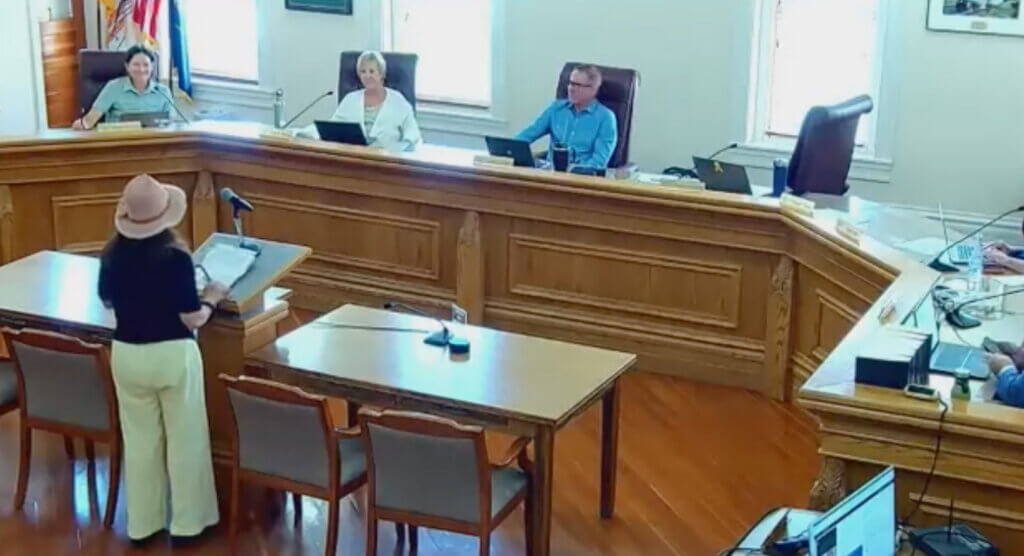
During public comment before the council’s July 8 meeting, Old Ranch Road resident Debbie Scoggin urged the county to make notices easier for residents to understand. She said the legal description of Ordinance 1016 did not adequately convey what the proposed changes could mean.
“I think this is an important issue,” Scoggin told the council. “The average Joe is not going to know. They’re going to have to do a lot of work.”
County officials responded that public notices are governed by state requirements and must remain neutral. Council Chair Canice Harte said the county could explore ways to improve public communication but cautioned against language that could be interpreted as taking a position on a legislative proposal.
“I think the government can’t really print the opinion,” Harte said.
The council ultimately postponed consideration of the ordinance and asked staff for additional time.
Wednesday’s work session is not a vote on the ordinance. Staff is asking the council to identify any changes it wants made before the proposal proceeds to a public hearing.
The Snyderville Basin Planning Commission recommended approval of the amendments following its June 9 public hearing. The County Council will have the final say on whether the changes become part of the development code.


4251 E Lipizzan Jump
Moab, UT 84532