Politics
Election loss may not end Adams’ influence over Deer Valley, data centers


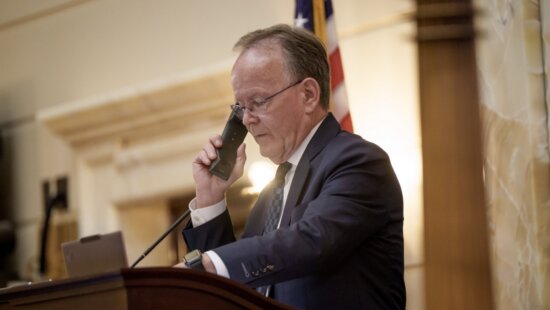
MIDA President J. Stuart Adams at the grand opening celebration of the Grand Hyatt in Deer Valley's East Village on Jan. 10, 2025. Photo: TownLift//Randi Sidman-Moore
As the Legislature prepares for a post-Adams era, the question may not be whether his influence is ending, but where it will continue.
PARK CITY, Utah — Utah voters may have ended Stuart Adams’ nearly two-decade run in the Utah Senate, but the defeat may not fully remove one of the state’s most influential political figures from positions of power.
Adams, the longtime Senate president and one of the most powerful Republicans on Capitol Hill, conceded Tuesday after losing his GOP primary race to challenger Stephanie Hollist in Senate District 7. The upset sent what political observers described as “shockwaves” through the Utah Legislature and marked the first primary defeat of Adams’ legislative career.
Much of the attention surrounding Adams’ loss has centered on his role in advancing the controversial Stratos data center project in Box Elder County as chairman of the Military Installation Development Authority, or MIDA. The proposed AI-focused data center campus sparked fierce opposition over concerns about water consumption, energy demand and potential impacts on the Great Salt Lake. Political consultant Taylor Morgan told Utah News Dispatch that Adams became a political target because of the controversy surrounding the project.
“I think it really is all about the timing with the data center and Stuart being the target as chair of MIDA,” Morgan said.
But while Adams’ Senate career appears to be ending, state law suggests his influence over some of Utah’s largest development projects may continue.
MIDA is the state authority responsible for overseeing several major project areas, including Deer Valley East Village, the massive ski-resort expansion being developed in partnership with Extell Development in Wasatch County. The authority also played a central role in advancing the proposed Box Elder County data center project and is spearheading a controversial initiative to establish Utah as a global nuclear hub with projects like a proposed uranium enrichment facility at Camp Williams.
Long before he became Senate president, Adams was helping shape MIDA. He has served on the authority’s board since 2008, two years before joining the Utah Legislature. He was appointed to the MIDA board by Governor Huntsman and entered the role as former chair of the Utah Transportation Commission and a former Layton City Council member.
The authority’s seven-member board is controlled by political appointments rather than elections. Five members are appointed by the governor, while the Senate president and House speaker each appoint one member. According to Utah’s Boards and Commissions records, he currently appoints himself to that seat, rather than naming another senator or private citizen. State law also says board members serve at the pleasure of their appointing authority and may be removed or replaced at any time.
The statute does not automatically terminate a board member’s service when that person leaves elected office, except for certain municipal and county representatives whose board service is tied to holding local office.
That means Adams’ departure from the Senate does not necessarily mean an immediate departure from MIDA.
Sen. Adams did not respond to questions about the future of his role with MIDA and other questions about his appointment to the authority.
In his current role as MIDA chair, Adams oversees consideration of creating of project areas, public infrastructure districts, bond issuances, development agreements, major financing decisions, and board appointments to MIDA subsidiaries.
Whether Adams remains involved with MIDA may ultimately depend on actions by state leaders and the authority itself. For now, his election defeat does not automatically sever his connection to one of Utah’s most powerful development agencies.
By: Marina Knight


1548 W Woodsview Lane
St. George, UT 84770
1263 E Wild Maple Court
Draper, UT 84020
336 W Broadway Unit 201
Salt Lake City, UT 84101
29 Marilyn Court
Park City, UT 84060Talk of the Town


Park City Jobs


Math Instructor / Tutor, Mathnasium of Park City
Today Part time $22.00 - $24.00 hourly

Technician, Park & Facility Operations, Basin Recreation
1 day ago Full time $51,192 - $63,990 yearly

Intermediate Architect, A43 Design.com
1 day ago Full time $63,000 - $81,000 yearly
Interior Designer, A43 Design.com
1 day ago Full time $62,000 - $70,000 yearly