Collecting beta: How climbing transformed Sonja Tschabrun’s life

At Summit County Library in Kimball Junction, a librarian of medium height with fine brown hair, whom I faintly recognize from attending childhood book clubs here, stops Sonja and me on our way out. Sonja and I have just finished one of my favorite interviews in the teen section of the library, where books surround a couple of quiet, inviting, diner-style booth seats. As the planned hour-long chat had grown close to two hours, I stopped the transcript, and we began to pack up, our conversation easily continuing as we walked towards the exit. Although we had kept our voices down, pieces of our conversation drifted out into the surrounding areas and apparently caught this librarian’s ear. She told us that our conversation, “powerful and interesting,” inspired her. Sonja and I smile, thank her, and continue to walk to our cars.
I didn’t recognize the reality of this moment until I was home reviewing the audio recording of our transcript. The librarian was right: Sonja, with her openness, humor, and charisma, made the interview incredibly special. I learned how the quiet, playful six-year-old who used to live two doors down from my own became a strong, passionate, and loving young woman.
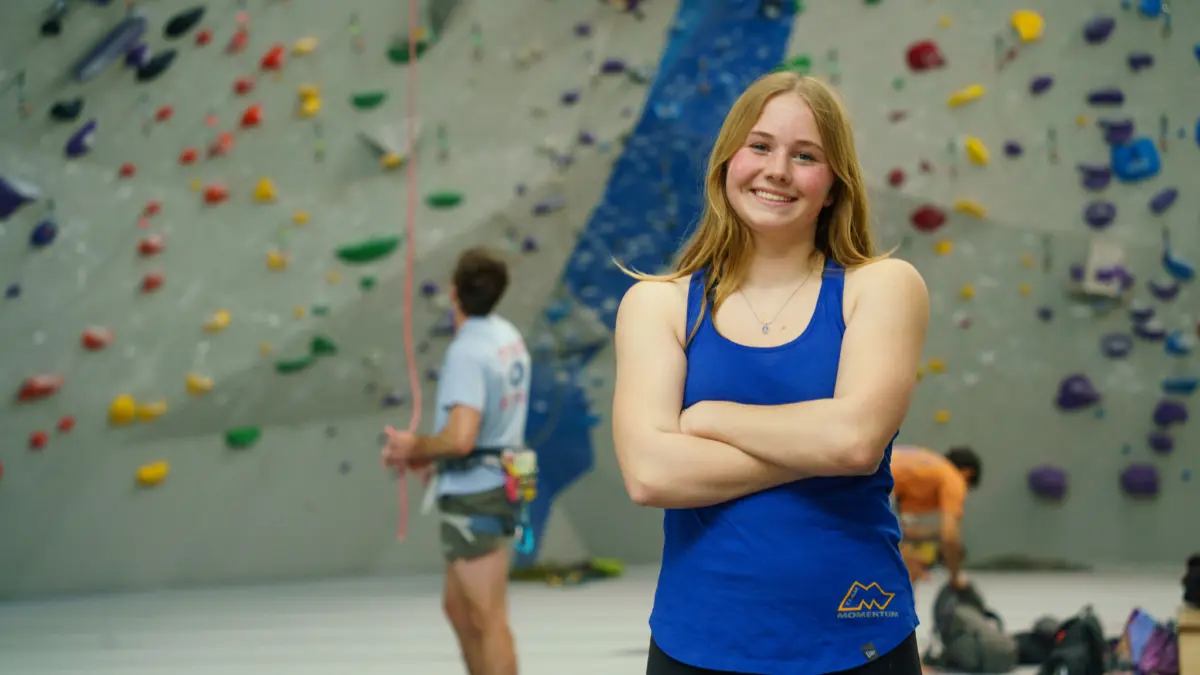
Sonja Tschabrun is now a sophomore at Park City High and is competitive in both bouldering and lead-climbing. Since a summer camp 10 years ago, Sonja has been part of the Momentum Climbing Team, whose climbers train at indoor gyms in Millcreek, Lehi, and the new Fort Union location. Two-to-three-hour-long practices—typically Monday, Wednesday, Friday, and Sunday—are spent refining skills, learning new moves, and gaining endurance, all of which are put to the test in qualifying events (QEs). Though many compete only in the more popular discipline of bouldering, Sonja is also competitive in lead. Both disciplines, Sonja says, are a mix of strength, technique, and, perhaps the most important, mental fortitude.
For bouldering, over the course of two months, four QEs qualify you for regionals. These events are more casual, where competitors are given 10 boulders and have three hours to top as many routes as possible. The 10 routes are generally a mix of slab and overhung routes. Slab is all about technique and balancing on your feet with intentional movements. Sonja’s teammates describe overhung routes as “thuggy,” explaining that “you just have to thug it out” with strength-intensive moves. Some of these moves take a great deal of contact strength, where momentum-filled dino moves—jump moves that audience members love—are quickly controlled to be able to grasp the next hold. If a competitor clears each of these 10 boulders on their first try, they can earn the maximum number of points, which is 25 per boulder. But typically, certain crux moves of a boulder can take multiple tries to complete successfully, with each additional attempt deducting 0.1 points. To maintain energy for the rest of the competition, Sonja generally gives a strength move four attempts, while taking upward of 10 attempts for dynamic moves.
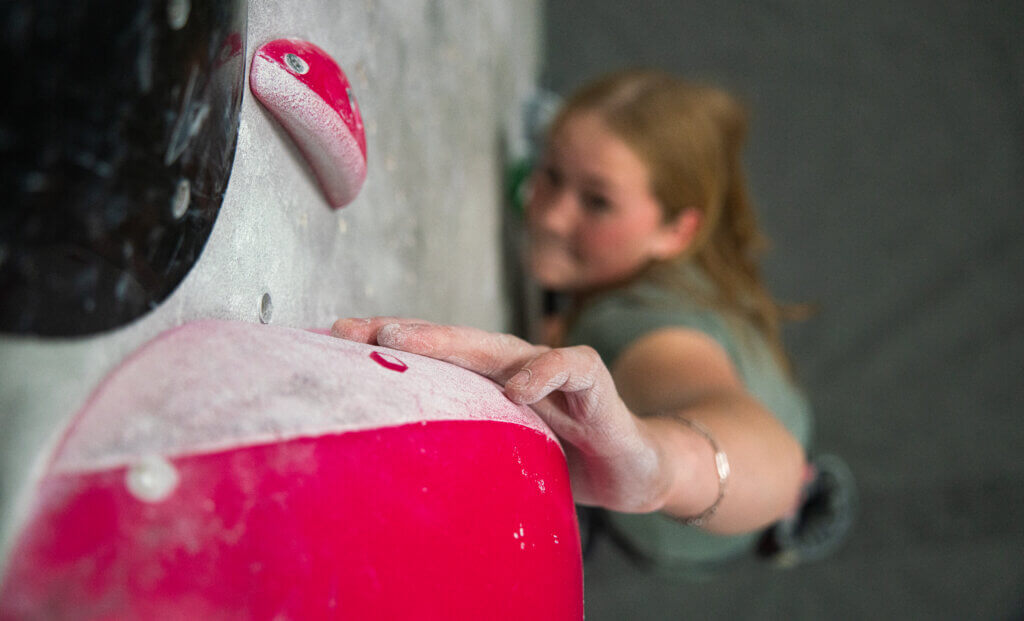
As Sonja works through the boulders at the QEs, she is allowed to talk with coaches, competitors, and teammates, collecting beta, meaning she tries to piece together the route setter’s intention. This environment is the cornerstone of the bouldering community. Even with placement and qualification on the line, fellow competitors share their opinions, watch each other’s moves, and congratulate one another’s efforts.
The top 30 girls from the four QEs move on to regionals, which hosts climbers from Idaho, Montana, Utah, and Wyoming. The format for the regional competition is more serious and individualistic. One hour before the start of the competition, climbers are led into an isolation area, where only two coaches are allowed. Here, it is a mental game as they begin to prepare—focusing on what can be controlled, warming up the body for the coming physical exertion, and preparing the brain for that effort. It is about knowing that the training is done and that now is the time to put it to the test.
After an hour in the isolation area, Sonja is led out to a chair, where she can observe the boulder for the first time. Here, she is alone, with just her brain and its ability to see the pattern of a route up the wall. It is about focusing a busy mind when big goals are at stake. When she is done reading the climb, it is up to her physical body and its ability to execute as she attempts to top the wall. She has only four minutes to observe, read, and climb each boulder. Like in QEs, every attempt deducts 0.1 points, but at regionals, there is an additional incentive to make it to certain points of the route. If you make it to the top hold, the maximum point value is 25, and if you get halfway up, there is a zone hold that is worth 10 points. Sonja explains that some boulders are so difficult that no one makes it to the top, so it all comes down to who can get to the zone hold in the fewest number of attempts to determine the winner.
Those four minutes, for both observing the route and attempting the climb, is what weeks of training can come down to. It becomes a game of perseverance, almost stubbornness, to never stop trying for the full time—constantly testing new beta, pushing that one percent harder to see if this will make the move work. These couple of minutes of pure perseverance on the wall are much like any other testing moment of the day. They represent the willingness to try, to show up—even if failure is the likely outcome. “It is not an option not to try,” shares Sonja, so even when life becomes overwhelming, she can at least try by sheer force of will.
However, this “trying” isn’t a simple act of completion or a ticking of a box. It is a learning process, says Sonja, through which each attempt up the wall builds on the previous, and where the angle of a foot on a hold can be slightly shifted to give her just a bit more stability for the next move. Every attempt, in training and competition, Sonja sees as a chance to become an improved climber. These opportunities aren’t huge; they are small changes to body position or little gain in strength after weeks in the gym. They are small, daily choices: to show up, to pay attention to the little things, to notice a shift in a friend’s mood, and to care enough to dream big.
This state of being, where all the focus is on trying and learning, is something truly special. In my sport, we call it the “flow state,” where thoughts run freely, yet not at all. Where movement comes naturally, and even though pain is high, it feels innate. And despite the fact that I don’t competitively climb, I could tell Sonja had found a similar state in climbing. It simply becomes her and the wall; her teammates’ cheers are drowned out, school stressors suddenly feel inconsequential, and life feels simple. The only focus is getting as far up the wall as she can, being the best version of herself for that day.
This attitude of being willing to try, to learn, to enter a state of flow, is similar in lead. In lead climbing, the climber is responsible for clipping the rope into the wall as they make their way up, while the belayer is on the ground, ready to catch the climber in case of a fall. Since the belayer is helpless without the climber attaching the rope to the wall, Sonja explains to people that she is her own safety.
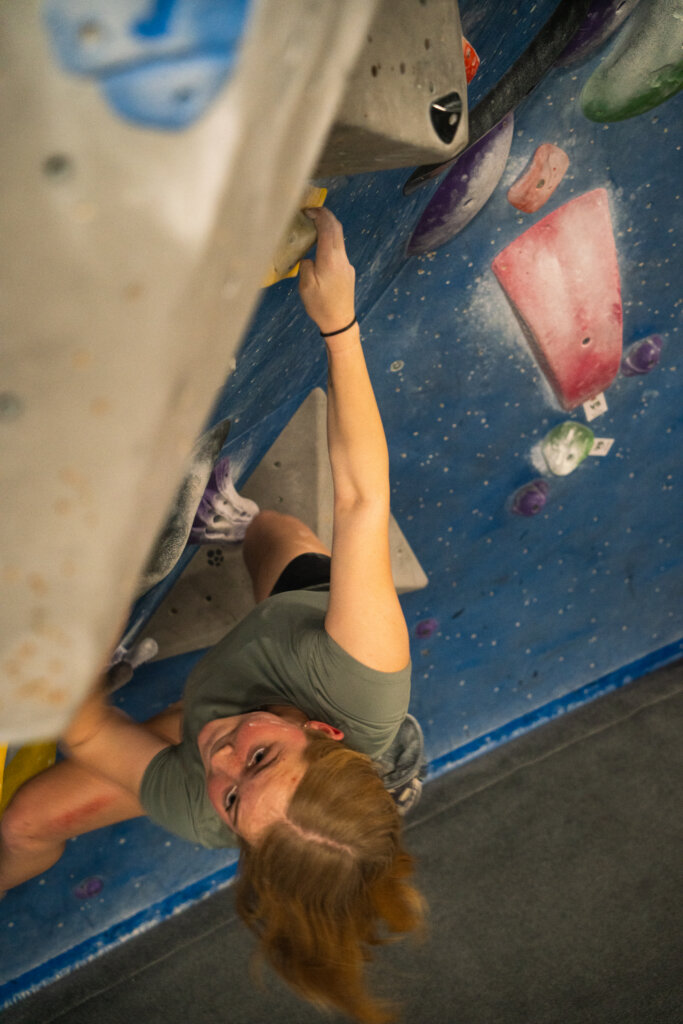
In competition, lead climbing follows a similar pattern to bouldering, with an isolation, viewing, and climbing period. With lead, instead of having 10 boulders, there are three longer climbs, each of which needs to be attempted in five minutes. Between each climb, there is a 10-minute rest period. It is in these 10 minutes—right after you finish one lead and before you start the next—that the mental battle is the strongest.
“Something I have had to teach myself is that once you get off the wall, that climb is over,” Sonja admits. It is easy to overthink the last lead—“Why didn’t I get one hold higher, or why didn’t I top that climb?”—so Sonja has learned how to harness her breathing to prevent herself from spiraling. How to let go of what just happened, reminding herself to “focus on now” and what can be controlled for the next lead. One of these “controllables” is nourishing the body during the 10 minutes between leads, when Sonja will drink water and have her lucky Swedish Fish candy. And, before going out for the next lead, she repeats to herself her mantra, “Try my best, have fun.”
From the outside, with her perfected race-day system, it would look like Sonja has never been harrowed by lead climbing. But that is only because she has worked through the fear and learned how to trust. Years ago, when Sonja was 10, she was lead-climbing outside and took a fall that resulted in a serious concussion, as well as a bone bruise on her shoulder blade. This fall broke Sonja’s trust with belayers and herself. No matter the belayer, Sonja refused to climb lead for five years. “I remember being so panicked before going to lead practice” to the point where “I didn’t even want to go,” Sonja reflects. Something that was once freeing became threatening.
One day, with a lot of bribing, her coach got her up on the wall. “I got to the second clip on the wall; I was shaking, unable to breathe or let go of the wall. Finally, my coach climbed up there and pulled me off,” Sonja recalls. After that first lead, she told herself, “I’m never doing this again,” but slowly, her stubborn self wanted to improve. “I decided I was just going to take it one step at a time,” she says.
That first step was to acknowledge the fear. Sonja explains that for the longest time, she refused to admit to others, and herself, that she was scared to lead a climb. By acknowledging it, she was then able to work through the fear by making herself fall. Eventually, she forced herself to fall once a day, then twice, increasing her confidence little by little. After months of work, she was able to fall without fearing it. Sonja admits that she “has never been the most trusting of people,” because she is “someone who has highly built walls.” So, she says that realizing her life is literally in “this belayer’s hands” hasn’t been easy.
“It really taught me that sometimes you have to have this blind faith in people; you have to believe that these people want the best for you,” she says. Chuckling, she adds, “They are never intentionally trying to drop you.” Sonja is now also the belayer; she is the one in control of another person’s physical safety, having been the one she fought to trust for years. But she has learned that “if you trust people, they’ll trust you back.” It is a two-way street.
A climbing wall, essentially a wooden board with hand grips and foot holds, has become so much more for Sonja Tschabrun. It has made her stronger physically, building endurance and body awareness. It has taught her to keep trying, even when life becomes overwhelming, to keep learning and building day after day. It has become a place where she can quiet her mind and control her breathing. It has let her work through fear and relearn how to trust people. Both bouldering and lead-climbing have helped her grow into a young woman who is ready to scale and conquer all of life’s challenges.


4251 E Lipizzan Jump
Moab, UT 84532