Natural History Museum of Utah repatriates indigenous objects

SALT LAKE CITY, Utah — Twenty years after a major federal sting in the Four Corners region that led to indictments by a Salt Lake City grand jury in 2009, and the preservation and identification of about 101,000 Native American objects forfeited to the Bureau of Land Management (BLM) and FBI, the Natural History Museum of Utah (NHMU) and BLM Utah State Office (BLM Utah) received the “Award for Excellence in Curation and Collections Management” from the Society for American Archaeology for their outstanding and ongoing work on the Cerberus Collection.
Starting in 2006, Operation Cerberus Action was a major federal sting spanning Utah, Colorado, Arizona, and New Mexico, including undercover operations in which undercover agents and informants purchased illegally obtained Indigenous artifacts for more than $335,000.
In June 2009, search warrants were served in Blanding, Utah, and other Four Corners communities where a number of individuals were arrested for violations of the Archaeological Resources Protection Act (ARPA) and the Native American Graves Protection and Repatriation Act (NAGPRA). When the operation concluded, work on the recovered items commenced.
“Illegal trafficking of cultural resources is not a victimless crime. It harms communities and erases history,” said Jeff Titus, acting special agent in charge for BLM law enforcement in Utah. “These items carry deep cultural meaning, and we’re proud to stand with our partners to help ensure they are preserved and returned with the respect they deserve.”
The Cerberus Collection is the largest and most archaeologically significant illegal collection ever recovered by the federal government. It consists of rare, unique and well-preserved objects that were unlawfully removed from public lands, Tribal lands, and burial sites for personal collection and black-market sales. The collection includes approximately 1,600 ceramic objects; 350 baskets, sandals and other woven materials; 1,000 pieces of personal adornment; 1,600 pieces of ground stone and other stone tools; and tens of thousands of projectile points.
“The complexity, scale, and importance of the collection is truly unique, and we have an ethical and legal responsibility to ensure the recovered objects are cared for respectfully and appropriately, including through repatriation to descendant Tribal communities and management for public benefit,” said Diana Barg, BLM Utah’s curator and NAGPRA coordinator. “NHMU has been, and continues to be, instrumental in our efforts.”
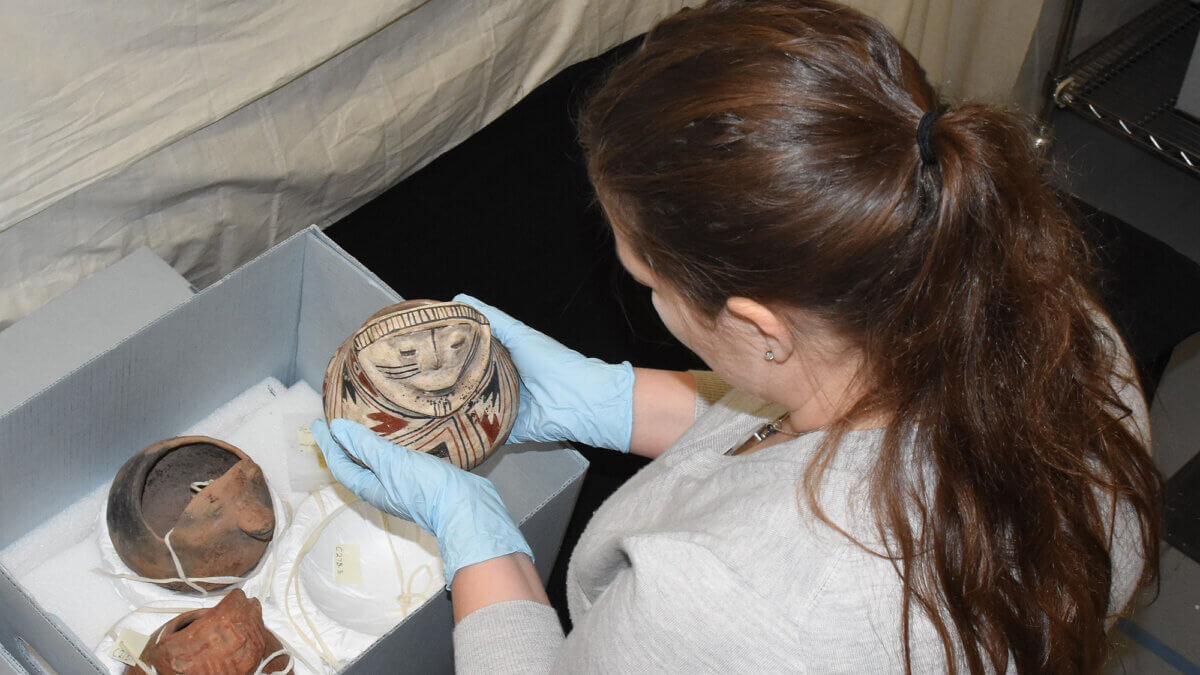
A team at BLM Utah cataloged and inventoried the recovered items and began consultations with 30 Tribal governments over the span of 10 years. The BLM then partnered with NHMU to prepare objects for long-term curation at various BLM partner repositories, including NHMU in Salt Lake City.
Without context or documented locations, common with such theft, many items have not been traced back to their origin, and more work and consultation are required. Once accessioned at repositories, the objects of the Cerberus Collection are more readily available to the public, researchers, and descendant Tribal communities.
“It’s an ongoing effort to rectify the damages from this tragic case of widespread depredation,” said Jason Cryan, Ph.D., NHMU’s Sarah B. George executive director. “We are immensely proud of the role NHMU played in preserving these invaluable items and ensuring their return to appropriate homes in a careful and efficient manner.”
There have been numerous successes, including the return of 47 traditional pottery making tools to the Pueblo of Santa Ana, Tamaya, in New Mexico. These tools, including grinding stones, mortars, pestles, manos, and metates, are not destined for curation but for hands-on use by a group of individuals knowledgeable in traditional techniques who pass on the art form to new generations of Santa Ana Potters.
“Typically passed down generationally, grinding stones [one of the traditional tools] are hard to come by, but crucial to the process,” said Thomas Armijo, the Pueblo of Santa Ana’s cultural resources technician. “For the community, it’s important to give life back to these objects whereas they were sitting on shelves for years and years and years.”
Another item returned to the Pueblo of Santa Ana Tribal Historic Preservation Office is a distinctive and rare bowl from an unknown contemporary Pueblo artist, who likely crafted the piece in the 1960s during a resurgence in Pueblo pottery. The bowl is a unique example of the polychrome technique that was quickly identified by Tribal members during consultation with NHMU and BLM Utah. It will be featured at the Pueblo of Santa Ana’s future cultural center that will highlight a revival in Santa Ana pottery making.
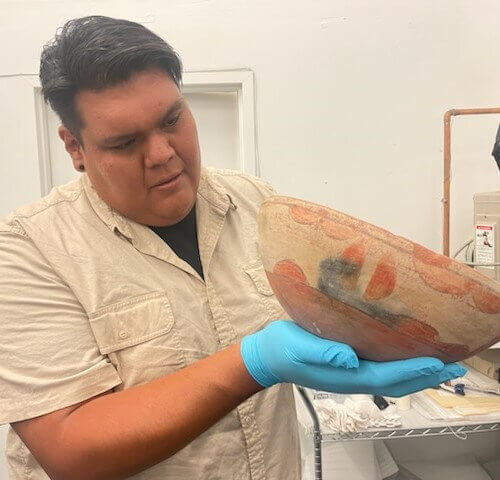
“We worked closely with the BLM and NHMU to consult on all items in the collection that were of interest to us, resulting in the expeditious return of the bowl back to Santa Ana,” said Monica Murrell, Tribal historic preservation officer and director of the Santa Ana Historic Preservation Department.
Back at NHMU, the preservation of Cerberus Collection objects will be an ongoing journey that could take another five years to complete, and the work is being recognized well beyond this award by the Society for American Archaeology.
“The dedication and professionalism of the collections management team is truly a remarkable partnership,” said James Toledo, Utah Division of Indian Affairs program manager, in a letter of support for the award. “They have always recognized the importance of including Tribal perspectives and have moved mountains with the limited resources available.”


4251 E Lipizzan Jump
Moab, UT 84532