Environment
Utah paying hunters to kill mountain lions in state-led predator study

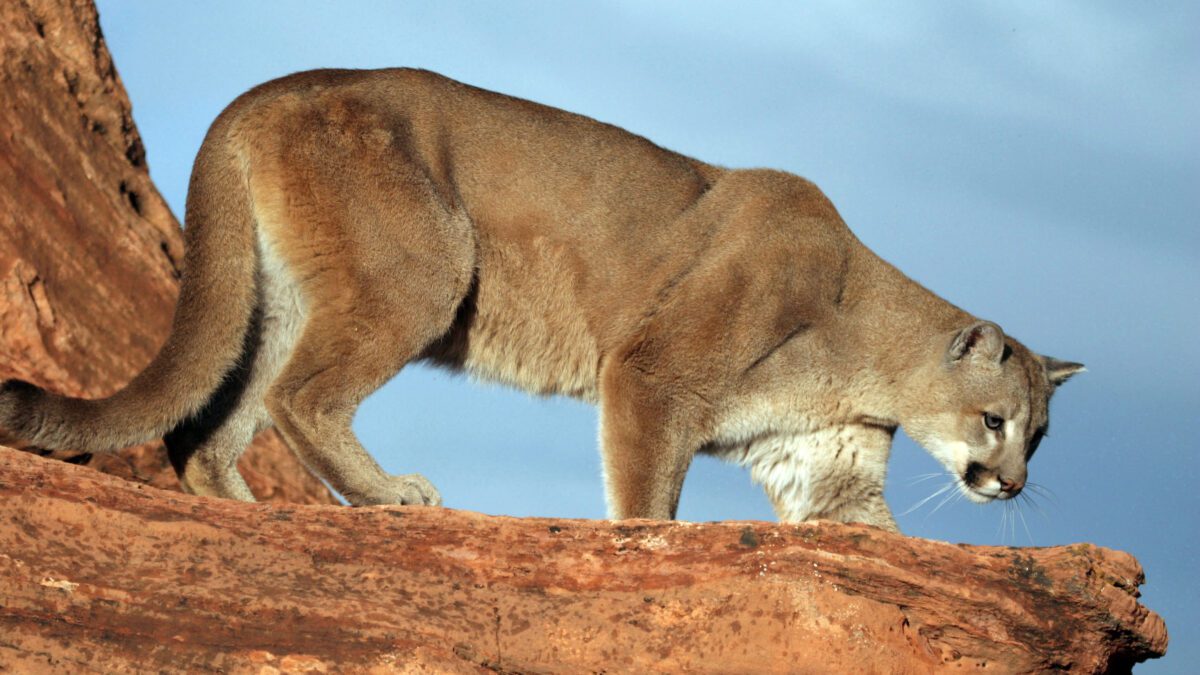
A mountain lion in Utah. The state is paying hunters and trappers to kill as many cougars as possible in six hunting units as part of a multi-year predator management study, according to High Country News. Photo: Courtesy of Utah Division of Wildlife Resources.
Critics question science, transparency behind year-round removal effort targeting cougars in six hunting units
The Utah Division of Wildlife Resources is paying hunters and trappers to kill as many mountain lions as possible in six of the state’s 30 hunting units as part of a multi-year study, according to an investigation by High Country News reporter Kylie Mohr.
The effort, formally known as Utah’s Watershed Restoration Initiative Predator Management Study, began last October and is scheduled to run year-round through 2029, with data analysis extending into 2031. As of March 19, hunters and trappers had killed 45 mountain lions across the six units, DWR spokesperson Faith Jolley told HCN.
There are no limits on how many lions can be killed. The stated goal, Jolley told HCN, is to “remove as many cougars as possible.”
The study is a cooperative effort among DWR, Brigham Young University biologists Brock McMillan and Randy Larsen, and two nonprofit sportsmen’s groups — the Utah Wild Sheep Foundation and Sportsmen for Fish and Wildlife — each of which contributed $150,000 to fund the project in fiscal year 2026, HCN reported. A BYU research proposal obtained by HCN estimates the total cost at $1.29 million.
The removal effort is mandated under H.B. 125, passed by the Utah Legislature in 2020, which requires DWR to cull mountain lions when deer and elk populations fall below target levels. Jolley told HCN the herds in the six units have been below those targets for several years, though the law did not take effect until May 2025.
Separately, in 2023, the Legislature lifted all seasons and bag limits on mountain lion hunting statewide. Anyone with a general hunting license can now shoot, trap, or snare mountain lions year-round with no cap.
Critics raise concerns about science and oversight
The study has drawn sharp criticism from wildlife advocates, researchers, and even some ranchers and hunters who told HCN the approach lacks scientific rigor and adequate public oversight.
Andy Rice, a sheep herder near Boulder who has lost roughly 100 sheep to mountain lions over the past decade, told HCN he is troubled by the state’s approach despite his own losses. “My concern is that the government that I pay into, and the conservation organizations that I’ve trusted my whole life as a hunter in Utah, are willfully creating programs that are destructive to our communities,” Rice told HCN.
Elliot Ross, a National Geographic explorer and photographer who lives in southern Utah, told HCN he views the effort as “an extermination campaign masquerading as science.”
According to HCN’s reporting, many residents did not learn about the project until December, when a recreational lion hunter’s dog was killed in a snare set by the study’s trappers. Denise Peterson, founder and director of Utah Mountain Lion Conservation, told HCN the lack of public notice was alarming. “The fact that the public wasn’t given the opportunity to get involved or even comment on this is a big red flag to me,” Peterson said.
Jolley told HCN that no public comment period was required because the removal is a mandated action, not a rule change, though comments were accepted at regional advisory council meetings in December and a wildlife board meeting in January.
Research suggests that weather, not predators, drives deer decline
At a January DWR Wildlife Board meeting, the agency’s own wildlife managers acknowledged that most mule deer declines in Utah are driven by habitat loss and poor plant quality rather than predation, HCN reported.
That finding is consistent with existing research. A 2010 study by Mark Hurley, then a wildlife research manager at Idaho Fish and Game, found that removing mountain lions in Idaho had “no strong effect” on mule deer population growth, with winter severity as the dominant factor.
David Stoner, an ecologist at Utah State University who is not involved in the DWR study, told HCN he has reached similar conclusions. “What drives deer populations is largely weather,” Stoner said. “Our wet and dry cycles in the West have the biggest proportional impact on the abundance of mule deer.”
Utah’s mountain lion population has been declining for years. Jolley told HCN the estimated adult population dropped from roughly 1,900 in 2016 to 1,100 in 2024. State managers will not directly measure lion populations during the study — they will track only the number killed, according to HCN’s reporting.
Local effects already visible
Rice told HCN the consequences are already showing up in Boulder, where DWR hunters and trappers have removed 15 mountain lions, including females. In early March, according to HCN, a young lion was seen swiping a cat off a porch; another got stuck under a chicken coop and was euthanized by state officials.
“You kill mothers and have offspring that can’t take care of themselves,” Rice told HCN. “We are literally seeing the consequences of it in real time.”
Peterson told HCN she worries the study could expand. The project proposal states that results “can be directly applied to other units throughout Utah to improve management.”
“It’s putting us on a very concerning trajectory,” Peterson told HCN.
This story is based on reporting by Kylie Mohr for High Country News, published March 24, 2026. Read the original at hcn.org.
By: Rebecca Brenner


597 Deer Valley Loop Road
Park City, UT 84060
2475 W White Pine Lane
Park City, UT 84060
137 W Bridlewood Lane
Midway, UT 84049
2154 S Rio Verde
Moab, UT 84532
2400 E Walker Lane
Holladay, UT 84117Talk of the Town


Park City Jobs

Chef de Cuisine, Washington School House Hotel
Today Full time $50,000 - $60,000 yearly
Housekeeper, Washington School House Hotel
Today Full time $20.00 - $22.00 hourly
Line Cook, Washington School House Hotel
Today Full time $20.00 - $22.00 hourly

Ski Patrol Medical & Rescue Technician, Utah Olympic Park
1 day ago Full time $22.00 hourly

Full or Part Time Dishwasher/Prep Cook, Rebekah's Kitchen
3 days ago Part time $13.00 - $18.00 hourly