Community
New program aims to expand adaptive access on Wasatch Back trails

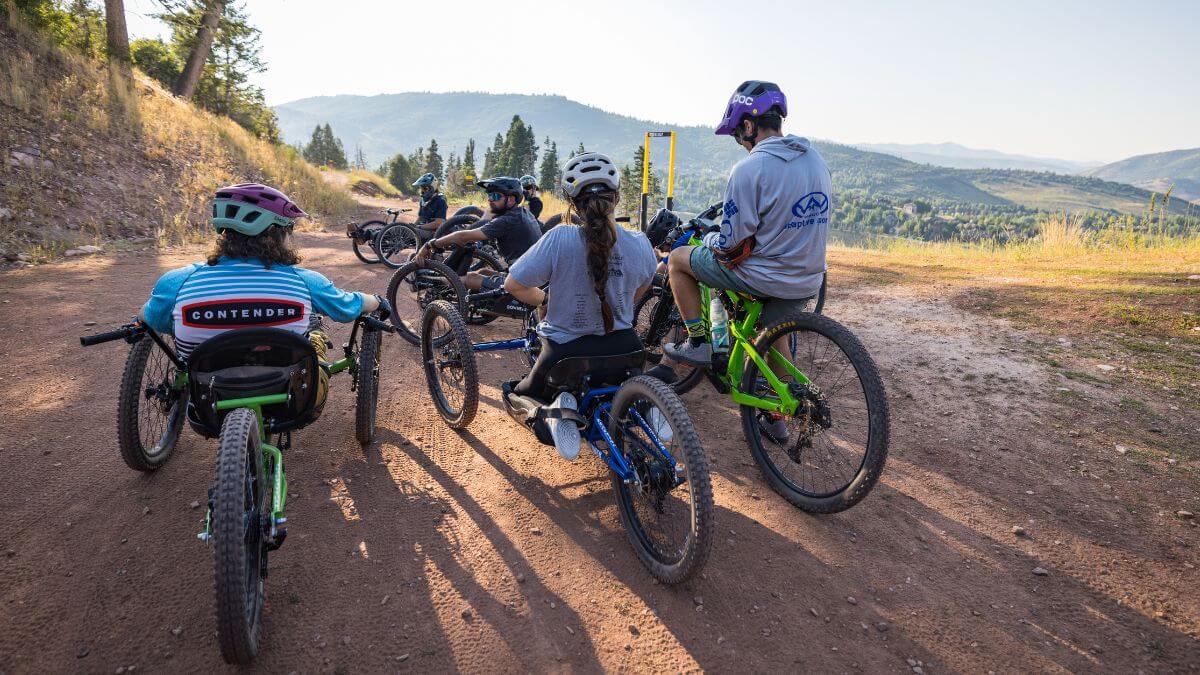
Adaptive mountain bikers out on the trail. Photo: Kylie Fly
PARK CITY, Utah — Mountain Trails Foundation has launched a new pilot program aimed at expanding access and improving information for adaptive mountain bikers and other trail users across the Wasatch Back.
The Adaptive Trails Assessment Program, supported by the Utah Division of Outdoor Recreation and funded through the Utah Legislature’s Outdoor Adventure Commission via an Outdoor Recreation Infrastructure grant, will evaluate existing trails and infrastructure to determine how they can better meet adaptive-friendly and universal design standards.
Building on years of adaptive access
Mountain Trails Foundation has worked for years alongside the National Ability Center to make Park City’s trail system more welcoming to riders using adaptive mountain bikes, or aMTBs.
Some of the first adaptive-friendly routes were built in Round Valley, adjacent to the National Ability Center campus, including the PorcUClimb–Downward Dog loop. The Big Easy trail followed a few years later. More recently, universal design elements have been incorporated into projects at Clark Ranch and on-mountain trails, including upgrades to Seldom Seen and the overhaul of Silver Queen.
Lora Anthony, director of Mountain Trails Foundation, said the new assessment program grew out of conversations with state leaders.
“The initiative for a program to assess existing trails and routes to determine universal upgrade feasibility originated at the Utah Division of Outdoor Recreation,” Anthony said. “When leadership at the UDOR approached MTF about piloting the program on the Wasatch Back, our answer was, ‘Of course!’ Since we have the National Ability Center and over 400 miles of trails right here in Park City, it was kind of a no-brainer.”
Two-phase, multi-year effort
The Adaptive Trails Assessment Program is structured as a two-phase project expected to span approximately two years, depending on funding.
During phase one, Mountain Trails Foundation will work with stakeholders including the National Ability Center and Wasatch Adaptive Sports, along with riders who use adaptive equipment, to evaluate trailheads, signage, difficulty ratings, and the physical characteristics of trails and routes.
The assessment will identify safety hazards, physical “roadblocks,” opportunities for aMTB-friendly upgrades, and improvements to reporting systems and wayfinding signage. A comprehensive report outlining recommendations will serve as the final product of this initial phase.
Phase two will focus on securing funding to implement recommended upgrades at trailheads and along routes deemed suitable for universal improvements and long-term sustainability.
Mountain Trails Foundation anticipates that construction and upgrades could begin as early as 2027.
Universal design for all users
Program leaders emphasize that universal trail design is not about simplifying trails.
“The aMTB community doesn’t want ‘dumbed down’ trails,” Anthony said. “The great thing about universal trail design is that all trail users benefit.”
Ian Hartley, resource manager at MTF, who is helping guide the program, said the effort is designed to maintain the character of each trail while expanding access.
“The goals are ambitious yet practical,” he said. “There’s a ton of work behind the scenes to ensure that a variety of users and equipment are considered, and that the character of each trail is maintained. The concept of universal trail design is exciting because it offers opportunities to enhance trails for all levels, from beginner to expert. It’s not a one-size-fits-all solution.”
Enhancements could include clearer and more accurate trail ratings, improved signage, upgraded trailhead infrastructure, and selective modifications to trail features that currently pose barriers to adaptive riders.
A model for Utah
While the program is being piloted on the Wasatch Back, its long-term vision extends statewide. If deemed scalable, the Adaptive Trails Assessment Program could be adopted by trail systems and communities across Utah.
Mountain Trails Foundation leaders say they are proud to be at the forefront of expanding access.
By: Heather Bergeson


1271 Lowell Avenue, C202
Park City, UT 84060
4028 E Outcrop Road
Park City, UT 84098
4155 S Parkview Drive
Salt Lake City, UT 84124
1355 E Snow Canyon Parkway, Lot 27
Ivins, UT 84738
4170 Vista Antigua Road
Moab, UT 84532
1104 West 10125 South
South Jordan, UT 84095Talk of the Town


Park City Jobs

Retail Sales Associate - Promontory Club, Promontory Club
Today Part time $23.00 hourly

SENIOR HOA BOOKKEEPER WANTED, Compass Management Services
7 days ago Full time

Systems Administrator, Basin Recreation
11 days ago Full time $70,645 - $88,306 yearly
Accounts Payable Lead Coordinator, Basin Recreation
11 days ago Full time $58,871 - $73,588 yearly

Logistics Specialist, PACIFICORP
12 days ago Full time $28.71 hourly