Town & County
UDOT considers adjusting Heber Valley bypass route through North Fields after wave of public opposition

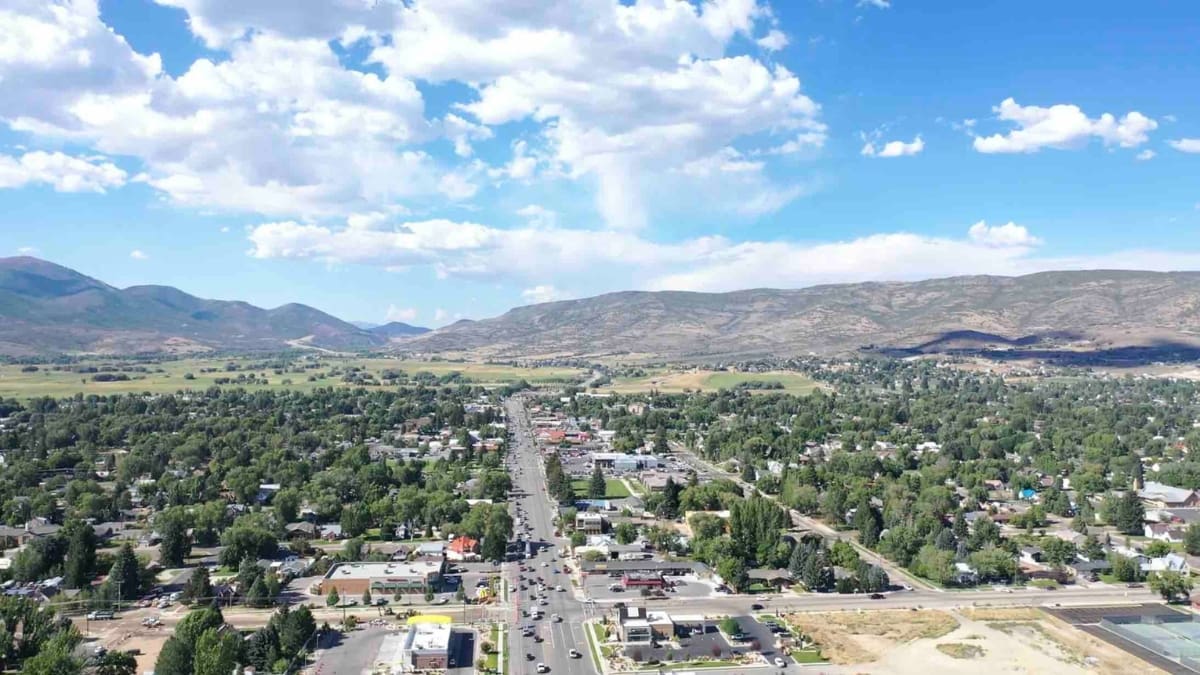
Photo: UDOT
HEBER CITY, Utah — The Utah Department of Transportation is evaluating design changes to the proposed Heber Valley Corridor after approximately 700 public comments were submitted, many raising concerns about the project’s impact on the North Fields and neighborhoods along 1300 South.
UDOT project manager Craig Hancock presented some potential design alternatives to the Wasatch County Council on Wednesday to address public concern.
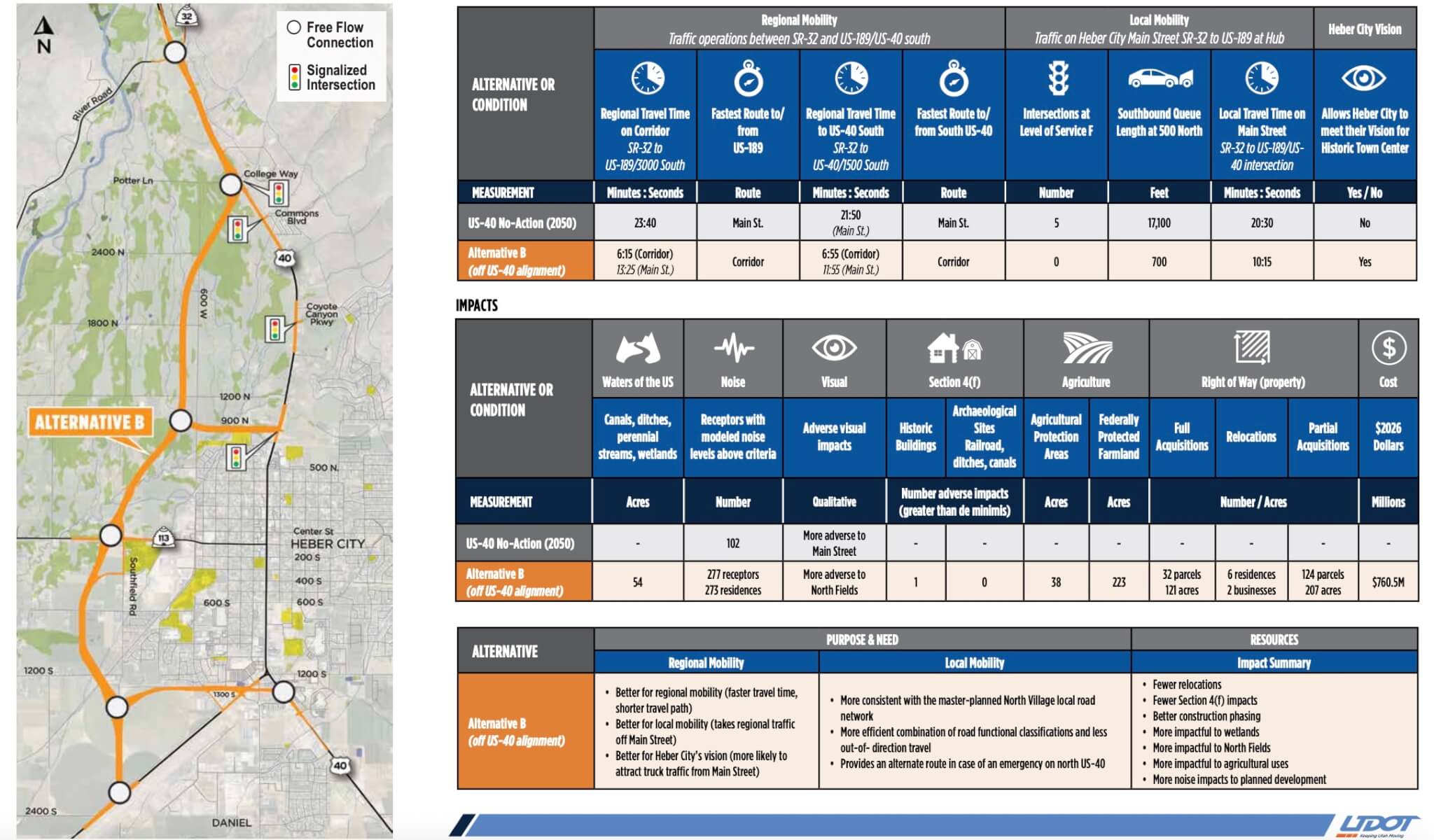
Many public comments urged UDOT to abandon its preferred Alternative B — which routes the corridor through the North Fields — in favor of Alternative A. Rather than completely reconsidering their preferred choice, the agency is looking at whether it can adjust the Alternative B alignment to reduce impacts in the areas that drew the most criticism.
Hancock described the potential changes as limited in scope.
“I call these alternatives. In reality, they’re more like design refinements,” Hancock said. “I don’t want to mislead anybody there, but it’s really just small adjustments in the design.”
What residents said
Impact on the North Fields — an area of agricultural land and wetlands on the west side of the valley — drew the most intense opposition. Under Alternative B, the corridor would cut through the area between Potter Lane and SR-113.
Adrienne Clyde, who identified her family as a seven-generation cattle ranch, wrote: “You will ruin the last bit of agricultural land and water ways just so Heber City can make something fit into their master plan . . . people will have land taken away that have been in their families for generations but Option A is less of an impact on lively hoods [sic] and the overall benefit of keeping the North Fields a viable agricultural area for Wasatch County.”
Ambrie Gordon-Carroll wrote: “The loss of farmland and the use of eminent domain to remove farm homes represents more than property acquisition. It represents the removal of history, livelihood, and identity from a place that many of us deliberately chose because of its rural character.”
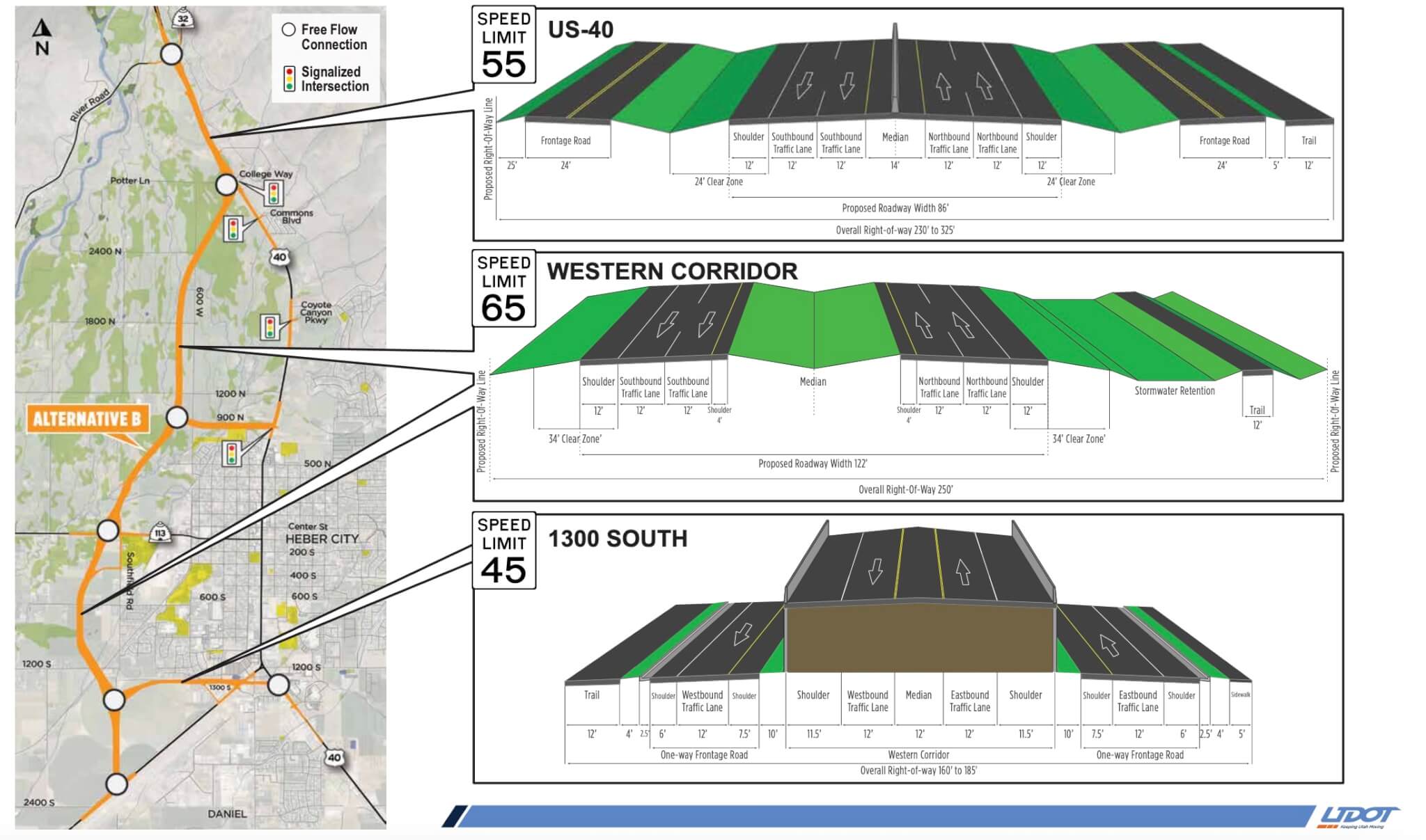
On 1300 South, where the design calls for elevated through lanes over existing streets, Brady Flygare, a homeowner on the corridor, wrote that the plan would create “permanent operational changes that would affect daily life along 1300 South for decades, including sustained noise exposure, visual intrusion, and continuous traffic activity.”
In a Feb. 3 letter to UDOT signed by Mayor Heidi Franco and all five council members, the Heber City Council stated it “would have preferred to see the South Highway 40 leg — planned to run along 1300 South — located further south through the undeveloped area to reduce impacts on residential and commercial properties along 1300 South.”
What UDOT is doing about it
Hancock said the agency is now reviewing whether the North Fields alignment can be shifted further east and whether the 1300 South segment can move further south. He made no commitments on either but said UDOT and Wasatch County are in regular communication and the agency is reaching out to stakeholders for input.
UDOT has also committed to expanding pedestrian and cyclist access at the SR-113 interchange, adding sidewalk, pedestrian crossings, and a bike lane in response to concerns raised by the county.
Why not Alternative A?
Despite public support for Alternative A, UDOT is not reconsidering the choice. The agency has said Alternative B requires fewer property relocations — eight compared with 27 — causes less harm to historic properties, and better diverts through traffic from Main Street. More on UDOT’s rationale for selecting Alternative B.
What’s next
UDOT is currently reviewing all formal comments and preparing responses, which will be published as part of the final EIS. The agency plans to release the final EIS alongside the Record of Decision — the document that formally selects an alternative — as a joint publication by the end of the year. Hancock said that timeline could shift depending on the outcome of the design reviews.
Once a Record of Decision is issued, the project would enter the state’s prioritization process for funding. There is currently no funding for final design, right-of-way acquisition, or construction. At this point, all state transportation funds are programmed through 2031, putting construction at least six years out. UDOT has said it will continue to update the Wasatch County Council on a regular basis as the process moves forward.
All draft EIS documents and public comments are available on the Heber Valley Corridor Project Website.
By: Laura M


7457 Buckboard Drive
Park City, UT 84098
2154 S Rio Verde
Moab, UT 84532
2475 W White Pine Lane
Park City, UT 84060
2400 E Walker Lane
Holladay, UT 84117
137 W Bridlewood Lane
Midway, UT 84049Talk of the Town


Park City Jobs
Head of Maintenance, Ptarmigan Property Services
3 days ago Full time $70,000 - $85,000 yearly


Sushi Chef, VR Inc
5 days ago Seasonal $26.00 - $28.00 hourly