Neighbors Magazines
Athlete of the month: Fili Liava

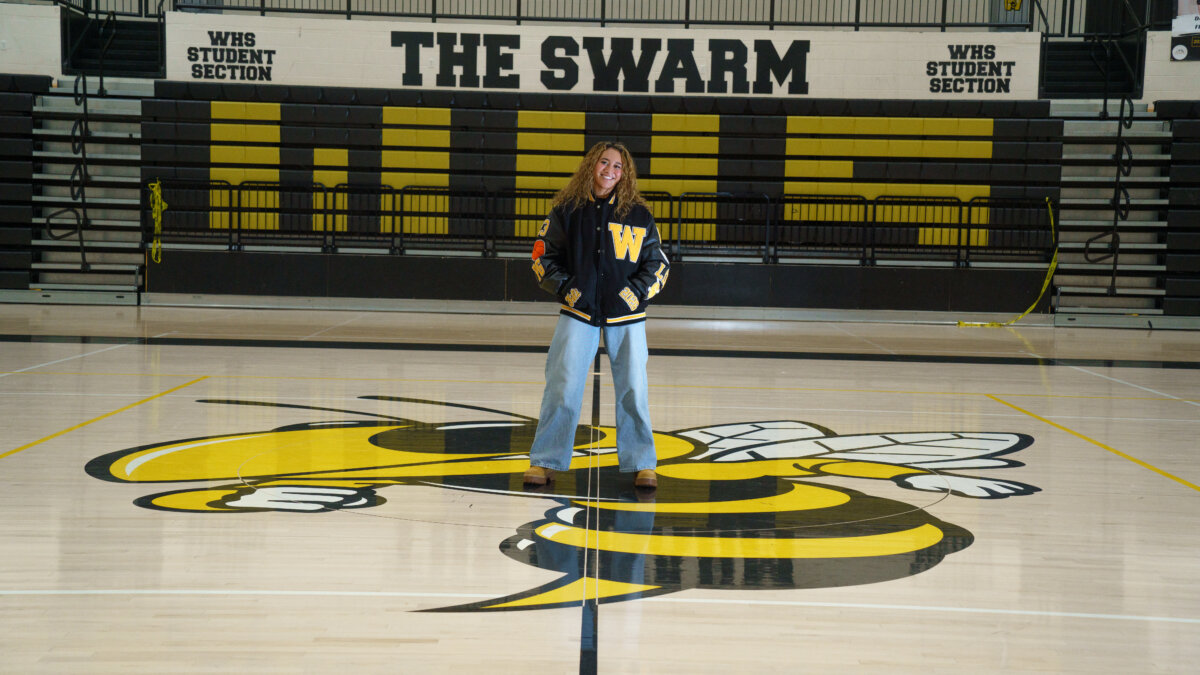
Photo: Neighbors of the Wasatch Back // Owen Crandall..
Inside The Bagel Den in Heber Valley, I take a seat in a corner facing away from the main entrance, positioning myself so that whenever the front door opens, a cold February breeze rustles my papers and makes me zip up my jacket. I get there a few minutes early, so I pull out my laptop and begin to organize the Neighbors magazines I always let my interview subjects look through.
After about five minutes, a sudden influx of teenagers enters, obviously on their lunch break, ordering bagels and filling the once-quiet room with constant conversation. Though I don’t attend Wasatch High School, I recognize much of the conversation, which is so similar to what I hear while walking down the hallways of Park City High. Constant chatter, new drama, and a certain energy towards life—almost a mix of excitement and despair for the future we are attempting to create.
With the crowd comes two girls, one with a lovely complexion framed with curly, bouncing hair, and another with a gentler face and a sweet expression. Somehow, we instantly catch sight of each other, and I know that this is who I’m waiting for: Fili Liava’a, with her supportive friend Brylee in tow.
I had first spoken with Fili on the phone a week prior, where I learned the beginning of her compelling account. I knew within the first moments of that call that we would need to meet in person; this was a story filled with far too much emotion. So, here I am, admittedly nervous at The Bagel Den, ready to learn more about this similarly aged peer, yet with such a different story from my own.
We start with her early childhood, as I try to chronologically understand her past. Her biological father, a college football player whose descendants are from the archipelago of Tonga in the South Pacific, met her mother at a Polynesian Dance Club in California. Quickly thereafter, at the age of 19, her mom—who is half-white, half-Samoan—gave birth to Fili.
The family of three moved to Oklahoma, where Fili’s father played for Oklahoma State, and where Fili’s younger sister was born. After a few short years there, they moved to Utah, in the Salt Lake Valley. Fili was now in kindergarten—her dad was in charge of dropping her off at school, but instead, he would leave her at her aunt’s house for the day, trying to flee the responsibility of picking her up. With tensions already high, this was the tipping point for Fili’s mom, who had been busy taking care of two kids and pursuing her cosmetology certification. So, she decided it would be best for Fili and her sister to live with their grandmother in California, where Fili spent some of her early elementary school years—before her mom joined them and after her husband decided to leave, right around Fili’s eighth birthday.
At this point, we are only to third grade in Fili’s story, and I already feel out of my depth. I was born and raised in the same house; I have never moved, let alone spent more than a week away from either of my parents. I’m unable to sympathize with 8-year-old Fili; I simply cannot relate. So, I take a breath, and I give Fili the floor—something she is incredibly good at. No matter the subject, she continues to be open, inspiring me with her vulnerability.
During Fili’s late elementary years in California, her mom met a pilot, who became her second husband. When his job took him to Salt Lake City International Airport, he—along with Fili, her younger sister, and Fili’s mother—moved back to Utah, this time to the smaller town of Heber Valley, where Fili attended middle school and most of high school.
On paper, this is Fili’s story; this is where she has been. But that “story” alone cannot be what made the strong, caring, and compassionate young woman conversing with me at this Heber bagel shop.
When I first met Fili, one thing that instantly stood out to me was how quickly she made me feel at ease. By the time she sat herself down across from me, she had learned what sports I played, asked me how my season was going, and quickly put a smile on my face. Even as we talked through her challenges, she would often take a pause and make eye contact, her face lighting up. It was as if she had taught herself grace inside of chaos—how to keep smiling and living when her conditions might have been an excuse to stop.
What has given Fili the resilience to keep going, I do not have a full answer to. But, I do think there are some key parts of her experiences, parts that gave her light when other aspects shriveled. One of these shining lights has been her mom. Though they have had their moments, Fili explains, her mother has always wanted the best for her, pushing Fili, especially when she could see she was struggling. Through her love, Fili knows that she cannot give up—her mom will always be her biggest fan.
Another continuity throughout her account has been sports. Through every move, every change in location and “parent figure,” sport has provided her with a connection point—a way to move her body, release her mind, and find reason to love.
The value Fili placed on athletics came before she could even play. It was something generational, something familial, especially through her life changes. For one, which we will come back to, there was her biological father. Then it was her grandmother, followed by her stepfather, and now herself, having finally found lifelong friends.
When Fili and her sister moved to California, her grandmother made an immediate effort to put the girls into any activity they wanted. At first, it was swimming for Fili, but after getting repeated double-ear infections, she began to look for another activity. Her grandmother had played volleyball throughout high school and at a community college, and together they began watching plays. So, in third grade, Fili started volleyball, driven by her relationship with her grandmother and the three years they lived together.
Fili’s stepdad moved the family back to Utah when Fili was in fifth grade, the year she tried out for the local volleyball team. Amazingly, she made the eighth-grade team, then started playing basketball. Initially, she seemed like any other elementary school kid, playing sports for the joy of it. But, when I ask Fili what she loved about these early memories, she explains that sports “had become a job”—from the time her dad left—acting as a “ticket out of the hole her family [was] stuck in.”

So, as Fili entered high school, the pressure she put on herself was immense. She “needed” the perfect everything: athletics, friendships, academics. This mindset did work for a while, as Fili reminisces on her “freshman prime.” For one, she excelled as an athlete. She played the libero position for the varsity volleyball team, in addition to being an outside hitter for all the freshman, sophomore, and JV games, which was unheard of. She had never played libero, where her job was to “talk to everyone.” She fell in love with the position, which involves calling out lines and seams, understanding the nuances of the game to instruct where to hit—giving her the rare feeling of being fully in control.
Basketball was similarly successful for Fili. She became a varsity guard, breaking Wasatch High’s losing record by helping the team reach the second round in State. As if she wasn’t busy enough, she was convinced by another one of her best friends to try out for the softball team. Borrowing her stepdad’s glove, in a sport she had never competed in, Fili was a natural, making the varsity team the day before they left for a meet in St. George, where she made a rushed purchase of cleats. With her stepdad’s glove on, a physical memento of their growing connection through sport, she hit a triple for her first-ever run. This freshman success continued beyond sports—she won homecoming attending, essentially “Freshman Queen,” and has maintained a 4.0 unweighted GPA.
Sophomore year started strong, as the volleyball team gained momentum, creating a winning record with a new coach, and hosting the first round of State. But as the days grew shorter and colder, it became difficult for Fili to get out of bed, to be motivated for each part of life that needed to be “perfected.” Fili started skipping classes, and even as she was getting A’s, her body was breaking down from the pressure she put on it during her unrelenting freshman year. But she didn’t stop. Instead, she poured more of herself into games, pushing herself and her asthma condition to the point where her face turned purple.
During State finals, where her team played Bountiful High, her biological father showed up. Seeing him and the masses of people cheering, she became overwhelmed: unable to complete passes, embarrassed to be performing poorly. After losing the game, she grew angry and decided again that she needed to do more, joining a new club—called “Utah Lady Prospects”—for the summer.
The summer and fall of junior year fared better for Fili’s mental health. Volleyball season was amazing; she had 563 digs and played in 26 games. During the last regional game before State, she accidentally stepped on the middle-backer’s hand and tore a ligament in her foot. Barely able to walk, Fili played two more games at UVU stadium, where the team took second place in all of Utah.
When basketball season started, as Fili was trying to bounce back from injury, her struggle with seasonal depression continued. Before the semifinals, Fili again felt overwhelmed, explaining she couldn’t “let her sisters [teammates] down.” That evening, Fili’s mom found her—engaging in self-harm—and rushed her to the hospital. The pressure had become too much. Fili was no longer the freshman star, where every success was new and exciting. She had fallen into the trap of perfection, where expectations could never meet reality.
This pressure surrounding sports is oftentimes disregarded. We, as a society, play up sports in youth athletes as offering only positive impacts. But that is not always the case. According to the National Library of Medicine, more than 91 percent of student-athletes report feeling stress associated with sport, while just 9 percent would consider seeking help from a medical professional. It can become a source of stress, instead of a relief, where a teenager tries to create a future path through a sea of never-ending, seemingly insurmountable pressure.
This isn’t to say that Fili’s sports have become a sole source of pressure. They have still given her the foundation for strong friendships, as well as space and perspective in forgiving her biological father.
After Fili’s hospital stay, her mom decided it would be best for her to stay with her biological father in Provo. So, for the last semester of junior year, Fili lived with her nine step- and half-siblings, whom she lovingly calls “sisters and brothers,” and enrolled at Timpview High School. This change was difficult; she had not been with her father since she was eight, and she was in a new community, missing her routine and her Wasatch High friends.
However, this opportunity gave her a chance for reconnection. Fili explains that when her dad loves, “he loves big.” Together, they would wake up at five in the morning to work out, and Fili began playing rugby, inspired by her dad’s football career. Athletics was a common ground for them to connect, a way for them to build a relationship where forgiveness could happen, one through which Fili finally understood that her father had been in a place of youth, so ashamed of leaving them that he couldn’t even look his family in the face.
Now, the “hole in the stands,” where she would look longingly for her dad, is filled with forgiveness. She has learned to focus on what he is doing now: showing up, checking in, and loving deeply.
Filled, also, by people like Fili’s best friend, Brylee—who, throughout our meeting, has sat patiently at her friend’s side, quietly glancing at Fili when the conversation got tough.
Everyone who loves her has filled this hole.
Fili Liava’a has committed to playing both basketball and volleyball in college this fall. Exactly what her future holds, no one knows. But I am certain that she will move through this unwavering world with resilience—resilience that is so apparent in the young, strong, beautiful young lady seated across from me at The Bagel Den.
By: Neighbors of Park City // Izzy Crandall


1548 W Woodsview Lane
St. George, UT 84770
1263 E Wild Maple Court
Draper, UT 84020
29 Marilyn Court
Park City, UT 84060
336 W Broadway Unit 201
Salt Lake City, UT 84101Talk of the Town


Park City Jobs

SOUS CHEF/COOK, Rebekah's Kitchen
3 days ago Full time $50,000 - $60,000 yearly

Live Like Sam: Marketing Manager, Live Like Sam
4 days ago Full time $60,000 yearly

Construction Assistant, Jorgenson Builders
4 days ago Full time $20.00 - $26.00 hourly

Business Development Specialist, Sky Digital Media
5 days ago Contractor $30,000 - $65,000 yearly

Barista, Baker, Salesperson, Kitchen Cleaner, Marvelli Artisan Breads
5 days ago Part time $18.00 - $25.00 hourly