The Shop that love built

Ninety years ago, when Park City was a mecca to ambitious prospectors with mine dust on their coats and dreams of gold and silver, and decades before the mountains became a leading lady for international recreation, the small town with dirt roads and a clapboard-clad Main Street turned its ambitions toward development, and a future outside of its humble mining roots.
With the progress of the Second Industrial Revolution and the accessibility of the automobile toward mass production in the 1920s, Park City took notice and responded with the construction of a building at the corner of 12th Street and Woodside Avenue, which would complement Park City High School, then home to nearly 1,200 students and the site of the current Park City Library.
The impressive 4,500-square-foot building designed by the architectural firm Scott and Welch, and constructed by the Paul Paulsen Company at a cost of $15,000, was made possible by the Works Progress Administration (WPA), an American New Deal agency that employed millions of job seekers to carry out public-works projects, including the construction of public roads and buildings, and ushering in goals in 1935 set by President Franklin D. Roosevelt under his post–Great Depression Second New Deal policies.
The grand structure was designated the Park City High School Mechanical Arts Building, which was officiated in a public gathering on December 4, 1936, with the goal of teaching local students the skills of woodworking, drafting, working processes for both cold and hot metal, and auto mechanics. The building quickly became known as “The Shop,” a moniker that holds today and stays relevant to its original roots through 1981, when Park City built and moved its high school to Kearns Boulevard, thereby shuttering the original Old Town buildings.
But the story doesn’t end there. With boarded windows and a roof full of holes, and having sat vacant for more than nine years, the once impressive Moderne-style structure became a curiosity and an eyesore, with city officials wondering what to do with the decaying commercial building sitting idle within the quickly emerging residential district around its site at 1167 Woodside Avenue. Fortunately for Park City and its surrounding communities, one person’s trash is indeed another’s treasure, and the building’s storied past was fated for a new chapter with the advent of a young, ambitious architect new to town, posing a clear urban vision and having a heart for history.
The Young Visionary
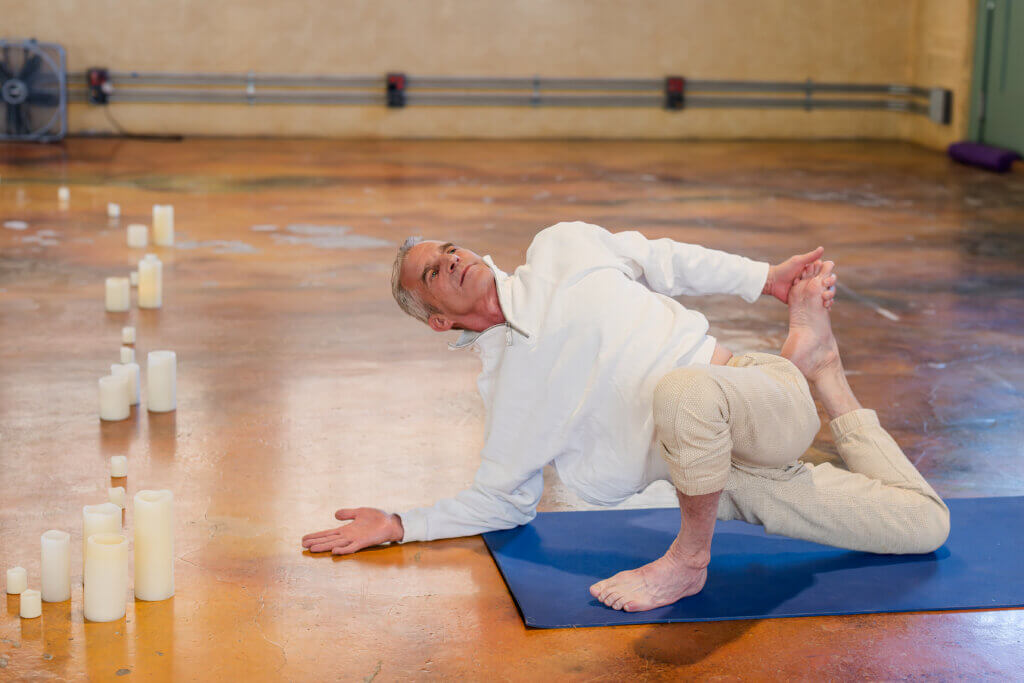
With his signature yoga pants and always present smile, David Belz, now in his mid-sixties, is one of those small-town characters instantly recognized, both a local celebrity and described by many as somewhat of an enigma. But in 1990, he was a 30-something—a long-haired, Berkeley-educated urban architect arriving on the scene in a car jammed with clothes and skis, a hunger for the mountains, and an inspired future in a ski town full of promise.
Born in Memphis in 1959, the third child and youngest son to his mom and architect dad, David knew loss at a young age. When he was four, his father was tragically killed in a plane crash; a few years later, he moved with his family to Nashville after his mom remarried. Always an entrepreneur, he recalls his childhood studying at the Peabody Demonstration School as productive. “I was a photographer for the yearbook and found out they were paying the local drugstore 50 cents to process each photo. I built a dark room at home, so I said, ‘I can do it for 25,’” he laughs.
In 1977, David enrolled at the University of Florida to study architecture, following in his father’s footsteps and honoring a bond cut short, while staying close to his brother and sister, who also lived in the Sunshine State. “I had done drafting and had a feeling that was where I was headed. With my dad dying when I was so young, it was probably an unconscious desire to create a connection where I didn’t have one,” he recalls.
Following a two-year stint at an architectural firm in Atlanta working for renowned architect John Portman, he earned his master’s degree at UC Berkeley, after also being accepted to Harvard and MIT. “At Berkeley, they gave you the freedom to choose your curriculum, and mine focused on large-scale urban design, so I loved that,” David says. His thesis included designing and building a scale model of 25 blocks of downtown Memphis. “I was hooked,” he recalls. That passion for urban design would come into play in just a few years.
The Martial Artist
It was during his undergraduate years that David began a lifelong journey into martial arts, a path that also marked his first steps into yoga and a life devoted to the pursuit of the Divine. A self-described late bloomer, David recalls his entry into more individualized activities. “I was never into team sports; in fact, I was the kid they argued over who had to have me,” he laughs. “But Gainesville had an amazing skate park, and I got pretty good at it. I skated for hours every day, but after several broken bones, I hung it up.” That decision led him to his first foray into what he describes as “divine intervention.”
“I ran into a new friend at a campus pool who was stretching,” shares David, “and he invited me to come down to Dragon Gate Dojo, and so I did.” For the next 30 years, martial arts became central to not only his physical strength, but a spiritual one as well. He studied different philosophies and styles, becoming a devotee, earning a black belt, and pursuing teaching of both Cuong Nhu and Shotokan Karate.
The Pilgrimage and the Road to Home
Following his years at Berkeley, David moved back to Memphis to spend time with family, yet he knew from the age of 14 and from a trip to Colorado that he would eventually call the mountains and “somewhere in the West” home. That quest led him to travel extensively to ski towns from Bend, Oregon, and Sun Valley to many other resort communities to find his “place.” He had been traveling to Park City since 1977 to stay with local developer Ira Sachs, also from Memphis and a friend of his late father. In his own words, the road leading him to Summit County was also what he attributes to divine intervention, a belief that began to inform his choices—and his life.
“I knew unequivocally at some point in my life,” says David, “when I got through with this and that, that I was going to move to the mountains; that’s where I knew I wanted to be. On many things, like ‘Do I paint it beige or teal,’ I can sit there unable to choose, what I call ‘analysis paralysis,’ but on most of my major life decisions, there was a certain knowing that was always there.”
Reviving a Legacy
Not one to waste time, David quickly secured a large parcel at the corner of Park Avenue and 8th Street, with goals of building an upscale development of eight homes, including the refurbishing of three historic buildings sitting on the lots. But the eventual multiyear pushback from the municipal district on his ambitious plans proved to be both a blessing and a curse. While that project was steeped in delays, in 1993 he turned his sights toward the abandoned warehouse at the corner of 12th Street and Woodside. The Shop, owned by the school district, had been on the market for more than nine years, listed at $210,000. David looked past the broken windows and weighty rehab and signed a contract, moving forward with a crew of five to restore the building to its original glory.
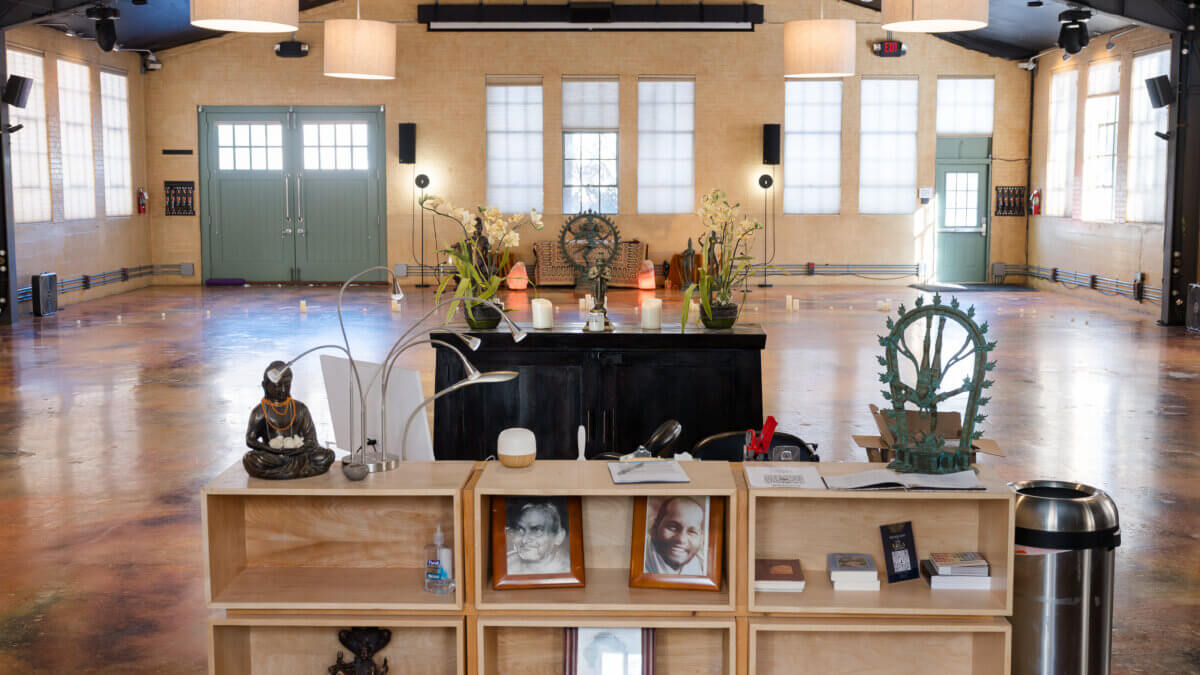
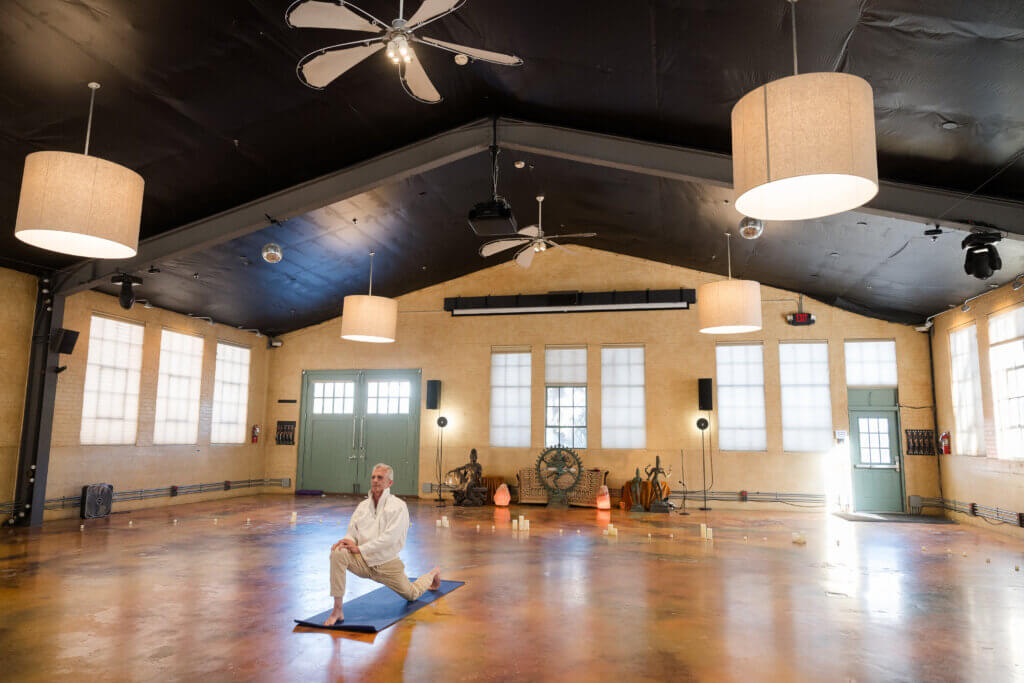
The two-and-a-half-year planning and one-year rehabilitation process included a new roof, reinforced footings, and the addition of heated concrete floors, with a glossy finish of multiple layers of aniline dyes resembling a luminous nebula. Not one to shrug off history, and with an obsessive eye for detail, David hired Interstate Brick to re-create the historic brick used in the main structure to construct a second building that sits on the back of the lot. His final touch was the creation of a Japanese-style meditation garden on the property, with manicured flora, a waterfall feature, and a koi pond. There, he housed his office and welcomed the community, continuing to teach karate. On November 7, 1996, The Shop was added to the National Register of Historic Places (NHRP), one of nearly 100 buildings to earn the accolade.
The Yogi
David had also continued his karate practice, teaching at the Prospector Athletic Club (now the Silver Mountain Sports Club), and began incorporating Ashtanga Yoga into his routine, quickly recognizing the benefits of adding strength and flexibility to his practice. But it was due to his uphill struggles with the city on his planned larger residential project, and the violent death of one of his dogs by a neighbor, that one day led him to his puja in a plea that would move his life in a new direction. “I had hit a wall, and I went to my altar and said, ‘I give up…thy will be done,’” he recalls. “And I said, ‘Oh, and by the way, bring me a teacher and make it dramatic.” Three weeks later, the universe would answer.
It was an invitation extended in 1999 to host a workshop for Anusara Yoga founder John Friend—whom David had met in Estes Park, Colorado—another defining moment in David’s belief in a higher power. “I had already gotten an energetic blast in Colorado at the Yoga Journal Conference. I felt stoned and blissed out. I didn’t know what it was at the time, but some would call it ‘Kundalini’ or ‘Shakti Pat.’ When John showed up at The Shop with a hundred other yogis, I got blasted again for a week,” he recalls. He fully understood that this was the teacher he had asked for.
For the next 20 years, David would become fully entrenched in the Anusara brand of yoga, teaching multiple classes a week, mentoring other practitioners, and hosting hundreds of workshops, speakers, musical gatherings, sound baths, dances, and multiday events from yogis from all over the world. For nearly two decades, The Shop became synonymous with the practice of yoga in Park City, prior to the pandemic and the expansion of other studios in the area.
In addition to offering yoga-based activities, The Shop hosts other community events, large and small, including weddings, lectures, corporate gatherings, nonprofit fundraisers, and, every January, the international audience of the annual Sundance Film Festival.
For David, it has always been about community. For nearly two decades, classes were taught on a donation-based, “give what you can” basis, supplemented by David and his personal desire to give back. “I have been blessed to provide the teachings through classes, and opening the studio to the community was my way,” he says. “Park City has been my home, my life force, and I’m so grateful to have made my life here. I never wanted yoga to be something someone couldn’t afford to do.”
Mary Allen, a former instructor at The Shop for more than 15 years, recalls what David, and the Old Town studio, meant to her. “It was truly my saving grace and to be a positive part of someone’s life, to help another person; THAT is the true gift. David always knew this. He was the catalyst for all of it by designing this beautiful sacred space and building this loving community,” she says.
As David looks ahead to the future of The Shop, he gets sentimental. “The building is almost a hundred years old. It will be here long after I’m gone, and I believe its true legacy is a tribute to Park City. It represents its past, present, and future. I’m glad I could be a part of preserving a slice of history.”


2266 E Garfield Avenue
Salt Lake City, UT 84108