Olympics
What is Slippery Fish? A secret project to win Olympic speedskating medals with help from an app


From front to back, United States’ Casey Dawson, Emery Lehman and Ethan Cepuran skate to a new world record during the men’s team pursuit at a World Cup speedskating event, Nov. 16, 2025, in Salt Lake City. (AP Photo/Tyler Tate, File) Photo: AP Photo/Tyler Tate, File
This article was written by Howard Fendrich.
MILWAUKEE (AP) — All it took was the mere mention of the words “Slippery Fish” for U.S. Speedskating national team coach Ryan Shimabukuro to purse his lips and shake his head.
There wasn’t even a full question asked about the secret project using computer technology aimed at shaving fractions of a second off speedskating times to help the Americans bring home gold medals from the Milan Cortina Olympics. Just those four syllables were enough to catch Shimabukuro off-guard a little more than a month ahead of the Feb. 6-22 Winter Games.
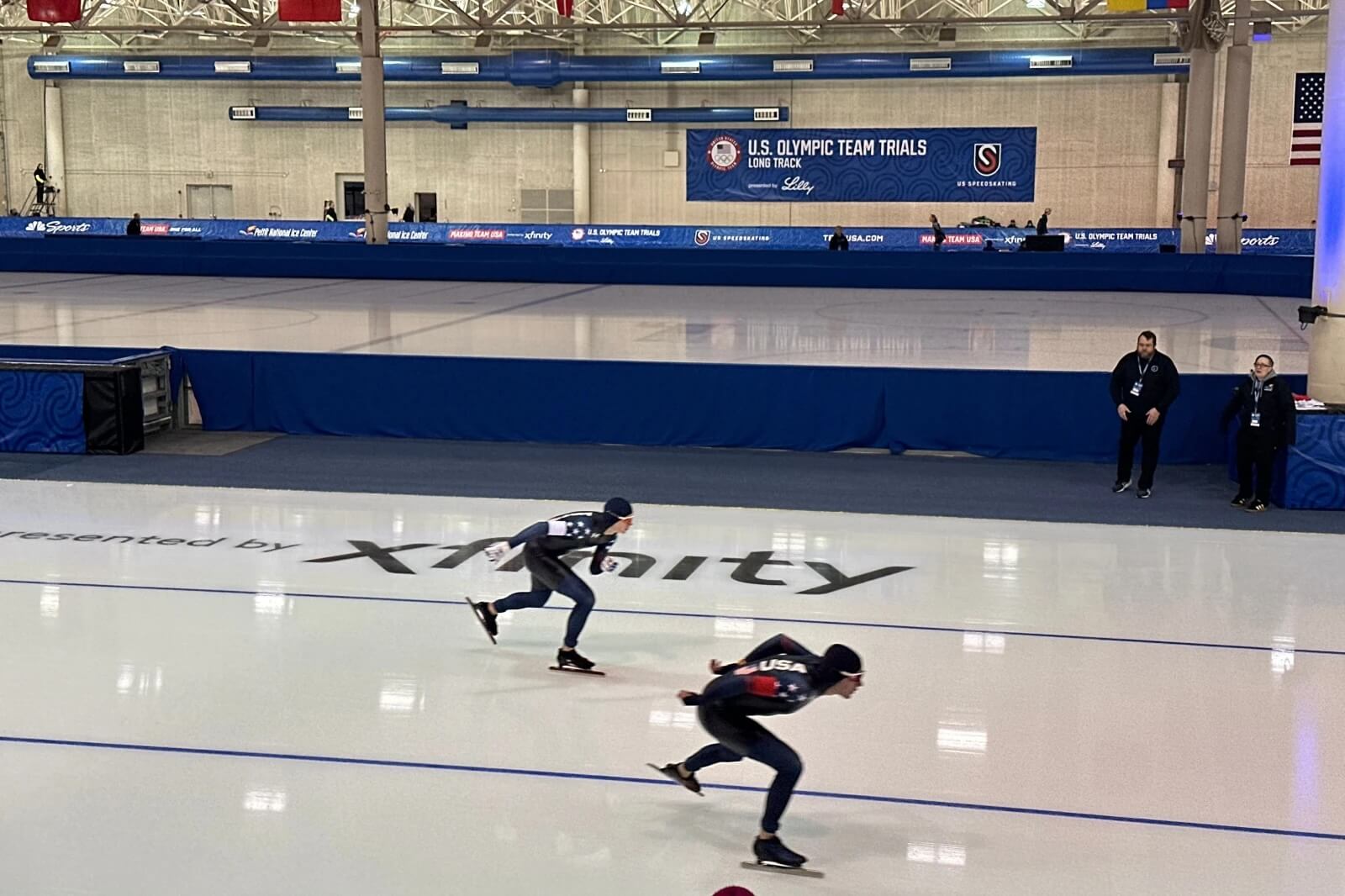
“No comment. I don’t know how you even know about that,” said the genial Shimabukuro, who otherwise was forthcoming about all manner of topics during an interview with The Associated Press about his team and his sport while sitting in the stands at Milwaukee’s Pettit National Ice Center, site of the Olympic trials for long trackin January.
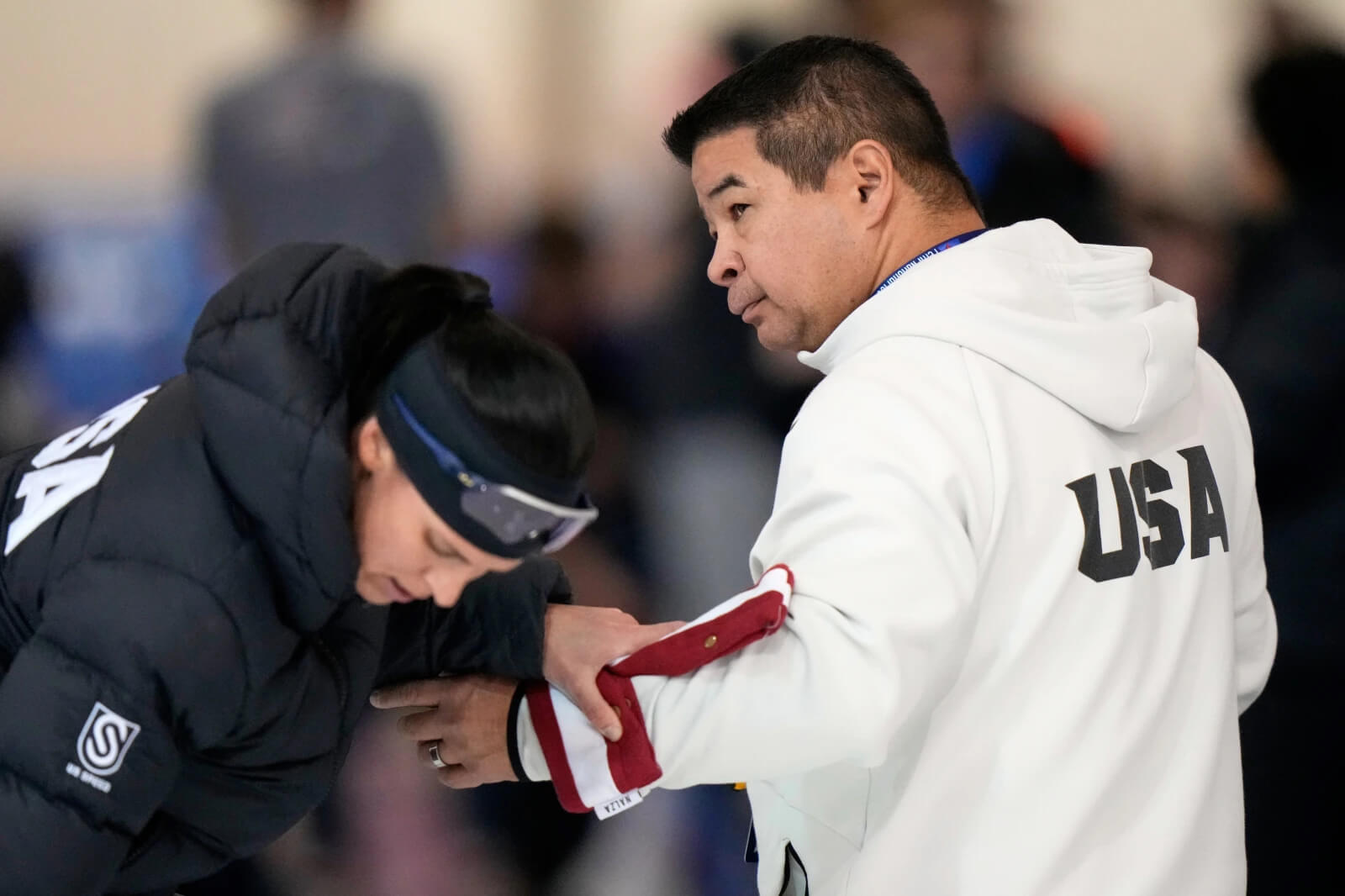
“No comment. Nope. Nope,” Shimabukuro said. “Respectfully, no comment.”
So what, exactly, is Slippery Fish? And why would Shimabukuro — and some other folks connected to the American team — be so tight-lipped about it?
Using an app to make U.S. speedskaters faster
According to Shane Domer, U.S. Speedskating’s chief of sport performance, the idea behind the program was to increase athletes’ aerodynamic efficiency by reducing the amount of drag they create pushing against the air during a race.
For years, speedskaters, like cyclists, trained in wind tunnels to study that phenomenon.
Now, Domer explained, it happens virtually: An app lets skaters scan their bodies, creating a “digital twin.” The software simulates wind passing over the avatar, computational fluid dynamics calculate how much resistance there is — and how tweaking a skater’s form alters that.
“We can basically say, ‘How much faster will the avatar be in this position vs. that position at a certain speed?’ You’re trying to make someone a little bit slippery through the air,” Domer said about the work that began in 2023 at a cost approaching $100,000.
“Significant performance benefits from small changes: changing the head position slightly, changing the way your shoulders are positioned, elbow positions,” he said. “You’re talking about tenths of a second per lap in a sport where we look at hundredths or thousandths.”
U.S. long distance coach Gabe Girard said they’ve seen improvements from raising both arms in corners instead of only in straightaways.
“We’re always hoping to bring something a bit out of left field to catch people off-guard,” Girard said. “There’s also ‘mental warfare’ about it and makes people guess if they should (do) it.”
Speedskating secrets at the Olympics
As with other sports, successful speedskating innovations get copied.
At Beijing in 2022, the U.S. men won their first Olympic speedskating medal since 2010, a bronze in team pursuit. That was thanks to a revolutionary change developed by the not-so-creatively-named Project Push: The team’s three racers remained in the same order and pushed the leader of the trio, instead of rotating who led.
But the Americans debuted that two years earlier, and other countries soon adopted the same strategy. “We unveiled it too early,” Domer lamented.

“I don’t think they understand the mechanics and the math behind it,” he said. “We have made small changes to the way we’re executing it, based on what we have learned from Slippery Fish.”
Indeed, the U.S. holds the world record and Casey Dawson, Ethan Cepuran and Emery Lehman are favored for gold on Feb. 17.
Lehman said the 3-D modeling fostered better understanding of the ideal spacing between the three racers.
“We’re thinking about things analytically,” Lehman said. “We definitely have some niche things that we do that we try not to share with other people.”
Does Jordan Stolz use Slippery Fish?
Slippery Fish mostly is being used for team pursuit and long-distance events like the 5,000 or 10,000 meters.
“We were going to work on a program for more of the sprint side, but I had a little too much on my plate to kind of spearhead that project,” said Erin Jackson, who defends her Olympic 500 gold Feb. 15. “Hopefully that’s something we can get more into” before the 2030 Games.
Domer said “a lot” of U.S. skaters and coaches have been shown what Slippery Fish can do. “Some have made changes,” he said. “Some have not.”
The world’s best speedskater at the moment, Jordan Stolz, who excels at shorter distances, hasn’t taken advantage.
“It’s not something that I really got into — changing your technique to be more ‘aero,’” Stolz said. “Everybody skates so differently. If somebody is more ‘aero’ … I don’t know if I would be changing my technique to try and match them.”
Tech will fuel future speedskating changes
U.S. Speedskating has redesigned helmets — including one revealed at the 2022 Games — and employs technology to improve performance in other ways.
Cutting Edge is for skate blades. Iron Fist focuses on weighted gloves. New uniforms will arrive, eventually.
“It’s really hard to change someone who has been training a certain way their entire life, and then you ask them to do something that makes skating feel different. That’s a tough sell,” Domer said. “But I do think we’ll see crazy new things at the next Olympic Games.”
By: Associated Press


80 West 300 North
Salt Lake City, UT 84103
438 Castle Valley Drive
Castle Valley, UT 84532
3267 W Deer Hollow Road, Unit 2305
Park City, UT 84060
2349 S Lava Vista Drive, Lot 32
Santa Clara, UT 84765Talk of the Town


Park City Jobs

Junior Interior Designer, Abigail Hill
4 days ago Contractor

Dental Assistant, Rise Dental Wellness
4 days ago Full time

Sales & Marketing Coordinator – B2B Publishing, Power Trade Media
6 days ago Full time $40,000 - $45,000 yearly

Garden Steward and Educator, Summit Community Gardens and EATS
11 days ago Seasonal

PROGRAM AND EVENT COORDINATOR, PC READS
12 days ago Part time $25.00 hourly