Moab groundbreaking kicks off long-term Utah Trails Network vision

MOAB, Utah — State and local leaders gathered in Moab this week to break ground on a key section of the Utah Trails Network, a long-term effort to connect trail systems across the state and expand access to outdoor recreation.
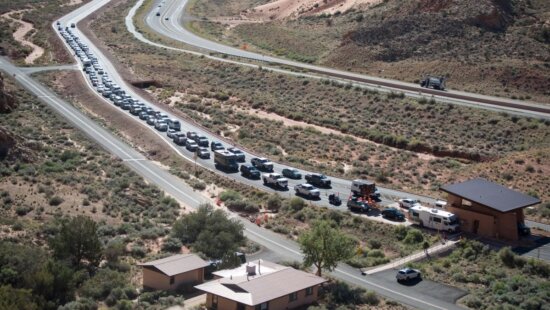
The Moab project will create a 0.7-mile trail connection along State Route 128, closing a long-standing gap in the Colorado River Trail, where people today are forced onto a narrow stretch of highway with little to no shoulder. Officials say roughly 30,000 users each year encounter gaps that prevent them from safely reaching town.
Speaking at the event, Governor Spencer Cox framed the project as part of a broader vision to link Utah’s extensive but often disconnected trail systems.
“Almost all of those trails exist in their own ecosystem. They don’t connect to anywhere,” Cox said. “How incredible would it be if we very intentionally started to connect those trails together in a way that would lift the experience — not just for people visiting our state, but especially for the people who live here.”
The project is the first of more than 20 Utah Trail Network projects currently in development across the state, focused on creating new regional trails, connecting existing trails, and closing challenging gaps.
“We look at this kind of the way we do the interstate highway system,” Cox said. “This is a project that we hope will outlive us.”
A 20-year vision with no true endpoint
State officials described the Utah Trails Network as an evolving, long-term initiative, with a current 20-year roadmap but no defined finish line.
The goal, leaders said, is to continuously expand connectivity between communities, recreation, and transportation corridors.
In Wasatch County, leaders have published a feasibility study for paving the Deer Creek Reservoir Trail as part of the Utah Trails Network. The trail is currently gravel and connects Wasatch State Park to the Deer Creek Dam along the west side of the reservoir.
While the feasibility study has been completed, UDOT officials note that construction is dependent on funding and may not begin for up to four years in the future.
Collaboration across agencies
Speakers repeatedly pointed to collaboration between state, local and federal partners as a key factor in moving the initiative forward.
Funding has come through legislative appropriations as well as programs like the Utah Outdoor Recreation Grant.
Construction on the Moab trail is expected to continue through the coming months, with officials suggesting completion could come as soon as this fall.
Even as crews work to close existing gaps, leaders emphasized that the broader Utah Trails Network will continue to expand.
“The idea is that we have an ongoing program to keep building this out,” Cox said. “Just like we do our roads.”


2266 E Garfield Avenue
Salt Lake City, UT 84108