Town & County
Summit County holds at one measles case while state outbreak grows

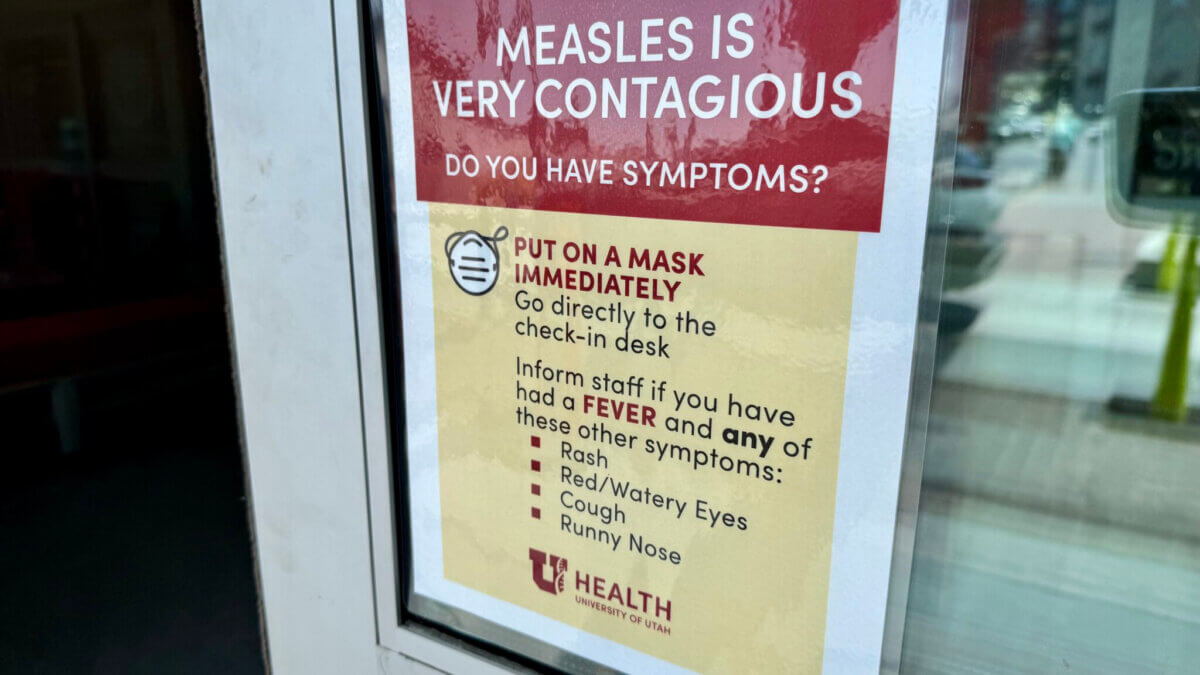
A University of Utah health clinic with a sign warning of measles is pictured in Salt Lake City on June 30, 2025. Photo: McKenzie Romero/Utah News Dispatch
PARK CITY, Utah — Summit County health officials told the Board of Health on Monday that no additional measles cases have emerged following the county’s first confirmed infection this winter. Early coordination with schools and families appears to have prevented wider spread, officials said.
“We have still just the one case,” epidemiology staff told the board during the Feb. 2 monthly meeting, adding that the county had passed the expected exposure window without identifying any secondary cases linked to the initial infection.
The first measles case in Summit County this season was confirmed Jan. 10 in a student in the South Summit School District, with potential exposures at South Summit Elementary School on Jan. 5, according to the Summit County Health Department.
The county’s response contrasts with broader state trends. Utah’s outbreak response dashboard lists 237 Utah residents diagnosed in the current outbreak, including 54 identified in the last three weeks, as of its most recent update.
Why Summit avoided secondary cases
Health officials credited advance planning with school partners — including a pre-established “blueprint” for how notifications, roles, and communications would work if a case appeared — and cooperation from parents who kept exposed students home when asked. Officials emphasized that the county’s response plan was built before Summit’s first case was confirmed.
The board also heard a brief update on surveillance signals. Staff reported a single measles-positive wastewater detection in mid-January in the Snyderville Basin/East Canyon sampling area and said subsequent results did not show a second positive at that location. Utah’s wastewater surveillance system indicates if the virus is present in a sewer shed, but it does not directly translate into case counts.
Related legislation during outbreak
The measles discussion comes as health officials monitor legislative proposals that could affect future outbreak response. Health Officer Dr. Phil Bondurant told the board that legislation that would have removed Utah’s required vaccine-education module for families seeking school immunization exemptions did not advance out of committee.
The proposal, House Bill 152, failed to pass out of the House Health and Human Services Committee, according to legislative tracking summaries and committee reporting.
Bondurant described the bill’s failure as a positive development for outbreak management. The current exemption process — including the paperwork and education requirement — helps schools and health officials understand which students are not fully vaccinated and respond more quickly when a contagious disease is introduced into a school community, he said.
“That is a win,” he told the board, referencing the bill’s failure to move forward. Retaining the exemption framework supports the county’s ability to offer protections during outbreaks, he said.
What residents should know
Measles is highly contagious and can spread through the air when an infected person coughs or sneezes, with transmission possible even after an infected person has left a room, according to Utah Department of Health and Human Services guidance.
Summit County health officials have urged residents to check vaccination status and follow school or health department instructions during exposures. The county’s Jan. 10 notice about the South Summit case said the department was working with the district to notify families and limit further spread.
The Board of Health will continue receiving legislative updates and communicable disease briefings at its next meeting in early April.
By: Rebecca Brenner


4155 S Parkview Drive
Salt Lake City, UT 84124
1104 West 10125 South
South Jordan, UT 84095
4028 E Outcrop Road
Park City, UT 84098
4170 Vista Antigua Road
Moab, UT 84532
1355 E Snow Canyon Parkway, Lot 27
Ivins, UT 84738Talk of the Town


Park City Jobs

Junior Interior Designer, Abigail Hill
6 days ago Contractor

Dental Assistant, Rise Dental Wellness
6 days ago Full time

Sales & Marketing Coordinator – B2B Publishing, Power Trade Media
8 days ago Full time $40,000 - $45,000 yearly

Garden Steward and Educator, Summit Community Gardens and EATS
13 days ago Seasonal

PROGRAM AND EVENT COORDINATOR, PC READS
14 days ago Part time $25.00 hourly