Town & County
Clark Ranch at a crossroads: Leaders weigh the 10-acre housing footprint

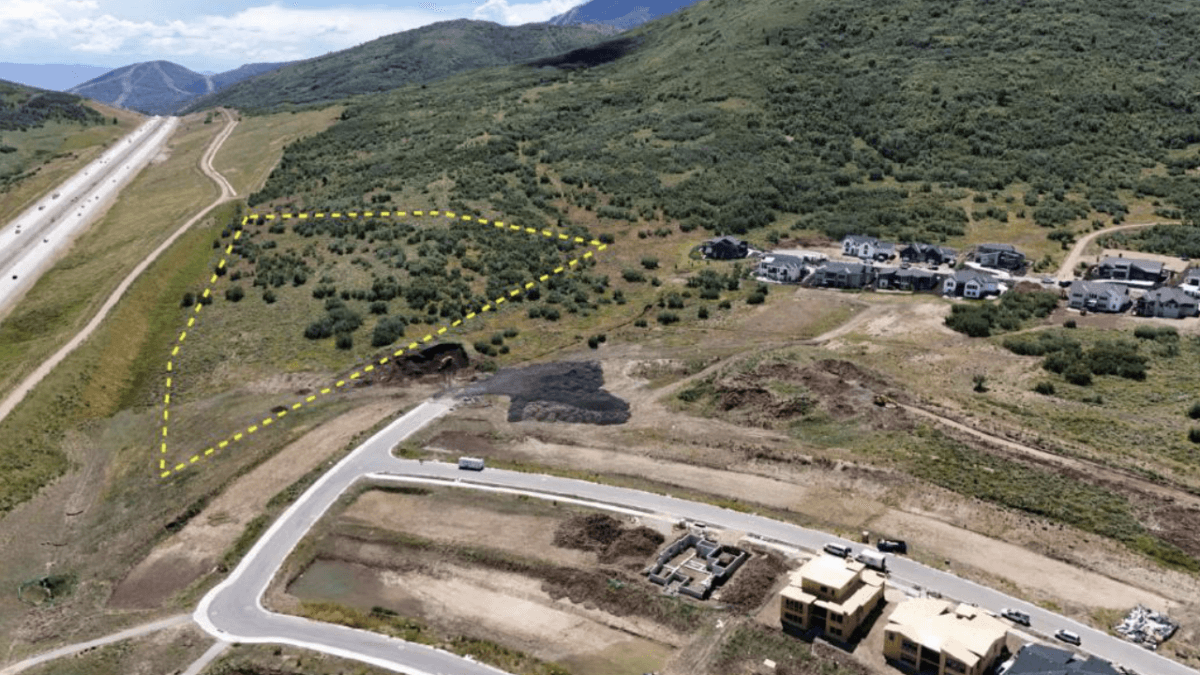
An aerial view shows the Clark Ranch hillside near Quinn’s Junction, with a yellow dashed outline marking a proposed 10-acre development footprint discussed by Park City officials and planning commissioners. Photo: Park City Municipal Corp.
PARK CITY, Utah — Park City officials on Tuesday weighed where to place a 10-acre affordable housing site within a 15-acre carveout at Clark Ranch, a decision that will shape both the project’s visibility on the hillside and how much of the surrounding land is ultimately locked into permanent open space protection.
The joint work session between the City Council and Planning Commission was held Feb. 3 and was focused on narrowing location options before the city restarts a rezoning process for the development footprint.
The discussion comes weeks after the city approved a conservation easement that TownLift reported permanently protects 329 acres of the 344-acre Clark Ranch property, leaving 15 acres outside the easement because of the planned housing project. The city’s open space advisory committee, COSAC, supported an easement over the property while excluding up to 10 acres for an affordable housing proposal.
Triangle vs. open-space buffer
At the center of Tuesday’s meeting was a choice between a “triangle” 10-acre development area closer to Park City Heights and “open space buffer” options that shift the 10 acres farther south, creating a larger undeveloped buffer between Park City Heights and the new housing.
Under the triangle concept, the development footprint is clustered nearer Park City Heights and lower on the hillside, which staff said could reduce visual impact and minimize encroachment into areas identified as wildlife habitat in the application materials.
Staff described trade-offs with the buffer concepts: pushing development south would create an open-space buffer from Park City Heights and provide more flexibility for site design, but would move construction farther up steeper slopes, increase visibility and grading disturbance, and potentially reduce wildlife habitat, according to the meeting packet.
Unit counts and building heights are under discussion
During the work session, city staff and the development team walked councilmembers and planning commissioners through several conceptual development scenarios to illustrate what different 10-acre footprints could support. The scenarios varied by building height — generally ranging from about 28 feet to 35 feet — and by how the housing would be distributed across the site, from more numerous smaller buildings to fewer larger ones.
Under one concept clustered closer to Park City Heights, the team discussed a roughly 138-unit scenario that paired multi-unit buildings with a set of townhomes. Under the “open space buffer” concept, shifting the footprint farther south, the team discussed a wider unit range — roughly in the 120s to 160s — depending on building height and massing.
Officials stressed the goal of the joint meeting was not to approve a final design, but to narrow in on the preferred 10-acre location to guide the rezoning path and the more detailed design work that would follow.
Why the SLO matters
The area proposed for rezoning sits within Park City’s Sensitive Land Overlay (SLO), which is intended to preserve environmentally and aesthetically sensitive lands, including wildlife habitat, and restrict development on ridgelines, steep slopes, and wetlands. City code also requires applicants in the SLO to submit a sensitive land analysis and contemplates wildlife habitat reporting by qualified professionals as part of the review process.
The Clark Ranch proposal has been under sustained public and commission scrutiny in prior hearings, including concerns about hillside massing, density, and design compatibility near Park City Heights, as TownLift previously reported.
No vote was taken on Tuesday. City staff and the development team said the next step is refining a preferred 10-acre footprint to guide the rezoning effort and future design review.
By: Rebecca Brenner


4155 S Parkview Drive
Salt Lake City, UT 84124
1355 E Snow Canyon Parkway, Lot 27
Ivins, UT 84738
4170 Vista Antigua Road
Moab, UT 84532
1104 West 10125 South
South Jordan, UT 84095
4028 E Outcrop Road
Park City, UT 84098Talk of the Town


Park City Jobs

Junior Interior Designer, Abigail Hill
6 days ago Contractor

Dental Assistant, Rise Dental Wellness
6 days ago Full time

Sales & Marketing Coordinator – B2B Publishing, Power Trade Media
8 days ago Full time $40,000 - $45,000 yearly

Garden Steward and Educator, Summit Community Gardens and EATS
13 days ago Seasonal

PROGRAM AND EVENT COORDINATOR, PC READS
14 days ago Part time $25.00 hourly