Environment
Northern lights possible tonight as NOAA issues severe geomagnetic storm watch

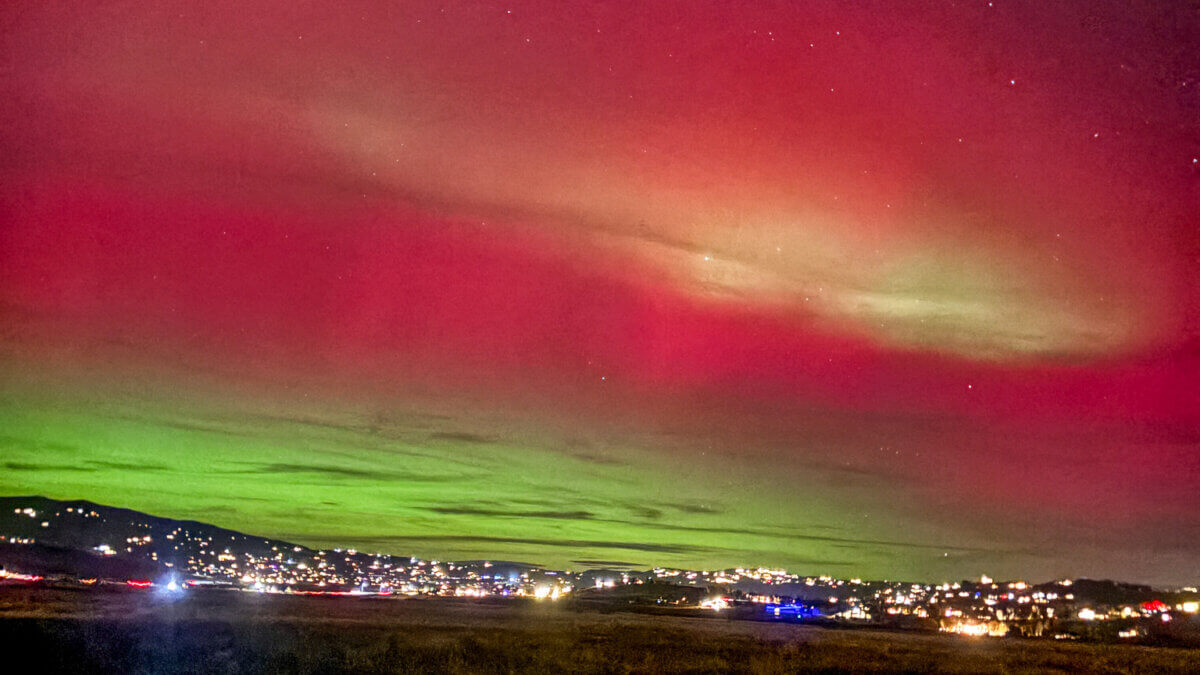
Aurora borealis glows above Park City’s skyline on November 11, casting vivid green and pink hues during a rare geomagnetic storm. Photo: TownLift
PARK CITY, Utah — If you’ve been looking for an excuse to step outside and scan the northern horizon, tonight might deliver it.
NOAA’s Space Weather Prediction Center issued a G4 (severe) geomagnetic storm watch for the Jan. 20 UTC day, tied to an Earth-directed coronal mass ejection launched from the sun on Jan. 18. NOAA said the CME could arrive as early as late Jan. 19 Eastern time, with storm levels initially ranging from minor to strong before potentially intensifying.
Space.com reported the incoming CME could push auroras unusually far south and that NOAA forecasters expect conditions capable of producing northern lights visibility in 24 states, with the forecast “view line” extending as far south as Colorado.
For Utah skywatchers, that’s the key: Colorado’s inclusion suggests the viewing line is brushing the interior West, but Park City and Summit County sit south of the typical cutoff. That means the odds here are lower, and any aurora, if it appears, may be faint and concentrated low on the northern horizon. Still, locals are watching closely. Meteorologist Chase Thomason urged neighbors to “find a spot away from city lights” after dark and keep an eye on the sky.
Whether Utah sees much depends on the CME’s magnetic orientation when it arrives. Space.com noted that if the CME’s magnetic field aligns southward, it can couple more effectively with Earth’s field and drive stronger geomagnetic storming; a northward orientation can blunt the effect.
When to look in Utah
NOAA reported the strongest storming is currently forecast between 1 a.m. and 4 a.m. Eastern (Jan. 20). That translates to 11 p.m. to 2 a.m. for Utah (Monday night into early Tuesday). Conditions may fluctuate, and earlier activity is possible after full dark.
How to improve your chances
NOAA’s aurora products emphasize the basics: get away from city lights, find a clear view north, and watch in real time as forecasts update.
A few practical tips:
- Go darker than you think you need to. Even a small amount of light pollution can wash out a weak display.
- Use your phone camera. Night mode can reveal faint green bands before your eyes register them.
- Give it time. Let your eyes adapt to the dark and keep checking — auroras can surge, fade, and return.
One more note: if you head out, bundle up, park safely, and avoid stopping on road shoulders.
By: Rebecca Brenner


325 White Pine Canyon Road
Park City, UT 84060
2349 S Lava Vista Drive, Lot 32
Santa Clara, UT 84765
438 Castle Valley Drive
Castle Valley, UT 84532
1511 S Valley View Circle
Springville, UT 84663
80 West 300 North
Salt Lake City, UT 84103
3267 W Deer Hollow Road, Unit 2305
Park City, UT 84060Talk of the Town


Park City Jobs

Hiring Barista Assistants and Baristas, Silver King Coffee
8 days ago Part time $17.00 - $30.00 hourly

General Maintenance Technician, Moose Management Vacation Rentals
11 days ago Full time

Office Coordinator, Park City Community Foundation
14 days ago Full time $50,000 - $55,000 yearly

Summit Land Conservancy Programs Specialist, Summit Land Conservancy
15 days ago Full time
Vice President of Finance, Park City Community Foundation
15 days ago Full time $115,000 - $130,000 yearly