Education
Award-winning authors and Utah high school students challenge book ban law in court

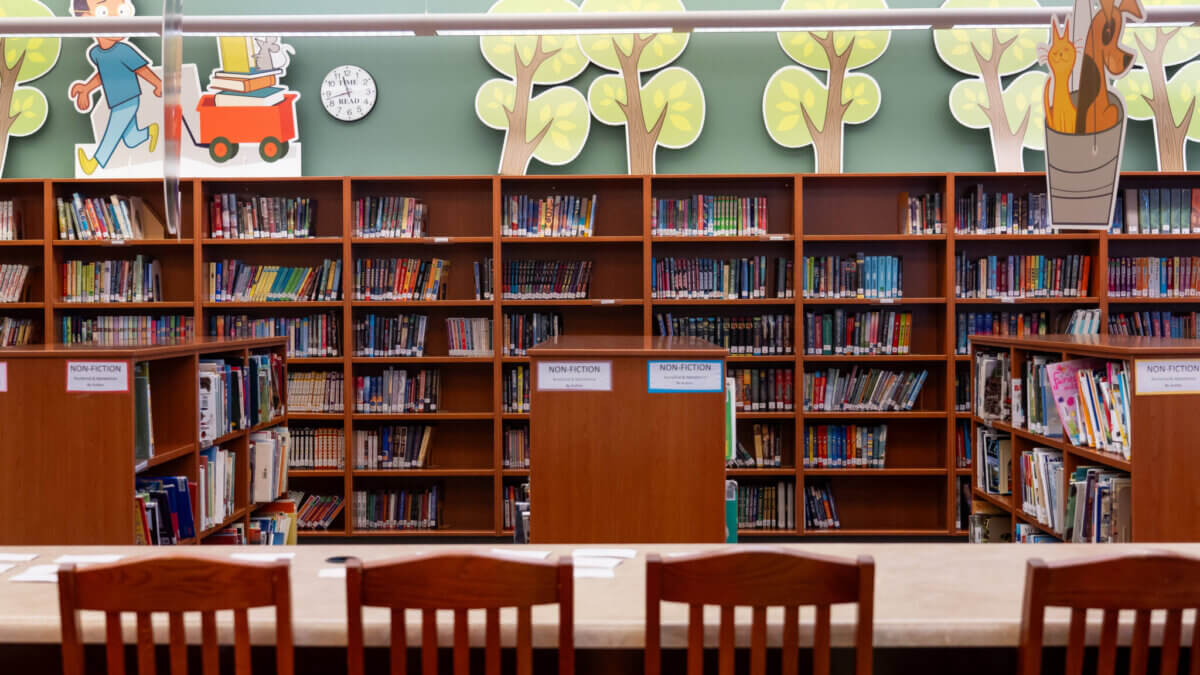
The library at Woodrow Wilson Elementary School in South Salt Lake is pictured on Tuesday, March 12, 2024. Photo: Spenser Heaps for Utah News Dispatch
The ACLU Utah filed a lawsuit against the state, the Utah State Board of Education and different school districts over ‘the freedom to read’
As Utah adds more titles to its banned book list, three award-winning authors and two high school students are suing the state, the board of education and three school districts over what they describe as “the freedom to read.”
In a lawsuit filed Tuesday with the American Civil Liberties Union of Utah, authors Elana K. Arnold, Ellen Hopkins and Amy Reed, the Kurt Vonnegut Estate, and two anonymous students challenged Utah’s “sensitive materials” law that the Legislature expanded in 2024, making it easier to prohibit “criminally indecent or pornographic” books from public schools statewide.
“The right to read and the right to free speech are inseparable. The First Amendment protects our freedom to read, learn, and share ideas free from unconstitutional censorship,” Tom Ford, attorney at the ACLU of Utah said in a statement. “This law censors constitutionally protected books, silences authors, and denies students access to ideas, in violation of the First Amendment rights of students and authors alike, and must be struck down.”
Plaintiffs are asking a federal judge to rule the state’s book bans as unconstitutional under the First and Fourteenth Amendments, since, they say, they constitute “blatant violations of the free speech rights of students and authors alike.”
The Utah State Board of Education has a list of 22 titles that at least three school districts have reported to contain “objective sensitive materials,” which the law defines as “pornographic or indecent.” And, hundreds of books have also been removed from individual school libraries in the state.
Arnold is the author of “What Girls are Made of” and “Damsel,” and Ellen Hopkins is the author of “Tilt,” “Fallout” and “Tricks,” all books that have been prohibited from public school libraries all over the state. Other individual libraries have banned works including Vonnegut’s “Slaughterhouse-Five” and Toni Morrison’s “The Bluest Eye.”
The Utah State Board of Education said in a Tuesday statement that it is aware of the lawsuit and cannot comment on specifics of ongoing litigation.
“We remain committed to fulfilling our responsibilities under state law and supporting local education agencies in serving Utah students,” the board wrote. “The Board will respond through the appropriate legal channels.”
In the lawsuit, plaintiffs criticized that the book ban applies to “any book that contains even a single description or depiction of sex, no matter how fleeting, no matter its context, and no matter its literary, artistic, political, or scientific value.”
One of the student plaintiffs said in an ACLU news release that making books disappear sends “a clear message about whose stories matter and whose do not.”
“Book bans do more harm than simply removing stories. Empty shelves cost us understanding and connection, turning schools from places of learning into systems of control,” the student said. “Censorship does not just make ideas disappear, but also makes schools more confusing and dangerous because of its chilling effect on our right to learn.”
The suit also rejects a lack of distinction between kindergartners and 12th graders in the rule.
“This creates an absurd mismatch with other parts of Utah’s own legal standards. State law permits sixteen-year-olds to consent to certain sexual activity,” the lawsuit reads. “Yet the same students whom Utah trusts to make intimate, real-world decisions about their bodies are, under the Book Removal Law, barred from accessing out books that contain a mere single passage describing the very conduct in which is lawful for them to engage.”
Plaintiffs say no one disputes that pornography and obscene material should be excluded from school libraries. However, statewide bans have gone further than what the U.S. Constitution allows, according to the lawsuit. The Constitution protects books from removal if they “have value as a whole” under the Miller-for-minors standard.
By: Utah News Dispatch


2349 S Lava Vista Drive, Lot 32
Santa Clara, UT 84765
80 West 300 North
Salt Lake City, UT 84103
3267 W Deer Hollow Road, Unit 2305
Park City, UT 84060
1511 S Valley View Circle
Springville, UT 84663
438 Castle Valley Drive
Castle Valley, UT 84532Talk of the Town


Park City Jobs

Staff Accountant, Surefoot
1 day ago Full time

Office Coordinator, Park City Community Foundation
2 days ago Full time $50,000 - $55,000 yearly

Summit Land Conservancy Programs Specialist, Summit Land Conservancy
2 days ago Full time
Vice President of Finance, Park City Community Foundation
2 days ago Full time $115,000 - $130,000 yearly