Environment
Groundwater tests show arsenic and lead contamination at Treasure Mountain school demolition site

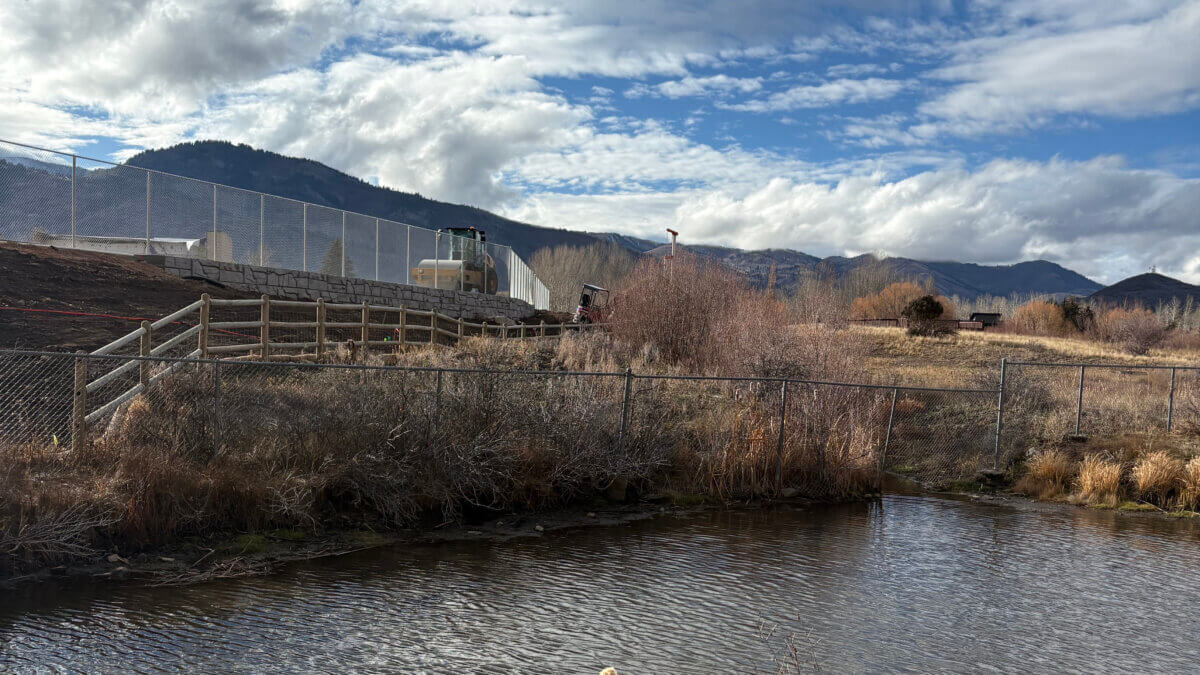
The creek east of Treasure Mountain Junior High School on November 19, 2025. Photo: Marina Knight // TownLift
The Utah Department of Environmental Quality is investigating more than half a million gallons of water from the Treasure Mountain demolition site that contractors discharged into a nearby creek.
PARK CITY, Utah — A state investigation is underway after Park City School District contractors discharged more than half a million gallons of water from the Treasure Mountain demolition site into a storm drain feeding Silver Creek, with thousands of additional gallons released directly into the creek.
The Utah Department of Environmental Quality said early water samples showed arsenic and lead contamination, though post-spill test results have not yet been released. According to DEQ noncompliance and incident records, the agency documents both the multi-week storm-drain discharge and the Oct. 10 creek event as unpermitted.

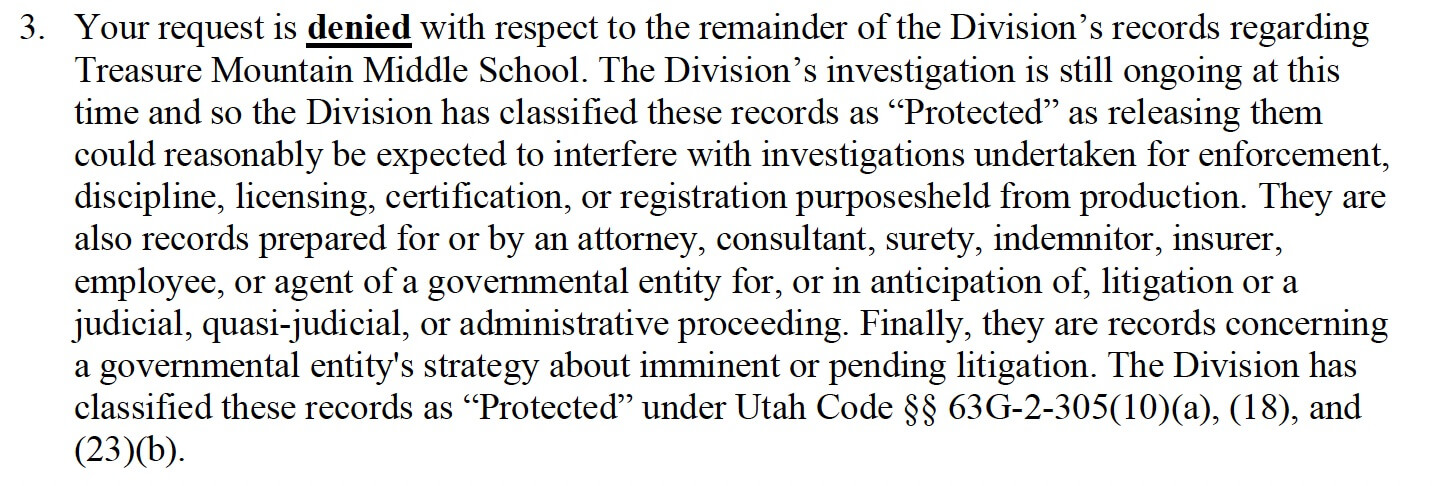
Records obtained by TownLift through a GRAMA request excluded some documents withheld by DEQ, citing an active enforcement investigation and “imminent or pending litigation” related to the water discharge.
The Treasure Mountain site sits atop historic mining waste and is governed by a CERCLA (Superfund) environmental agreement. Lead- and arsenic-laden soils were excavated from the campus during a prior remediation effort, and regulators require strict controls on excavation, dust, and water movement to prevent re-exposing contaminated material.
Contamination confirmed in pre-spill tests
PCSD provided TownLift with water samples taken from the site on Aug. 15, weeks before the contractor started discharging water. The tests showed elevated levels of arsenic and lead that exceeded Utah’s legal limits for a Class 1C drinking-water source. While the water violated state drinking-water standards, it did not meet the much higher thresholds for hazardous waste under federal or state law.
An email from the records request written by DEQ environmental scientist Lyndsey Shafer said the Aug. 15 groundwater tests “demonstrate arsenic and lead contamination” and “would not be an allowable discharge covered under the Construction Dewatering Hydrostatic Testing Permit.”
Unauthorized discharge
A DEQ incident report filed at 3:30 p.m. on Oct. 10 — just ten minutes after general contractor Hogan Construction submitted a dewatering permit application and weeks after the dewatering first started — states that “construction dewatering resulted in an unpermitted discharge to a creek.” The report noted that lead had been detected in prior onsite groundwater samples and cited three additional samples taken where water entered the creek and at two downstream locations. Those three sample results have not yet been released. Regulators have not yet determined whether the Oct. 10 discharge contributed incremental contamination.
The Oct. 10 discharge occurred east of the school, where the creek runs through the North 40 fields, past the school, under SR 248, and into Silver Creek. Pump logs show the Oct. 10 event lasted about three hours, with roughly 26,500 gallons discharged at a rate of 147 gallons per minute — more than twice the rate of prior storm-drain discharges between Sept. 9 and Oct. 8.
DEQ noncompliance records show the site “has been dewatering through weir tanks to [a] storm drain inlet for several weeks without [a] dewatering permit.” The district has said all water pumped into the municipal storm drain was “consistent with permitted drainage pathways,” a claim not reflected in DEQ’s noncompliance records.
Park City Municipal says that Park City’s storm drains do not channel water to a regional wastewater treatment facility. Our stormwater drains into the Silver and McLeod Creeks, before making its way to the Weber River and eventually the Great Salt Lake.
School district response
An internal DEQ email noted that R&R Environmental, the on-site environmental consultant who discovered the Oct. 10 discharge, recommended the district issue a press release “to address the issue proactively.” R&R’s contract was terminated shortly after the spill, and no statement was issued.
PCSD spokesman Colton Elliott said Thursday, “We have not issued a statement [about the incident] as the agencies having jurisdiction are working on a resolution moving forward.” The district said it changed contractors to provide full-time environmental site management and cited other performance and communication factors.
Public awareness of the construction water discharge came only after a whistleblower contacted TownLift and other regional media outlets on Nov. 17, alleging improper groundwater discharge and raising concerns about asbestos handling. PCSD Board of Education Vice President Nick Hill said officials found “no evidence of corner-cutting by the general contractor [Hogan Construction].”
According to the Utah Department of Environmental Quality, Silver Creek is designated a Class 1C stream, a category reserved for waterways that serve as potential sources of drinking water once treated. Under state water-quality rules, that classification requires tighter controls on construction runoff and prohibits discharges that would cause or contribute to exceedances of drinking-water standards for contaminants such as arsenic and lead.
Silver Creek is also a water source for downstream alfalfa fields used for cattle feed and is a habitat for Sand Hill Cranes, according to Utah’s Department of Wildlife.
The DEQ investigation remains open. A department investigator told TownLift the case is a “high priority” but would not provide details or a timeline. It has been 55 days since DEQ was first notified of the unpermitted discharge.
Park City School District contractor dumped contaminated water into city creek
12/8 – This story was originally published 12/5 at 14:51. TownLift updated the publish time for inclusion in Monday’s newsletter.
By: Marina Knight


325 White Pine Canyon Road
Park City, UT 84060
1511 S Valley View Circle
Springville, UT 84663
438 Castle Valley Drive
Castle Valley, UT 84532
2349 S Lava Vista Drive, Lot 32
Santa Clara, UT 84765
80 West 300 North
Salt Lake City, UT 84103
3267 W Deer Hollow Road, Unit 2305
Park City, UT 84060Talk of the Town


Park City Jobs

Hiring Barista Assistants and Baristas, Silver King Coffee
2 days ago Part time $17.00 - $30.00 hourly

General Maintenance Technician, Moose Management Vacation Rentals
6 days ago Full time

Office Coordinator, Park City Community Foundation
9 days ago Full time $50,000 - $55,000 yearly

Summit Land Conservancy Programs Specialist, Summit Land Conservancy
9 days ago Full time
Vice President of Finance, Park City Community Foundation
9 days ago Full time $115,000 - $130,000 yearly